
中东呼吸综合征冠状病毒地理定位事件数据库。
A database of geopositioned Middle East Respiratory Syndrome Coronavirus occurrences.
机构信息
Institute for Health Metrics and Evaluation, University of Washington, 2301 5th Ave., Suite 600, Seattle, WA, United States.
Bloomberg School of Public Health, Johns Hopkins University, 615N Wolfe St, Baltimore, MD, 21205, United States.
出版信息
Sci Data. 2019 Dec 13;6(1):318. doi: 10.1038/s41597-019-0330-0.
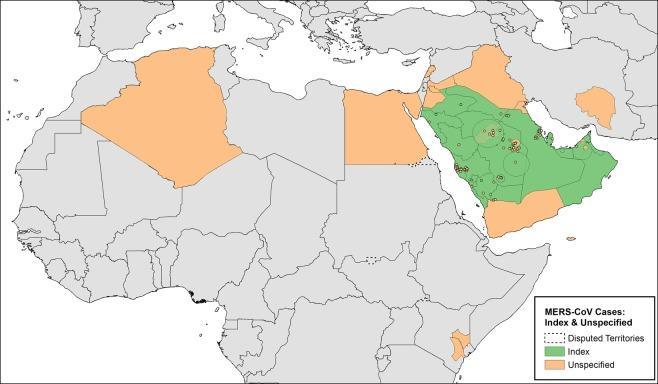
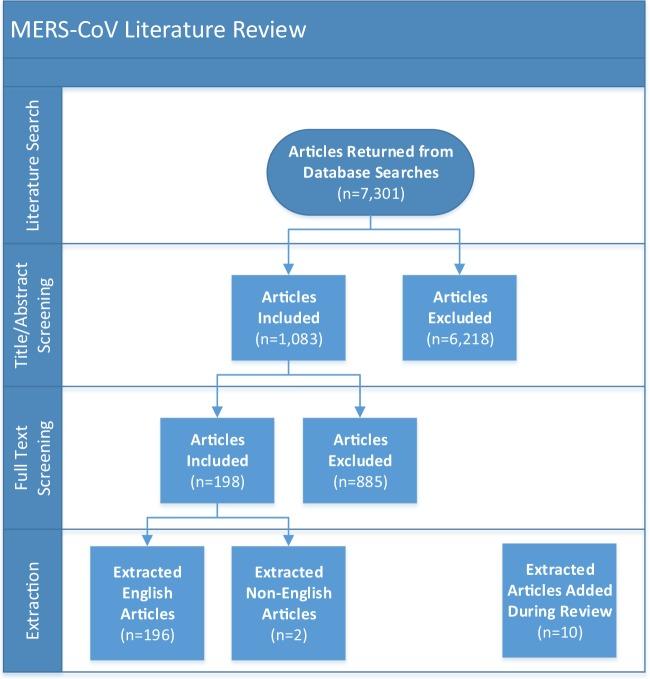
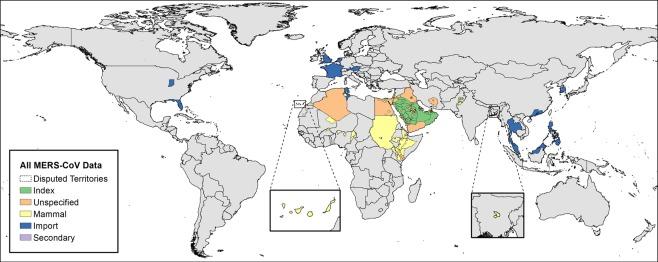
As a World Health Organization Research and Development Blueprint priority pathogen, there is a need to better understand the geographic distribution of Middle East Respiratory Syndrome Coronavirus (MERS-CoV) and its potential to infect mammals and humans. This database documents cases of MERS-CoV globally, with specific attention paid to zoonotic transmission. An initial literature search was conducted in PubMed, Web of Science, and Scopus; after screening articles according to the inclusion/exclusion criteria, a total of 208 sources were selected for extraction and geo-positioning. Each MERS-CoV occurrence was assigned one of the following classifications based upon published contextual information: index, unspecified, secondary, mammal, environmental, or imported. In total, this database is comprised of 861 unique geo-positioned MERS-CoV occurrences. The purpose of this article is to share a collated MERS-CoV database and extraction protocol that can be utilized in future mapping efforts for both MERS-CoV and other infectious diseases. More broadly, it may also provide useful data for the development of targeted MERS-CoV surveillance, which would prove invaluable in preventing future zoonotic spillover.
作为世界卫生组织研发蓝图的优先病原体,我们需要更好地了解中东呼吸综合征冠状病毒(MERS-CoV)的地理分布及其感染哺乳动物和人类的潜力。该数据库记录了全球范围内的 MERS-CoV 病例,特别关注人畜共患传播。我们最初在 PubMed、Web of Science 和 Scopus 中进行了文献检索;根据纳入/排除标准筛选文章后,共选择了 208 篇文章进行提取和地理定位。根据已发表的背景信息,将每个 MERS-CoV 事件分为以下几类之一:索引、未指定、继发、哺乳动物、环境或输入。该数据库共包含 861 个独特的地理定位的 MERS-CoV 事件。本文的目的是分享一个经过整理的 MERS-CoV 数据库和提取方案,可用于未来 MERS-CoV 和其他传染病的绘图工作。更广泛地说,它还可能为有针对性的 MERS-CoV 监测提供有用的数据,这对于防止未来的人畜共患病溢出将非常有价值。

 Zotero 插件