
细菌对感染和炎症中自噬反应的调控。
Bacterial Manipulation of Autophagic Responses in Infection and Inflammation.
机构信息
Division of Gastroenterology and Hepatology, College of Medicine, University of Illinois at Chicago, Chicago, IL, United States.
出版信息
Front Immunol. 2019 Dec 3;10:2821. doi: 10.3389/fimmu.2019.02821. eCollection 2019.
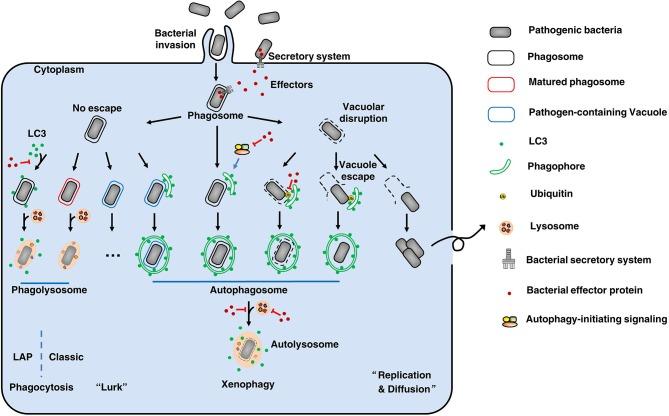
Eukaryotes have cell-autonomous defenses against environmental stress and pathogens. Autophagy is one of the main cellular defenses against intracellular bacteria. In turn, bacteria employ diverse mechanisms to interfere with autophagy initiation and progression to avoid elimination and even to subvert autophagy for their benefit. This review aims to discuss recent findings regarding the autophagic responses regulated by bacterial effectors. Effectors manipulate autophagy at different stages by using versatile strategies, such as interfering with autophagy-initiating signaling, preventing the recognition of autophagy-involved proteins, subverting autophagy component homeostasis, manipulating the autophagy process, and impacting other biological processes. We describe the barriers for intracellular bacteria in host cells and highlight the role of autophagy in the host-microbial interactions. Understanding the mechanisms through which bacterial effectors manipulate host responses will provide new insights into therapeutic approaches for prevention and treatment of chronic inflammation and infectious diseases.
真核生物具有针对环境压力和病原体的细胞自主防御机制。自噬是细胞内细菌的主要防御机制之一。反过来,细菌利用多种机制来干扰自噬的起始和进展,以避免被清除,甚至利用自噬为自己谋利。本综述旨在讨论最近关于细菌效应物调节的自噬反应的发现。效应物通过使用各种策略,如干扰自噬起始信号、阻止自噬相关蛋白的识别、颠覆自噬成分的稳态、操纵自噬过程以及影响其他生物过程,在不同阶段操纵自噬。我们描述了宿主细胞内细菌的障碍,并强调了自噬在宿主-微生物相互作用中的作用。了解细菌效应物操纵宿主反应的机制将为预防和治疗慢性炎症和传染病的治疗方法提供新的见解。
 Zotero 插件