
美国癌症患者的多种慢性病及其相关医疗费用:2010-2015 年医疗支出面板调查研究。
Multiple chronic conditions and associated health care expenses in US adults with cancer: a 2010-2015 Medical Expenditure Panel Survey study.
机构信息
Department of Science of Nursing Care, Indiana University School of Nursing, 1033 East Third Street, Bloomington, IN, 47045, USA.
Department of Clinical Pharmacy and Outcomes Sciences, University of South Carolina College of Pharmacy, 715 Sumter St., Columbia, SC, 29208, USA.
出版信息
BMC Health Serv Res. 2019 Dec 19;19(1):981. doi: 10.1186/s12913-019-4827-1.
BACKGROUND
Cancer increases the risk of developing one or more chronic conditions, yet little research describes the associations between health care costs, utilization patterns, and chronic conditions in adults with cancer. The objective of this study was to examine the treated prevalence of chronic conditions and the association between chronic conditions and health care expenses in US adults with cancer.
METHODS
This retrospective observational study used US Medical Expenditure Panel Survey (MEPS) Household Component (2010-2015) data sampling adults diagnosed with cancer and one or more of 18 select chronic conditions. The measures used were treated prevalence of chronic conditions, and total and chronic condition-specific health expenses (per-person, per-year). Generalized linear models assessed chronic condition-specific expenses in adults with cancer vs. without cancer and the association of chronic conditions on total health expenses in adults with cancer, respectively, by controlling for demographic and health characteristics. Accounting for the complex survey design in MEPS, all data analyses and statistical procedures applied longitudinal weights for national estimates.
RESULTS
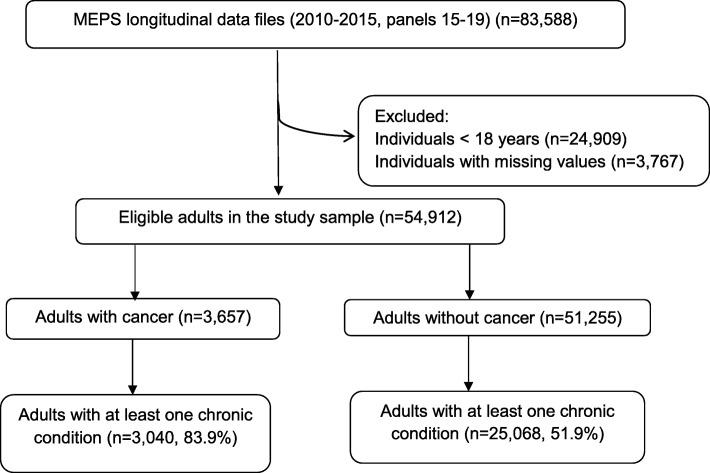
Among 3657 eligible adults with cancer, 83.9% (n = 3040; representing 16 million US individuals per-year) had at least one chronic condition, and 29.7% reported four or more conditions. Among those with cancer, hypertension (59.7%), hyperlipidemia (53.6%), arthritis (25.6%), diabetes (22.2%), and coronary artery disease (18.2%) were the five most prevalent chronic conditions. Chronic conditions accounted for 30% of total health expenses. Total health expenses were $6388 higher for those with chronic conditions vs. those without (p < 0.001). Health expenses associated with chronic conditions increased by 34% in adults with cancer vs. those without cancer after adjustment.
CONCLUSIONS
In US adults with cancer, the treated prevalence of common chronic conditions was high and health expenses associated with chronic conditions were higher than those without cancer. A holistic treatment plan is needed to improve cost outcomes.
背景
癌症会增加患上一种或多种慢性病的风险,但鲜有研究描述癌症患者的医疗费用、利用模式与慢性病之间的关系。本研究旨在探讨美国癌症患者的慢性病治疗患病率,以及慢性病与医疗费用之间的关系。
方法
本回顾性观察性研究利用美国医疗支出调查(MEPS)家庭部分(2010-2015 年)的数据,对诊断患有癌症和一种或多种 18 种特定慢性病的成年人进行抽样。使用的指标为慢性病的治疗患病率、癌症患者与非癌症患者的特定慢性病的总医疗费用和特定慢性病的医疗费用(人均/年)。使用广义线性模型分别评估癌症患者与非癌症患者的特定慢性病医疗费用以及癌症患者的慢性病对总医疗费用的影响,同时控制人口统计学和健康特征。为了考虑到 MEPS 中的复杂调查设计,所有数据分析和统计程序均对全国估计值应用了纵向权重。
结果
在 3657 名符合条件的癌症患者中,83.9%(n=3040;每年代表 1600 万美国个体)至少有一种慢性病,29.7%报告有四种或更多种慢性病。在癌症患者中,高血压(59.7%)、高血脂(53.6%)、关节炎(25.6%)、糖尿病(22.2%)和冠状动脉疾病(18.2%)是五种最常见的慢性病。慢性病占总医疗费用的 30%。患有慢性病的患者比没有慢性病的患者的总医疗费用高出 6388 美元(p<0.001)。调整后,癌症患者的慢性病相关医疗费用比非癌症患者增加了 34%。
结论
在美国癌症患者中,常见慢性病的治疗患病率较高,且与慢性病相关的医疗费用高于非癌症患者。需要制定整体治疗计划以改善成本效益。


 Zotero 插件