
神经丝取向弥散和密度成像指标的扫描-再扫描和跨供应商可重复性。
Scan-rescan and inter-vendor reproducibility of neurite orientation dispersion and density imaging metrics.
机构信息
Department of Radiology, Juntendo University Graduate School of Medicine, Tokyo, Japan.
Laboratory for Brain Connectomics Imaging, RIKEN Center for Biosystems Dynamics Research, Kobe, Japan.
出版信息
Neuroradiology. 2020 Apr;62(4):483-494. doi: 10.1007/s00234-019-02350-6. Epub 2019 Dec 27.
PURPOSE
The reproducibility of neurite orientation dispersion and density imaging (NODDI) metrics in the human brain has not been explored across different magnetic resonance (MR) scanners from different vendors. This study aimed to evaluate the scan-rescan and inter-vendor reproducibility of NODDI metrics in white and gray matter of healthy subjects using two 3-T MR scanners from two vendors.
METHODS
Ten healthy subjects (7 males; mean age 30 ± 7 years, range 23-37 years) were included in the study. Whole-brain diffusion-weighted imaging was performed with b-values of 1000 and 2000 s/mm using two 3-T MR scanners from two different vendors. Automatic extraction of the region of interest was performed to obtain NODDI metrics for whole and localized areas of white and gray matter. The coefficient of variation (CoV) and intraclass correlation coefficient (ICC) were calculated to assess the scan-rescan and inter-vendor reproducibilities of NODDI metrics.
RESULTS
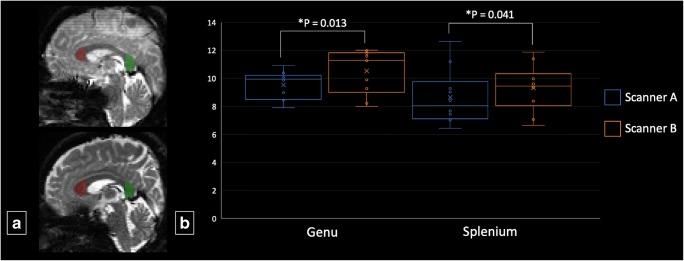
The scan-rescan and inter-vendor reproducibility of NODDI metrics (intracellular volume fraction and orientation dispersion index) were comparable with those of diffusion tensor imaging (DTI) metrics. However, the inter-vendor reproducibilities of NODDI (CoV = 2.3-14%) were lower than the scan-rescan reproducibility (CoV: scanner A = 0.8-3.8%; scanner B = 0.8-2.6%). Compared with the finding of DTI metrics, the reproducibility of NODDI metrics was lower in white matter and higher in gray matter.
CONCLUSION
The lower inter-vendor reproducibility of NODDI in some brain regions indicates that data acquired from different MRI scanners should be carefully interpreted.
目的
尚未探索不同供应商的不同磁共振(MR)扫描仪之间神经丝取向分散和密度成像(NODDI)指标的可重复性。本研究旨在使用来自两个供应商的两台 3-T MR 扫描仪评估健康受试者白质和灰质中 NODDI 指标的扫描间和跨供应商可重复性。
方法
本研究纳入了 10 名健康受试者(7 名男性;平均年龄 30±7 岁,范围 23-37 岁)。使用两台来自两个不同供应商的 3-T MR 扫描仪对全脑弥散加权成像进行了 b 值为 1000 和 2000 s/mm 的扫描。自动提取感兴趣区以获得全脑和局部白质和灰质区域的 NODDI 指标。计算变异系数(CoV)和组内相关系数(ICC)以评估 NODDI 指标的扫描间和跨供应商可重复性。
结果
NODDI 指标(细胞内容积分数和取向分散指数)的扫描间和跨供应商可重复性与弥散张量成像(DTI)指标相当。然而,NODDI 的跨供应商可重复性(CoV=2.3-14%)低于扫描间可重复性(CoV:扫描仪 A=0.8-3.8%;扫描仪 B=0.8-2.6%)。与 DTI 指标的发现相比,NODDI 指标在白质中的可重复性较低,在灰质中的可重复性较高。
结论
一些脑区 NODDI 的跨供应商可重复性较低表明,来自不同 MRI 扫描仪的数据应谨慎解释。



 Zotero 插件