
随机对照试验的结果和经验教训:用美托洛尔预防性治疗前庭性偏头痛(PROVEMIG)。
Results and lessons learnt from a randomized controlled trial: prophylactic treatment of vestibular migraine with metoprolol (PROVEMIG).
机构信息
German Center for Vertigo and Balance Disorders (DSGZ), Ludwig Maximilians University, Campus Grosshadern, Munich, Germany.
ReliaTec GmbH, Garching, Germany.
出版信息
Trials. 2019 Dec 30;20(1):813. doi: 10.1186/s13063-019-3903-5.
BACKGROUND
Vestibular migraine (VM) is the most frequent cause of recurrent spontaneous attacks of vertigo causally related to migraine. The objective of the Prophylactic treatment of vestibular migraine with metoprolol (PROVEMIG) trial was to demonstrate that metoprolol succinate is superior to placebo in the prevention of episodic vertigo- and migraine-related symptoms in patients with VM.
METHODS
This phase III, two-arm, parallel-group, double-blind, randomized placebo-controlled trial was designed to be conducted at tertiary referral centres at neurology and ear, nose and throat departments of eight German university hospitals. The planned sample size was a total of 266 patients to be allocated. Adults aged 18 years or above diagnosed with probable or definitive VM according to the Neuhauser criteria 2001 were randomly assigned 1:1 to 6 months blinded metoprolol (maintenance dosage of 95 mg daily) or placebo. The primary efficacy outcome was the self-reported number of vertiginous attacks per 30 days documented by means of a paper-based daily symptom diary. The pre-specified time period of primary interest was defined as months 4 to 6. Secondary outcomes included the patient-reported number of migraine days and vertigo days, the Dizziness Handicap Inventory, and clinical assessments. Adverse events were reported throughout the whole 9-month study period.
RESULTS
At the time of trial termination, no evidence for a difference in the incidence of vertiginous attacks between groups was detected. For the full analysis set, the incidence rate ratio was 0.983 (95% confidence interval (CI) 0.902-1.071) for metoprolol versus placebo. In both groups, there was a significant decline over time in the overall monthly vertigo attacks by a factor of 0.830 (95% CI 0.776-0.887). Results were consistent for all subjective and objective key measures of efficacy. The treatment was well tolerated with no unexpected safety findings.
CONCLUSIONS
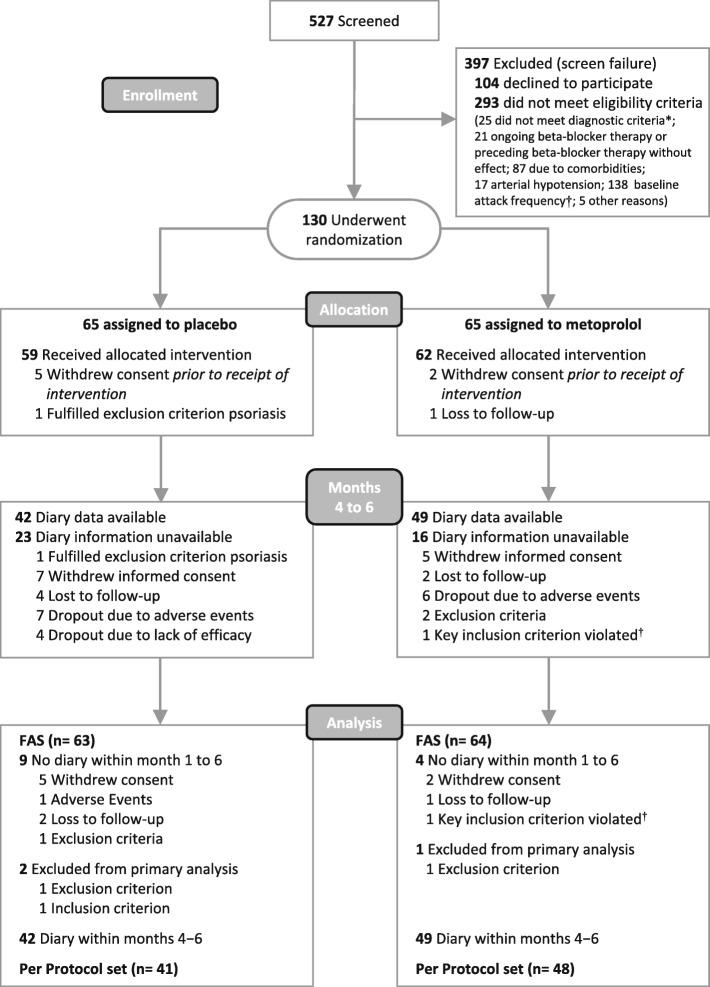
After randomizing 130 patients PROVEMIG had to be discontinued because of poor participant accrual not related to the tolerability of the study medication or safety concerns; no treatment benefit of metoprolol over placebo could be established. Additional preparatory work is much needed in the development, psychometric evaluation and interpretation of clinically meaningful end points in trials on episodic syndromes like VM taking into consideration the complexity of this disease entity comprising two domains (vertigo- and headache-related disability).
TRIAL REGISTRATION
EudraCT, 2009-013701-34. Prospectively registered on 8 April 2011.
背景
前庭性偏头痛(VM)是最常见的复发性自发性眩晕的病因,与偏头痛有因果关系。预防性治疗前庭性偏头痛的美托洛尔(PROVEMIG)试验的目的是证明琥珀酸美托洛尔优于安慰剂,可预防 VM 患者发作性眩晕和偏头痛相关症状。
方法
这是一项 III 期、双臂、平行组、双盲、随机安慰剂对照试验,在德国八所大学医院的神经病学和耳鼻喉科的三个转诊中心进行。计划的样本量为总共 266 名患者分配。年龄在 18 岁或以上的成年人,根据 2001 年 Neuhauser 标准诊断为可能或明确的 VM,随机分配 1:1 接受 6 个月的美托洛尔(维持剂量为 95mg/天)或安慰剂。主要疗效结局是通过纸质每日症状日记记录的每 30 天眩晕发作次数。主要关注的预先指定时间段定义为第 4 至 6 个月。次要结局包括患者报告的偏头痛天数和眩晕天数、眩晕障碍量表和临床评估。整个 9 个月的研究期间报告了不良事件。
结果
在试验终止时,未发现组间眩晕发作发生率的差异有统计学意义。对于全分析集,美托洛尔与安慰剂的发生率比值为 0.983(95%置信区间(CI)0.902-1.071)。在两组中,总体每月眩晕发作的时间都显著下降,下降幅度为 0.830(95%CI 0.776-0.887)。所有主观和客观疗效关键测量指标的结果均一致。治疗耐受性良好,未发现意外的安全性发现。
结论
在随机分配了 130 名患者后,由于与研究药物的耐受性或安全性问题无关的参与者入组率低,PROVEMIG 不得不停止;无法证明美托洛尔优于安慰剂的治疗效果。在开发、心理测量评估和解释 VM 等发作性综合征的有临床意义的终点时,需要进行更多的预备工作,考虑到这种疾病实体包括两个领域(眩晕和头痛相关残疾)的复杂性。
试验注册
EudraCT,2009-013701-34。于 2011 年 4 月 8 日前瞻性注册。

 Zotero 插件