
监禁人员中与阿片类药物相关的治疗、干预措施和结果:系统评价。
Opioid-related treatment, interventions, and outcomes among incarcerated persons: A systematic review.
机构信息
Institute for Mental Health Policy Research, Centre for Addiction and Mental Health, Toronto, Ontario, Canada.
Department of Psychiatry, University of Toronto, Toronto, Ontario, Canada.
出版信息
PLoS Med. 2019 Dec 31;16(12):e1003002. doi: 10.1371/journal.pmed.1003002. eCollection 2019 Dec.
BACKGROUND
Worldwide opioid-related overdose has become a major public health crisis. People with opioid use disorder (OUD) are overrepresented in the criminal justice system and at higher risk for opioid-related mortality. However, correctional facilities frequently adopt an abstinence-only approach, seldom offering the gold standard opioid agonist treatment (OAT) to incarcerated persons with OUD. In an attempt to inform adequate management of OUD among incarcerated persons, we conducted a systematic review of opioid-related interventions delivered before, during, and after incarceration.
METHODS AND FINDINGS
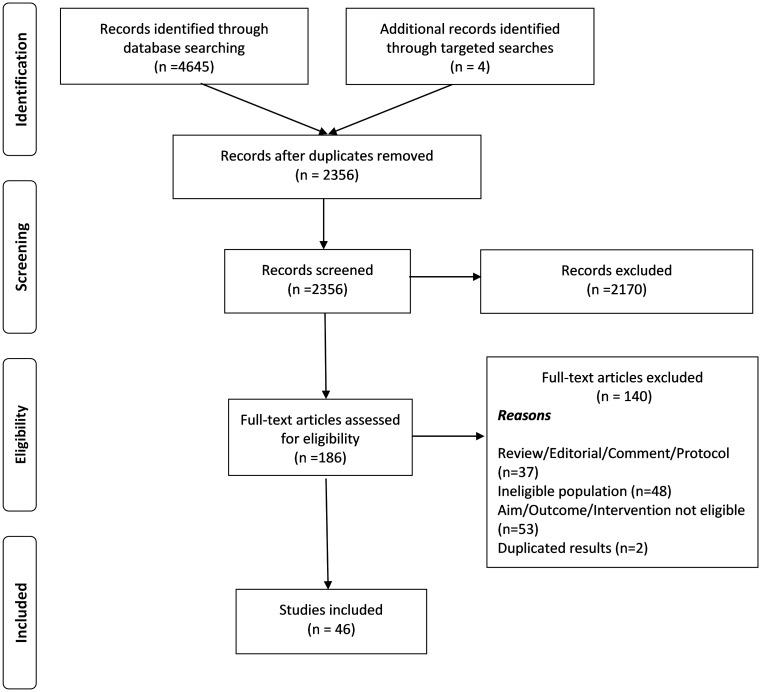
We systematically reviewed 8 electronic databases for original, peer-reviewed literature published between January 2008 and October 2019. Our review included studies conducted among adult participants with OUD who were incarcerated or recently released into the community (≤90 days post-incarceration). The search identified 2,356 articles, 46 of which met the inclusion criteria based on assessments by 2 independent reviewers. Thirty studies were conducted in North America, 9 in Europe, and 7 in Asia/Oceania. The systematic review included 22 randomized control trials (RCTs), 3 non-randomized clinical trials, and 21 observational studies. Eight observational studies utilized administrative data and included large sample sizes (median of 10,419 [range 2273-131,472] participants), and 13 observational studies utilized primary data, with a median of 140 (range 27-960) participants. RCTs and non-randomized clinical trials included a median of 198 (range 15-1,557) and 44 (range 27-382) participants, respectively. Twelve studies included only men, 1 study included only women, and in the remaining 33 studies, the percentage of women was below 30%. The majority of study participants were middle-aged adults (36-55 years). Participants treated at a correctional facility with methadone maintenance treatment (MMT) or buprenorphine (BPN)/naloxone (NLX) had lower rates of illicit opioid use, had higher adherence to OUD treatment, were less likely to be re-incarcerated, and were more likely to be working 1 year post-incarceration. Participants who received MMT or BPN/NLX while incarcerated had fewer nonfatal overdoses and lower mortality. The main limitation of our systematic review is the high heterogeneity of studies (different designs, settings, populations, treatments, and outcomes), precluding a meta-analysis. Other study limitations include the insufficient data about incarcerated women with OUD, and the lack of information about incarcerated populations with OUD who are not included in published research.
CONCLUSIONS
In this carefully conducted systematic review, we found that correctional facilities should scale up OAT among incarcerated persons with OUD. The strategy is likely to decrease opioid-related overdose and mortality, reduce opioid use and other risky behaviors during and after incarceration, and improve retention in addiction treatment after prison release. Immediate OAT after prison release and additional preventive strategies such as the distribution of NLX kits to at-risk individuals upon release greatly decrease the occurrence of opioid-related overdose and mortality. In an effort to mitigate the impact of the opioid-related overdose crisis, it is crucial to scale up OAT and opioid-related overdose prevention strategies (e.g., NLX) within a continuum of treatment before, during, and after incarceration.
背景
全球范围内与阿片类药物相关的用药过量已成为一个主要的公共卫生危机。患有阿片类药物使用障碍(OUD)的人群在刑事司法系统中所占比例过高,并且与阿片类药物相关的死亡率更高。然而,惩教机构通常采用完全戒断的方法,很少为有 OUD 的被监禁者提供阿片类激动剂治疗(OAT)的金标准。为了充分了解被监禁者的 OUD 管理,我们对监禁前、监禁中和监禁后提供的阿片类相关干预措施进行了系统评价。
方法和发现
我们系统地审查了 2008 年 1 月至 2019 年 10 月期间发表的 8 个电子数据库中的原始同行评审文献。我们的综述包括在监禁中或最近(监禁后 90 天内)被释放到社区的患有 OUD 的成年参与者中进行的研究。搜索确定了 2356 篇文章,其中 46 篇文章根据两名独立评审员的评估符合纳入标准。30 项研究在北美进行,9 项在欧洲进行,7 项在亚洲/大洋洲进行。系统评价包括 22 项随机对照试验(RCT)、3 项非随机临床试验和 21 项观察性研究。8 项观察性研究利用了行政数据,包括较大的样本量(中位数为 10419[范围 2273-131472]名参与者),13 项观察性研究利用了原始数据,中位数为 140(范围 27-960)名参与者。RCT 和非随机临床试验分别纳入了中位数为 198(范围 15-1557)和 44(范围 27-382)名参与者。12 项研究仅纳入男性,1 项研究仅纳入女性,在其余 33 项研究中,女性比例低于 30%。大多数研究参与者为中年成年人(36-55 岁)。在惩教设施接受美沙酮维持治疗(MMT)或丁丙诺啡(BPN)/纳洛酮(NLX)治疗的参与者,其非法阿片类药物使用率较低,对 OUD 治疗的依从性较高,再次入狱的可能性较低,并且在监禁后 1 年更有可能工作。在监禁期间接受 MMT 或 BPN/NLX 的参与者非致命性过量用药和死亡率较低。我们的系统评价的主要局限性是研究之间存在高度异质性(不同的设计、环境、人群、治疗和结果),因此无法进行荟萃分析。其他研究局限性包括关于患有 OUD 的被监禁女性的数据不足,以及关于未被发表研究纳入的患有 OUD 的被监禁人群的信息不足。
结论
在这项精心进行的系统评价中,我们发现惩教机构应扩大患有 OUD 的被监禁者的 OAT。该策略可能会降低与阿片类药物相关的过量用药和死亡率,减少监禁期间和监禁后的阿片类药物使用和其他危险行为,并改善监禁释放后的成瘾治疗保留率。在监禁释放后立即进行 OAT 以及其他预防策略(例如,NLX 套件的分发),可大大降低与阿片类药物相关的过量用药和死亡率的发生。为了减轻与阿片类药物相关的用药过量危机的影响,必须在监禁前、监禁中和监禁后扩大 OAT 和阿片类药物相关的过量用药预防策略(例如,NLX)。
 Zotero 插件