
临床细胞疗法对严重创伤人群的体外促凝血作用
Procoagulant in vitro effects of clinical cellular therapeutics in a severely injured trauma population.
作者信息
George Mitchell J, Prabhakara Karthik, Toledano-Furman Naama E, Gill Brijesh S, Wade Charles E, Cotton Bryan A, Cap Andrew P, Olson Scott D, Cox Charles S
机构信息
Department of Surgery, McGovern Medical School at The University of Texas Health Science Center, Houston, Texas.
Department of Pediatric Surgery, McGovern Medical School at The University of Texas Health Science Center, Houston, Texas.
出版信息
Stem Cells Transl Med. 2020 Apr;9(4):491-498. doi: 10.1002/sctm.19-0206. Epub 2020 Jan 6.
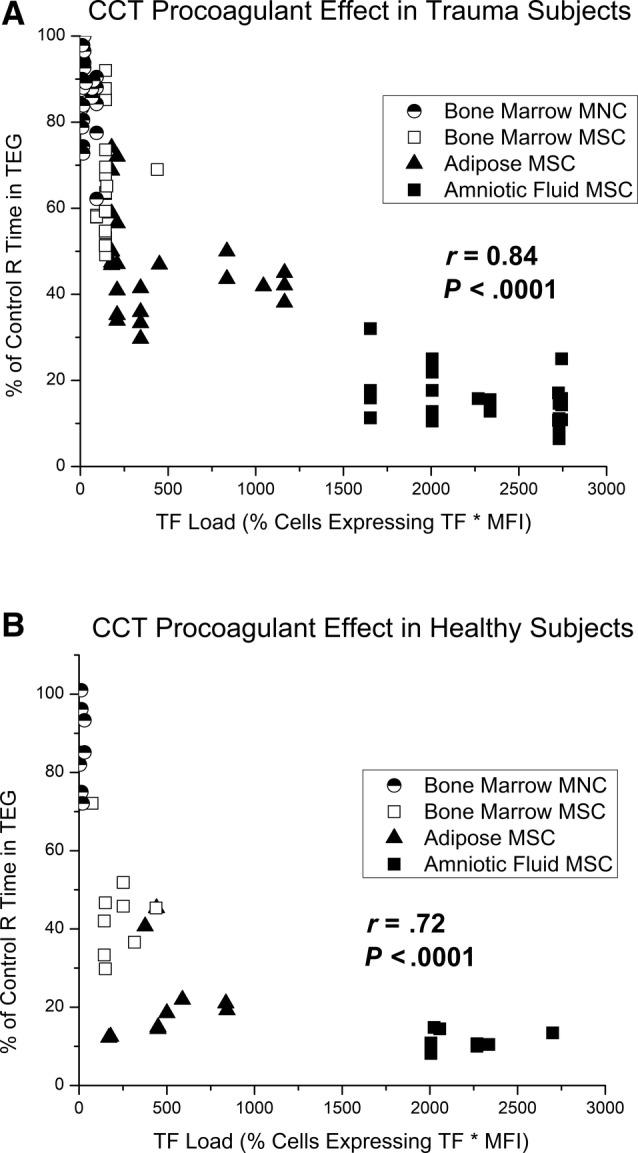
Clinical trials in trauma populations are exploring the use of clinical cellular therapeutics (CCTs) like human mesenchymal stromal cells (MSC) and mononuclear cells (MNC). Recent studies demonstrate a procoagulant effect of these CCTs related to their expression of tissue factor (TF). We sought to examine this relationship in blood from severely injured trauma patients and identify methods to reverse this procoagulant effect. Human MSCs from bone marrow, adipose, and amniotic tissues and freshly isolated bone marrow MNC samples were tested. TF expression and phenotype were quantified using flow cytometry. CCTs were mixed individually with trauma patients' whole blood, assayed with thromboelastography (TEG), and compared with healthy subjects mixed with the same cell sources. Heparin was added to samples at increasing concentrations until TEG parameters normalized. Clotting time or R time in TEG decreased relative to the TF expression of the CCT treatment in a logarithmic fashion for trauma patients and healthy subjects. Nonlinear regression curves were significantly different with healthy subjects demonstrating greater relative decreases in TEG clotting time. In vitro coadministration of heparin normalized the procoagulant effect and required dose escalation based on TF expression. TF expression in human MSC and MNC has a procoagulant effect in blood from trauma patients and healthy subjects. The procoagulant effect is lower in trauma patients possibly because their clotting time is already accelerated. The procoagulant effect due to MSC/MNC TF expression could be useful in the bleeding trauma patient; however, it may emerge as a safety release criterion due to thrombotic risk. The TF procoagulant effect is reversible with heparin.
针对创伤人群的临床试验正在探索使用临床细胞疗法(CCT),如人间充质基质细胞(MSC)和单核细胞(MNC)。最近的研究表明,这些CCT因其组织因子(TF)的表达而具有促凝作用。我们试图研究重伤创伤患者血液中的这种关系,并确定逆转这种促凝作用的方法。对来自骨髓、脂肪和羊膜组织的人MSC以及新鲜分离的骨髓MNC样本进行了测试。使用流式细胞术对TF表达和表型进行定量。将CCT分别与创伤患者的全血混合,用血栓弹力图(TEG)进行检测,并与使用相同细胞来源混合的健康受试者进行比较。向样本中添加浓度递增的肝素,直到TEG参数恢复正常。对于创伤患者和健康受试者,TEG中的凝血时间或R时间相对于CCT治疗的TF表达呈对数下降。健康受试者的非线性回归曲线显著不同,其TEG凝血时间的相对下降幅度更大。肝素的体外联合使用使促凝作用恢复正常,并且需要根据TF表达增加剂量。人MSC和MNC中的TF表达在创伤患者和健康受试者的血液中具有促凝作用。创伤患者的促凝作用较低,可能是因为他们的凝血时间已经加快。由于MSC/MNC TF表达导致的促凝作用可能对出血的创伤患者有用;然而,由于血栓形成风险,它可能成为一个安全释放标准。TF的促凝作用可被肝素逆转。


 Zotero 插件