
不平等现象正在减少吗?1999 - 2016年低收入和中等收入国家五岁以下儿童的出生登记情况。
Are inequities decreasing? Birth registration for children under five in low-income and middle-income countries, 1999-2016.
作者信息
Bhatia Amiya, Krieger Nancy, Beckfield Jason, Barros Aluisio J D, Victora Cesar
机构信息
Department of Social and Behavioral Sciences, Harvard University T H Chan School of Public Health, Boston, Massachusetts, USA.
Department of Global Health and Development, London School of Hygiene and Tropical Medicine, London, UK.
出版信息
BMJ Glob Health. 2019 Dec 16;4(6):e001926. doi: 10.1136/bmjgh-2019-001926. eCollection 2019.
INTRODUCTION
Although global birth registration coverage has improved from 58% to 71% among children under five globally, inequities in birth registration coverage by wealth, urban/rural location, maternal education and access to a health facility persist. Few studies examine whether inequities in birth registration in low-income and middle-income countries have changed over time.
METHODS
We combined information on caregiver reported birth registration of 1.6 million children in 173 publicly available, nationally representative Demographic Health Surveys and Multiple Indicator Cluster Surveys across 67 low-income and middle-income countries between 1999 and 2016. For each survey, we calculated point estimates and 95% CIs for the percentage of children under 5 years without birth registration on average and stratified by sex, urban/rural location and wealth. For each sociodemographic variable, we estimated absolute measures of inequality. We then examined changes in non-registration and inequities between surveys, and annually.
RESULTS
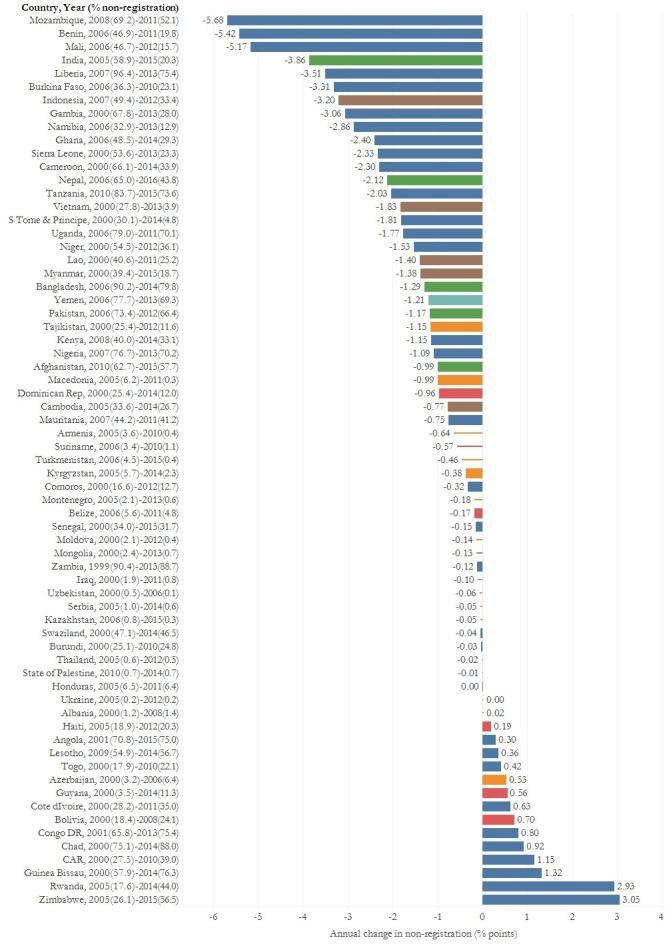
14 out of 67 countries had achieved complete birth registration. Among the remaining 53 countries, 39 countries successfully decreased the percentage of children without birth registration. However, this reduction occurred alongside statistically significant increases in wealth inequities in 9 countries and statistically significant decreases in 10 countries. At the most recent survey, the percentage of children without birth registration was greater than 50% in 16 out of 67 countries.
CONCLUSION
Although birth registration improved on average, progress in reducing wealth inequities has been limited. Findings highlight the importance of monitoring changes in inequities to improve birth registration, to monitor Sustainable Development Goal 16.9 and to strengthen Civil Registration and Vital Statistics systems.
引言
尽管全球五岁以下儿童的出生登记覆盖率已从58%提高到71%,但在出生登记覆盖率方面,仍存在因财富、城乡地区、母亲教育程度以及获得医疗设施情况而产生的不平等现象。很少有研究探讨低收入和中等收入国家出生登记方面的不平等现象是否随时间发生了变化。
方法
我们汇总了1999年至2016年间,67个低收入和中等收入国家的173项公开的、具有全国代表性的人口与健康调查以及多指标类集调查中,160万名儿童的照料者报告的出生登记信息。对于每项调查,我们计算了五岁以下未进行出生登记儿童百分比的点估计值和95%置信区间,并按性别、城乡地区和财富进行分层。对于每个社会人口统计学变量,我们估计了不平等的绝对指标。然后,我们研究了各次调查之间以及每年未登记情况和不平等现象的变化。
结果
67个国家中有14个国家实现了完全出生登记。在其余53个国家中,39个国家成功降低了未进行出生登记儿童的百分比。然而,在这一减少的同时,9个国家的财富不平等现象在统计学上显著增加,10个国家在统计学上显著减少。在最近一次调查中,67个国家中有16个国家未进行出生登记的儿童百分比超过50%。
结论
尽管出生登记平均有所改善,但在减少财富不平等方面取得的进展有限。研究结果凸显了监测不平等现象变化对于改善出生登记、监测可持续发展目标16.9以及加强民事登记和生命统计系统的重要性。
 Zotero 插件