
一种用于钌基光敏剂的定制多功能抗癌纳米递送系统:肿瘤微环境适应与重塑
A Tailored Multifunctional Anticancer Nanodelivery System for Ruthenium-Based Photosensitizers: Tumor Microenvironment Adaption and Remodeling.
作者信息
Liang Jin-Hao, Zheng Yue, Wu Xiao-Wen, Tan Cai-Ping, Ji Liang-Nian, Mao Zong-Wan
机构信息
MOE Key Laboratory of Bioinorganic and Synthetic Chemistry School of Chemistry Sun Yat-Sen University Guangzhou 510275 P. R. China.
出版信息
Adv Sci (Weinh). 2019 Nov 25;7(1):1901992. doi: 10.1002/advs.201901992. eCollection 2020 Jan.
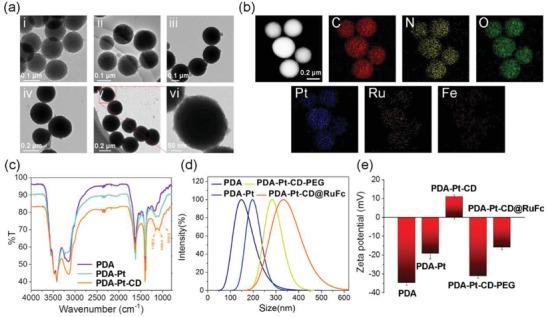
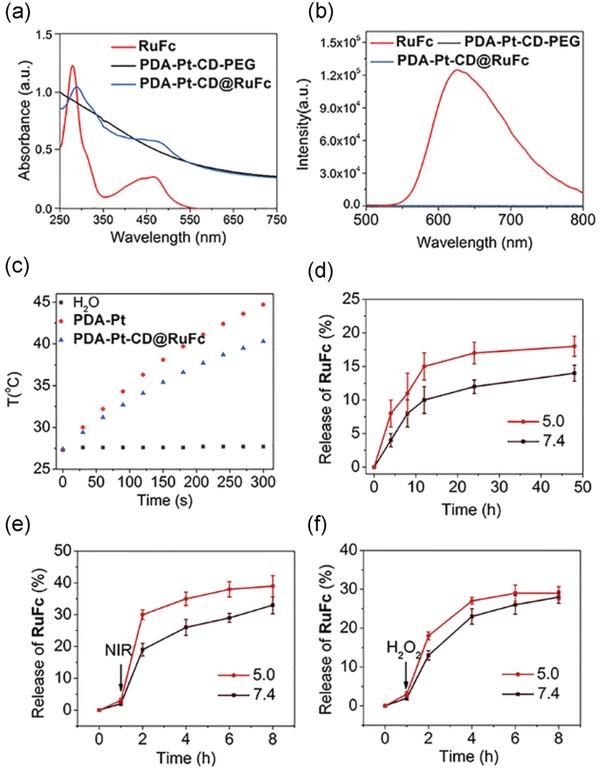
Ruthenium complexes are promising photosensitizers (PSs), but their clinical applications have many limitations. Here, a multifunctional nano-platform formed by platinum-decorated and cyclodextrin ()-modified polydopamine () nanoparticles (NPs) loaded with a ferrocene-appended ruthenium complex () is reported. The NPs can successfully deliver to the tumor sites. The release of from the NPs can be triggered by low pH, photothermal heating, and HO. The combined photodynamic and photothermal therapy (PDT-PTT) mediated by NPs can overcome the hypoxic environment of tumors from several aspects. First, the platinum NPs can catalyze HO to produce O. Second, vasodilation caused by photothermal heating can sustain the oxygen supplement. Third, PDT exerted by can also occur through the non-oxygen-dependent Fenton reaction. Due to the presence of , platinum NPs, and , the nanosystem can be used in multimodal imaging including photothermal, photoacoustic, and computed tomography imaging. The NPs can be excited by the near-infrared two-photon light source. Moreover, the combined treatment can improve the tumor microenvironments to obtain an optimized combined therapeutic effect. In summary, this study presents a tumor-microenvironment-adaptive strategy to optimize the potential of ruthenium complexes as PSs from multiple aspects.
钌配合物是很有前景的光敏剂(PSs),但其临床应用存在诸多局限性。在此,报道了一种由负载二茂铁附加钌配合物()的铂修饰和环糊精()修饰的聚多巴胺()纳米颗粒(NPs)形成的多功能纳米平台。这些NPs能够成功地将递送至肿瘤部位。NPs中 的释放可由低pH值、光热加热和HO触发。由 NPs介导的联合光动力和光热疗法(PDT-PTT)可从多个方面克服肿瘤的缺氧环境。首先,铂纳米颗粒可催化HO生成O。其次,光热加热引起的血管舒张可维持氧气补充。第三,由 施加的PDT也可通过非氧依赖的芬顿反应发生。由于 的存在、铂纳米颗粒和 ,该纳米系统可用于包括光热、光声和计算机断层扫描成像在内的多模态成像。NPs可由近红外双光子光源激发。此外,联合治疗可改善肿瘤微环境以获得优化的联合治疗效果。总之,本研究提出了一种肿瘤微环境适应性策略,从多个方面优化钌配合物作为PSs的潜力。





 Zotero 插件