
PCR 检测新生儿早发性败血症中的病原体。
PCR for the detection of pathogens in neonatal early onset sepsis.
机构信息
Paediatric Infectious Diseases, Institute of Infection and Immunity, St George's, University of London, London, United Kingdom.
Molecular Microbiology, Institute of Infection and Immunity, St George's, University of London, London, United Kingdom.
出版信息
PLoS One. 2020 Jan 24;15(1):e0226817. doi: 10.1371/journal.pone.0226817. eCollection 2020.
BACKGROUND
A large proportion of neonates are treated for presumed bacterial sepsis with broad spectrum antibiotics even though their blood cultures subsequently show no growth. This study aimed to investigate PCR-based methods to identify pathogens not detected by conventional culture.
METHODS
Whole blood samples of 208 neonates with suspected early onset sepsis were tested using a panel of multiplexed bacterial PCRs targeting Streptococcus pneumoniae, Streptococcus agalactiae (GBS), Staphylococcus aureus, Streptococcus pyogenes (GAS), Enterobacteriaceae, Enterococcus faecalis, Enterococcus faecium, Ureaplasma parvum, Ureaplasma urealyticum, Mycoplasma hominis and Mycoplasma genitalium, a 16S rRNA gene broad-range PCR and a multiplexed PCR for Candida spp.
RESULTS
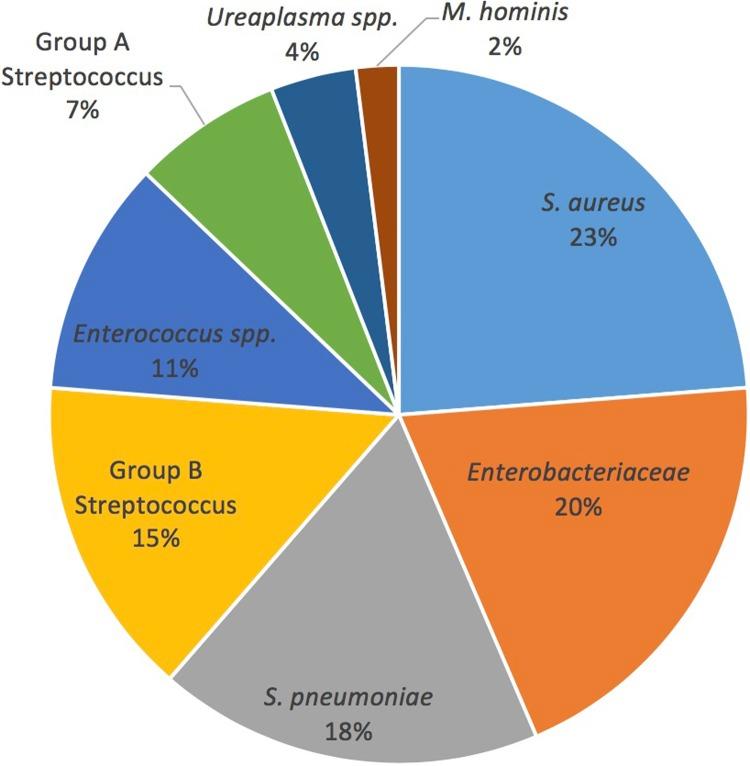
Two-hundred and eight samples were processed. In five of those samples, organisms were detected by conventional culture; all of those were also identified by PCR. PCR detected bacteria in 91 (45%) of the 203 samples that did not show bacterial growth in culture. S. aureus, Enterobacteriaceae and S. pneumoniae were the most frequently detected pathogens. A higher bacterial load detected by PCR was correlated positively with the number of clinical signs at presentation.
CONCLUSION
Real-time PCR has the potential to be a valuable additional tool for the diagnosis of neonatal sepsis.
背景
尽管随后的血液培养显示无生长,但仍有很大一部分新生儿被给予广谱抗生素治疗疑似细菌性败血症。本研究旨在探讨基于 PCR 的方法,以鉴定常规培养未检测到的病原体。
方法
对 208 例疑似早发性败血症的新生儿进行全血样本检测,采用针对肺炎链球菌、无乳链球菌(GBS)、金黄色葡萄球菌、化脓性链球菌(GAS)、肠杆菌科、粪肠球菌、屎肠球菌、解脲脲原体、人型支原体和生殖支原体的多重细菌 PCR 检测试剂盒、16S rRNA 基因广谱 PCR 和念珠菌属多重 PCR 检测试剂盒。
结果
处理了 208 个样本。在其中 5 个样本中,常规培养检测到了病原体;所有这些样本均通过 PCR 鉴定。PCR 在 203 个未培养出细菌的样本中检测到了 91 个(45%)细菌。金黄色葡萄球菌、肠杆菌科和肺炎链球菌是最常检测到的病原体。PCR 检测到的细菌载量与就诊时的临床体征数量呈正相关。
结论
实时 PCR 有可能成为新生儿败血症诊断的一种有价值的附加工具。
 Zotero 插件