
带状疱疹感染的危险因素:一项荟萃分析。
Risk Factors for Herpes Zoster Infection: A Meta-Analysis.
作者信息
Marra Fawziah, Parhar Kamalpreet, Huang Bill, Vadlamudi Nirma
机构信息
Faculty of Pharmaceutical Sciences, University of British Columbia, Vancouver, British Columbia, Canada.
出版信息
Open Forum Infect Dis. 2020 Jan 9;7(1):ofaa005. doi: 10.1093/ofid/ofaa005. eCollection 2020 Jan.
BACKGROUND
The burden of herpes zoster (HZ) is significant worldwide, with millions affected and the incidence rising. Current literature has identified some risk factors for this disease; however, there is yet to be a comprehensive study that pools all evidence to provide estimates of risk. Therefore, the purpose of this study is to identify various risk factors, excluding immunosuppressive medication, that may predispose an individual to developing HZ.
METHODS
The literature search was conducted in MEDLINE, EMBASE, and Cochrane Central, yielding case control, cohort, and cross-sectional studies that were pooled from January 1966 to September 2017. Search terms included the following: OR OR OR AND OR OR OR OR OR OR OR OR OR OR . Risk ratios (RRs) for key risk factors were calculated via natural logarithms and pooled using random-effects modeling.
RESULTS
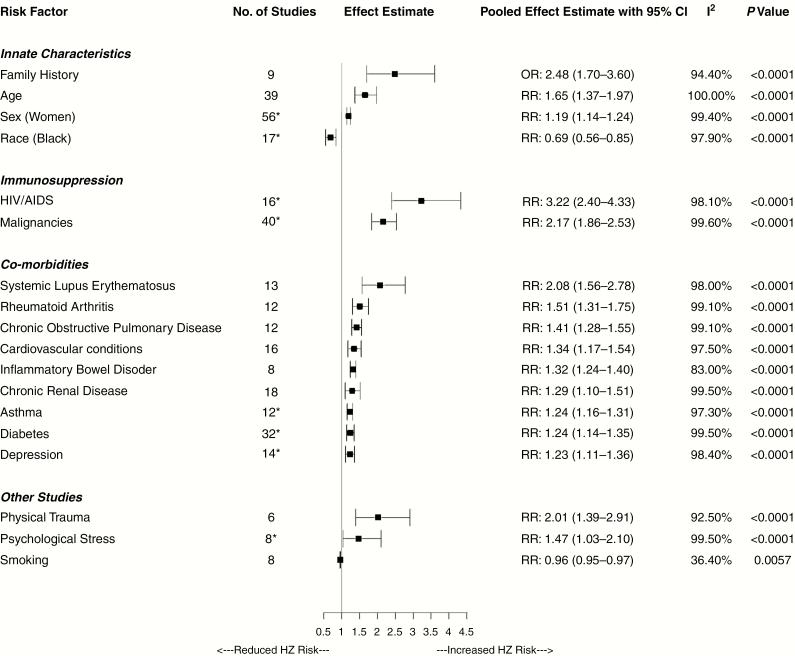
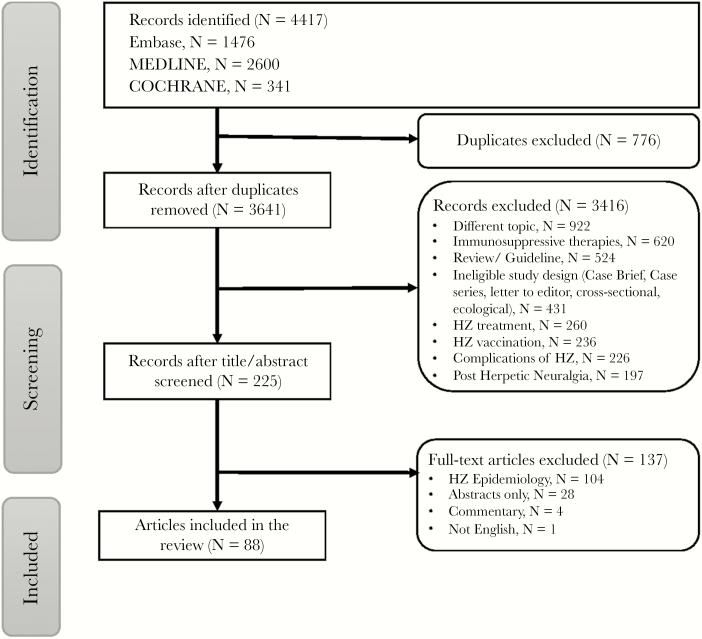
From a total of 4417 identified studies, 88 were included in analysis (N = 3, 768 691 HZ cases). Immunosuppression through human immunodeficiency virus/acquired immune deficiency syndrome (RR = 3.22; 95% confidence interval [CI], 2.40-4.33) or malignancy (RR = 2.17; 95% CI, 1.86-2.53) significantly increased the risk of HZ compared with controls. Family history was also associated with a greater risk (RR = 2.48; 95% CI, 1.70-3.60), followed by physical trauma (RR = 2.01; 95% CI, 1.39-2.91) and older age (RR = 1.65; 95% CI, 1.37-1.97). A slightly smaller risk was seen those with psychological stress, females, and comorbidities such as diabetes, rheumatoid arthritis, cardiovascular diseases, renal disease, systemic lupus erythematosus, and inflammatory bowel disease compared with controls (RR range, 2.08-1.23). We found that black race had lower rates of HZ development (RR = 0.69; 95% CI, 0.56-0.85).
CONCLUSIONS
This study demonstrated a number of risk factors for development of HZ infection. However, many of these characteristics are known well in advance by the patient and clinician and may be used to guide discussions with patients for prevention by vaccination.
背景
带状疱疹(HZ)在全球范围内造成的负担十分巨大,数以百万计的人受到影响且发病率呈上升趋势。当前文献已确定了该疾病的一些风险因素;然而,尚未有一项综合研究汇总所有证据以提供风险估计。因此,本研究的目的是确定各种风险因素(不包括免疫抑制药物),这些因素可能使个体易患HZ。
方法
在MEDLINE、EMBASE和Cochrane Central数据库中进行文献检索,纳入1966年1月至2017年9月期间汇总的病例对照研究、队列研究和横断面研究。检索词包括以下内容:……(此处原文未完整列出检索词)。通过自然对数计算关键风险因素的风险比(RRs),并使用随机效应模型进行汇总。
结果
在总共识别出的4417项研究中,88项被纳入分析(N = 3,768,691例HZ病例)。与对照组相比,通过人类免疫缺陷病毒/获得性免疫缺陷综合征导致的免疫抑制(RR = 3.22;95%置信区间[CI],2.40 - 4.33)或恶性肿瘤(RR = 2.17;95% CI,1.86 - 2.53)显著增加了患HZ的风险。家族史也与更高的风险相关(RR = 2.48;95% CI,1.70 - 3.60),其次是身体创伤(RR = 2.01;95% CI,1.39 - 2.91)和老年(RR = 1.65;95% CI,1.37 - 1.97)。与对照组相比,心理压力大的人、女性以及患有糖尿病、类风湿关节炎、心血管疾病、肾脏疾病、系统性红斑狼疮和炎症性肠病等合并症的人患HZ的风险略低(RR范围为2.08 - 1.23)。我们发现黑人患HZ的发生率较低(RR = 0.69;95% CI,0.56 - 0.85)。
结论
本研究证明了一些导致HZ感染的风险因素。然而,患者和临床医生事先大多已熟知其中许多特征,这些特征可用于指导与患者讨论通过接种疫苗进行预防。
 Zotero 插件