
慢性肾脏病患者血清中从巨噬细胞流出至肝细胞的胆固醇转运受损,可能是心血管疾病风险增加的潜在原因。
Impaired Delivery of Cholesterol Effluxed From Macrophages to Hepatocytes by Serum From CKD Patients May Underlie Increased Cardiovascular Disease Risk.
作者信息
Gipson Graham T, Carbone Salvatore, Wang Jing, Dixon Dave L, Jovin Ion S, Carl Daniel E, Gehr Todd W, Ghosh Shobha
机构信息
Department of Internal Medicine, Virginia Commonwealth University (VCU) School of Medicine, Richmond, Virginia, USA.
Department of Pharmacotherapy and Outcomes Science, Virginia Commonwealth University (VCU) School of Pharmacy, Richmond, Virginia, USA.
出版信息
Kidney Int Rep. 2019 Nov 9;5(2):199-210. doi: 10.1016/j.ekir.2019.11.003. eCollection 2020 Feb.
INTRODUCTION
Although chronic kidney disease (CKD) is associated with increased risk for coronary artery disease (CAD), the underlying mechanisms are not completely defined. In the present study, we tested the hypothesis that flux of cholesterol from macrophage foam cells to liver is impaired in subjects with CKD.
METHODS
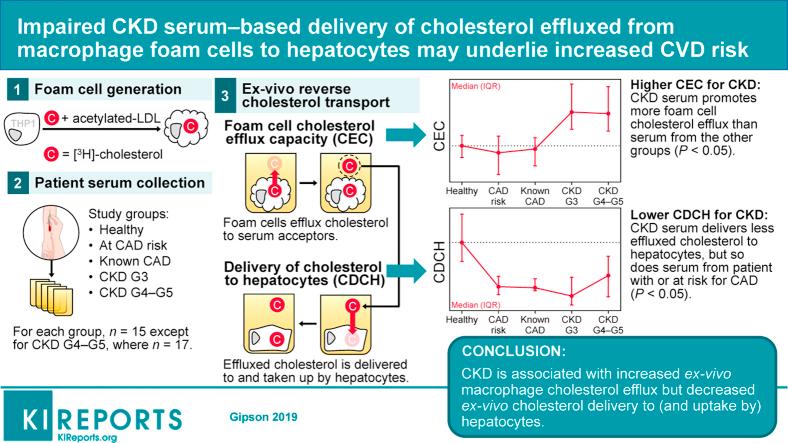
Consecutive healthy patients, patients with at least 1 CAD risk factor, patients with established CAD, and patients with CKD stages G3 to G5 ( ≥ 15/group) were recruited prospectively. The ability of total patient serum without any modifications to (i) facilitate efflux of cholesterol from human THP1-macrophage foam cells under physiological conditions (cholesterol efflux capacity [CEC]) and (ii) to deliver this effluxed cholesterol to primary hepatocytes with physiological expression of high-density lipoprotein (HDL) receptor SR-BI (capacity to deliver cholesterol to hepatocytes [CDCH]) was evaluated.
RESULTS
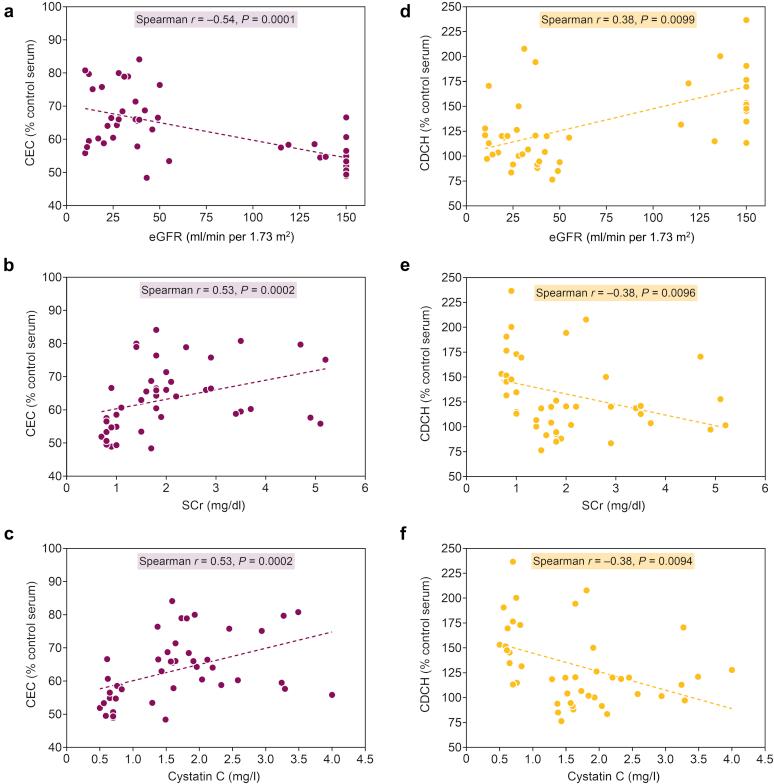
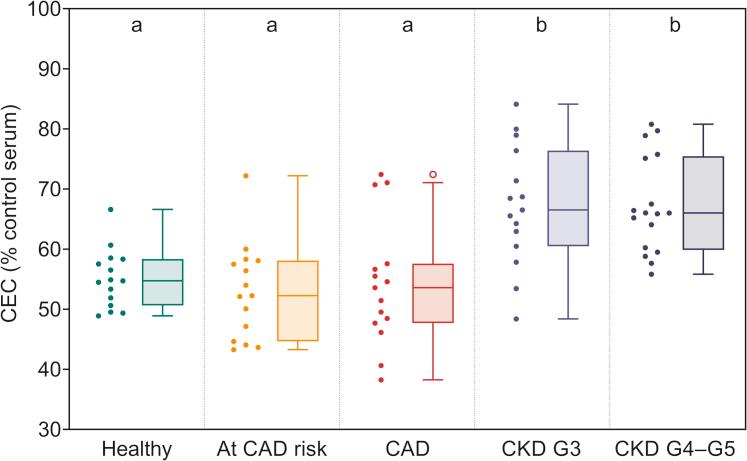
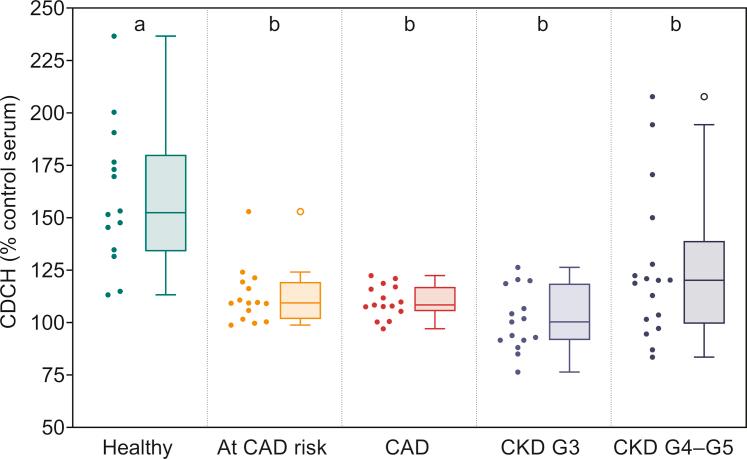
Although healthy patients, patients with at least 1 CAD risk factor, and patients with established CAD all showed similar CEC, patients with CKD showed significantly higher CEC. CDCH was significantly lower in all groups compared with the healthy patients; however, when corrected for higher CEC, CDCH in patients with CKD was significantly lower than in patients with CAD. CDCH correlated with age, body mass index, metabolic parameters, inflammatory markers, and kidney function markers (estimated glomerular filtration rate [eGFR], serum creatinine, and serum cystatin C).
CONCLUSIONS
These results suggest that aberrations in delivery of cholesterol effluxed from macrophage foam cells to liver for final elimination or the last step of reverse cholesterol transport, may underlie the increased risk of CAD in patients with CKD.
引言
尽管慢性肾脏病(CKD)与冠状动脉疾病(CAD)风险增加相关,但其潜在机制尚未完全明确。在本研究中,我们检验了CKD患者巨噬细胞泡沫细胞向肝脏的胆固醇流出受损这一假说。
方法
前瞻性招募连续的健康患者、至少有1个CAD危险因素的患者、已确诊CAD的患者以及CKD G3至G5期患者(每组≥15例)。评估未经任何处理的患者总血清在以下两方面的能力:(i)在生理条件下促进人THP1巨噬细胞泡沫细胞的胆固醇流出(胆固醇流出能力[CEC]);(ii)将流出的胆固醇递送至具有高密度脂蛋白(HDL)受体SR-BI生理表达的原代肝细胞(将胆固醇递送至肝细胞的能力[CDCH])。
结果
尽管健康患者、至少有1个CAD危险因素的患者以及已确诊CAD的患者均表现出相似的CEC,但CKD患者的CEC显著更高。与健康患者相比,所有组的CDCH均显著更低;然而,校正更高的CEC后,CKD患者的CDCH显著低于CAD患者。CDCH与年龄、体重指数、代谢参数、炎症标志物及肾功能标志物(估计肾小球滤过率[eGFR]、血清肌酐和血清胱抑素C)相关。
结论
这些结果表明,巨噬细胞泡沫细胞流出的胆固醇向肝脏最终清除或逆向胆固醇转运最后一步的递送异常,可能是CKD患者CAD风险增加的潜在原因。

 Zotero 插件