
开发一种更快的方法,使用空气粒子计数来识别装有高效空气过滤器的受控环境房间空气中的生物污染。
Developing a faster way to identify biocontamination in the air of controlled environment rooms with HEPA filters: airborne particle counting.
机构信息
Service of Preventive Medicine, Hospital Universitario de La Princesa, Madrid, Spain.
Department of Preventive Medicine and Public Health. School of Medicine, Universidad Autónoma de Madrid-IdiPaz; and CIBERESP (CIBER of Epidemiology and Public Health), Madrid, Spain.
出版信息
Sci Rep. 2020 Feb 13;10(1):2575. doi: 10.1038/s41598-020-59367-8.
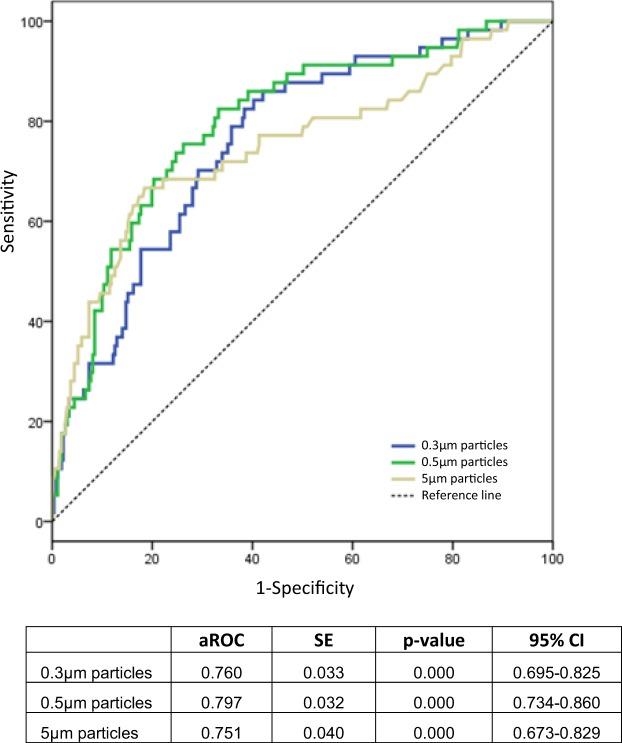
Our aim was to assess whether airborne particle counting is an immediate indicator of biocontamination in controlled environment rooms with HEPA filters in a hospital. A prospective study was carried out in a tertiary care hospital between 2016 and 2018. The study was divided in two periods and the measurements were performed in different controlled environment rooms with HEPA filters. The Environmental Biosafety Criterion (EBC) was defined as the absence of fungal and bacterial contamination. In the training period, the area under the ROC curve (aROC) of airborne particle counting and EBC was calculated for each particle size as well as the cut-off points that optimize the combination of sensitivity and specificity in the association between them. aROC is created by plotting sensitivity against 1-specificity. In the testing period, the cut-off points previously selected were validated. 328 measurements were carried out in the training period and 301 in the testing period. In the training period, an association was found between airborne particle counting and EBC. An aROC = 0.760, 95% Confidence Interval (95% CI) 0.695-0.825 was observed for 0.3 µm particles; an aROC = 0.797 (95% CI 0.734-0.860) for 0.5 µm particles; and an aROC = 0.751 (95% CI 0.673-0.829) for 5 µm particles. The cut-off points that optimized the combination of sensitivity and specificity were 9.0 × 10 for 0.3 µm particles, 3.6 × 10 particles for 0.5 µm, and 3.2 × 10 particles for 5 µm. In the testing period, the previous cut-off points were validated. We conclude that airborne particle counting is a useful, immediate, and preliminary measure to identify the presence of biocontamination in controlled environment rooms with HEPA filters.
我们的目的是评估在配备 HEPA 过滤器的受控环境室内,空气中颗粒计数是否是生物污染的直接指标。这项前瞻性研究于 2016 年至 2018 年在一家三级护理医院进行。该研究分为两个阶段,在配备 HEPA 过滤器的不同受控环境室内进行测量。环境生物安全标准(EBC)定义为无真菌和细菌污染。在培训期间,计算了空气中颗粒计数和 EBC 的每个粒径的 ROC 曲线下面积(aROC),以及优化它们之间关联的灵敏度和特异性组合的截止值。aROC 通过绘制灵敏度与 1-特异性来创建。在测试期间,验证了先前选择的截止值。在培训期间进行了 328 次测量,在测试期间进行了 301 次测量。在培训期间,发现空气中颗粒计数与 EBC 之间存在关联。对于 0.3µm 颗粒,观察到 aROC=0.760,95%置信区间(95%CI)为 0.695-0.825;对于 0.5µm 颗粒,aROC=0.797(95%CI 0.734-0.860);对于 5µm 颗粒,aROC=0.751(95%CI 0.673-0.829)。优化灵敏度和特异性组合的最佳截止值为 0.3µm 颗粒的 9.0×10,0.5µm 颗粒的 3.6×10,以及 5µm 颗粒的 3.2×10。在测试期间,验证了先前的截止值。我们得出结论,空气中颗粒计数是一种有用的、即时的、初步措施,可以识别配备 HEPA 过滤器的受控环境室内生物污染的存在。
 Zotero 插件