
用于在解脂耶氏酵母中高水平生产β-紫罗兰酮的模块化途径工程策略。
A modular pathway engineering strategy for the high-level production of β-ionone in Yarrowia lipolytica.
机构信息
School of Biology and Biological Engineering, South China University of Technology, 382 East Outer Loop Road, University Park, Guangzhou, 510006, China.
出版信息
Microb Cell Fact. 2020 Feb 27;19(1):49. doi: 10.1186/s12934-020-01309-0.
BACKGROUND
The GRAS and oleaginous yeast Yarrowia lipolytica (Y. lipolytica) is an attractive cell factory for the production of chemicals and biofuels. The production of many natural products of commercial interest have been investigated in this cell factory by introducing heterologous biosynthetic pathways and by modifying the endogenous pathways. However, since natural products anabolism involves long pathways and complex regulation, re-channelling carbon into the product of target compounds is still a cumbersome work, and often resulting in low production performance.
RESULTS
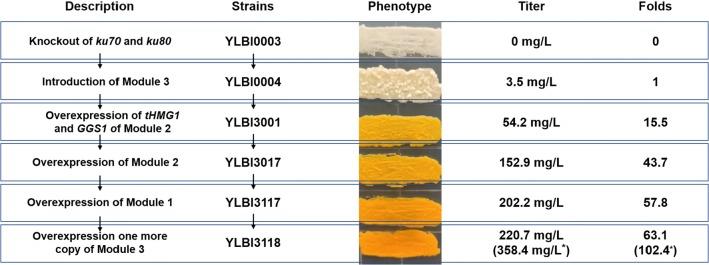
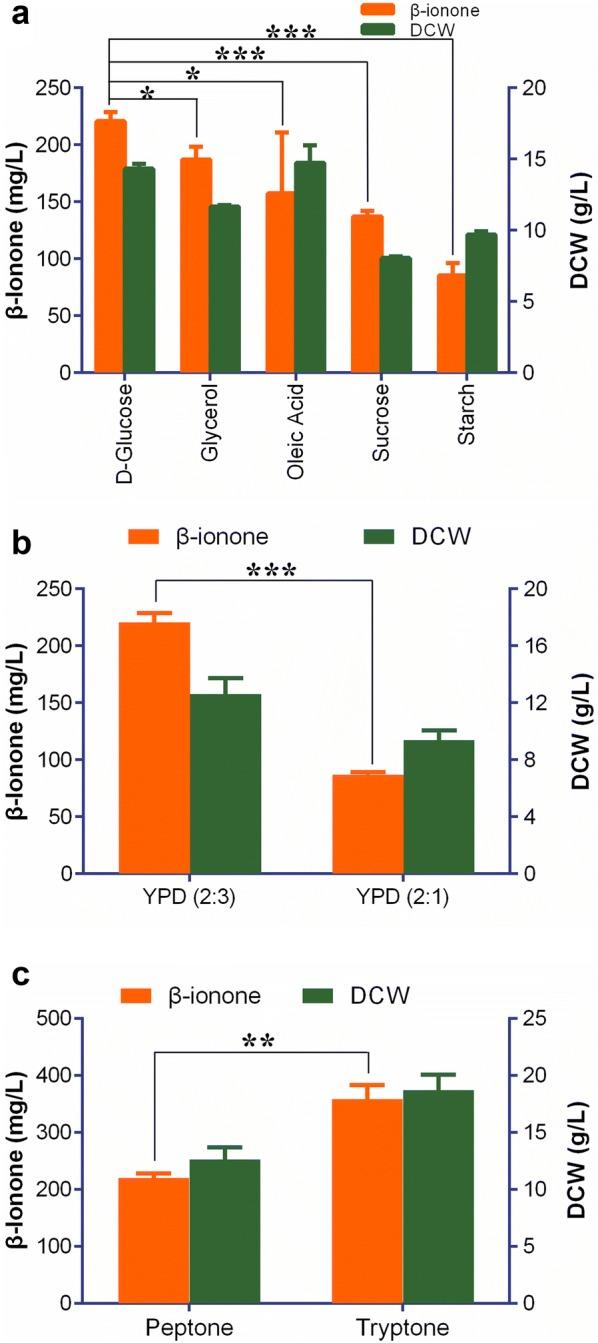
In this work, the carotenogenic genes contained carB and bi-functional carRP from Mucor circinelloides and carotenoid cleavage dioxygenase 1 (CCD1) from Petunia hybrida were introduced to Y. lipolytica and led to the low production of β-ionone of 3.5 mg/L. To further improve the β-ionone synthesis, we implemented a modular engineering strategy for the construction and optimization of a biosynthetic pathway for the overproduction of β-ionone in Y. lipolytica. The strategy involved the enhancement of the cytosolic acetyl-CoA supply and the increase of MVA pathway flux, yielding a β-ionone titer of 358 mg/L in shake-flask fermentation and approximately 1 g/L (~ 280-fold higher than the baseline strain) in fed-batch fermentation.
CONCLUSIONS
An efficient β-ionone producing GRAS Y. lipolytica platform was constructed by combining integrated overexpressed of heterologous and native genes. A modular engineering strategy involved the optimization pathway and fermentation condition was investigated in the engineered strain and the highest β-ionone titer reported to date by a cell factory was achieved. This effective strategy can be adapted to enhance the biosynthesis of other terpenoids in Y. lipolytica.
背景
GRAS 及产油酵母解脂耶氏酵母(Yarrowia lipolytica)是生产化学品和生物燃料的有吸引力的细胞工厂。通过引入异源生物合成途径和修饰内源性途径,已经在这个细胞工厂中研究了许多具有商业价值的天然产物的生产。然而,由于天然产物的合成涉及长途径和复杂的调控,将碳重新导向目标化合物的产物仍然是一项繁琐的工作,并且经常导致生产性能低下。
结果
在这项工作中,从卷枝毛霉中引入了包含 carB 和多功能 carRP 的类胡萝卜素生物合成基因,以及来自矮牵牛的类胡萝卜素裂解双加氧酶 1(CCD1),导致 β-紫罗兰酮的产量仅为 3.5mg/L。为了进一步提高 β-紫罗兰酮的合成,我们实施了模块化工程策略,用于构建和优化 Y. lipolytica 中β-紫罗兰酮的生物合成途径。该策略涉及增强细胞质乙酰辅酶 A 的供应和增加 MVA 途径通量,在摇瓶发酵中产生 358mg/L 的 β-紫罗兰酮产量,在分批补料发酵中约为 1g/L(比基线菌株高约 280 倍)。
结论
通过整合异源和天然基因的过表达,构建了一个高效的生产 GRAS 解脂耶氏酵母的 β-紫罗兰酮平台。研究了模块化工程策略涉及的途径优化和发酵条件,在工程菌株中实现了迄今为止报道的最高 β-紫罗兰酮产量。这种有效的策略可以适应于增强 Y. lipolytica 中其他萜类化合物的生物合成。



 Zotero 插件