
谷氨酰胺通过激活核因子红细胞 2 相关 2/ Kelch 样 ECH 相关蛋白 1 信号通路改善肉鸡大腿肌肉的热应激诱导的氧化损伤。
Glutamine improves heat stress-induced oxidative damage in the broiler thigh muscle by activating the nuclear factor erythroid 2-related 2/Kelch-like ECH-associated protein 1 signaling pathway.
机构信息
College of Animal Science, Anhui Science and Technology University, Fengyang, 233100 People's Republic of China.
College of Animal Science, Anhui Science and Technology University, Fengyang, 233100 People's Republic of China; Department of Pharmaceutical and Life Sciences, Jiujiang University, Jiujiang 332005, People's Republic of China.
出版信息
Poult Sci. 2020 Mar;99(3):1454-1461. doi: 10.1016/j.psj.2019.11.001. Epub 2019 Dec 26.
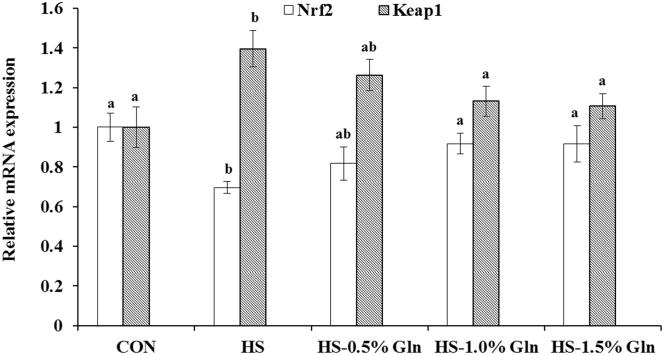
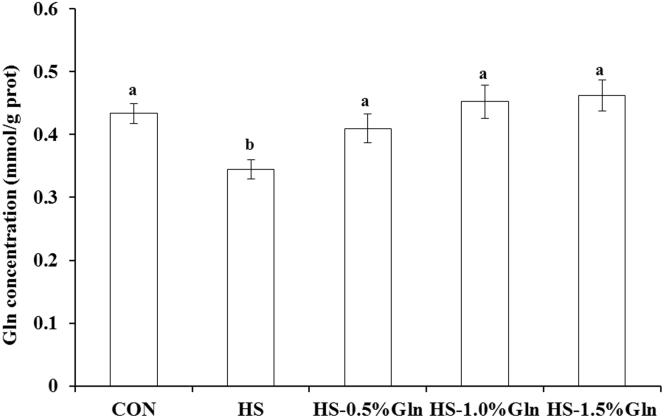
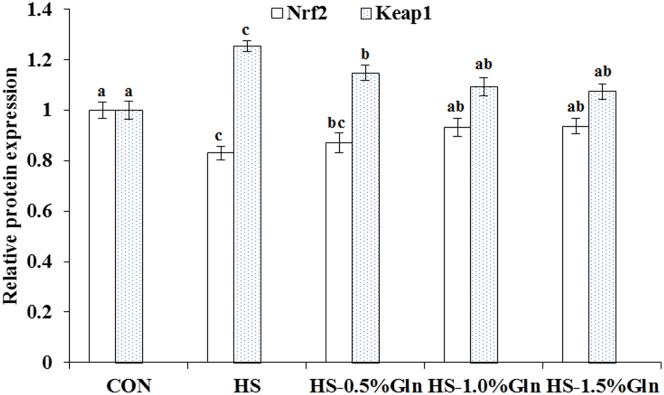
The aim of the present study was to evaluate the effect of glutamine (Gln) on modulating heat stress-induced oxidative damage in the broiler thigh muscle through nuclear factor erythroid 2-related 2/Kelch-like ECH-associated protein 1 (Nrf2-Keap1) pathway. Three-hundred 22-day-old Arbor Acres broilers were reallocated into 5 groups: a control group (24 °C) fed with basal diet and 4 heat stress (HS) groups (34 °C for 8 h/D) fed with basal diet containing 0, 0.5, 1.0, and 1.5% Gln. This experiment lasted 21 D. Heat stress decreased (P < 0.05) pH, redness, and Gln levels, and increased (P < 0.05) luminance, water loss rate, and cooking loss (CL) values of the thigh meat. Compared with the HS group, supplementation with 1.5% Gln increased (P < 0.05) pH, redness, and Gln levels, but decreased (P < 0.05) luminance and CL values in the thigh meat. There were significant decreases (P < 0.05) in glutathione (GSH), superoxide dismutase (SOD), catalase (CAT), glutathione peroxidase (GSH-Px), total antioxidant capacity (T-AOC), and Nrf2 levels, but significant increases (P < 0.05) in the malondialdehyde (MDA) and Keap1 levels of the thigh muscle after HS treatment. Compared with the HS group, supplementation with 1.0, and 1.5% Gln decreased (P < 0.05) MDA and Keap1 levels; supplementation with 1.5% Gln increased (P < 0.05) GSH, GSH-Px, T-AOC, CAT, SOD, and Nrf2 levels in the thigh muscle of heat-stressed broilers. Furthermore, HS decreased (P < 0.05) Nrf2, SOD, CAT, and GSH-Px mRNA expression levels, but increased (P < 0.05) Keap1 mRNA level in the thigh muscle of broiler. Dietary supplementation with 1.5% Gln increased (P < 0.05) Nrf2, GSH-Px, CAT, and SOD mRNA expression levels, but decreased (P < 0.05) Keap1 mRNA level in the thigh muscle of heat-stressed broilers. In conclusion, dietary Gln improved the resistance of heat-stressed broiler muscles to oxidative damage possibly through reversing the muscle Gln level and inducing the expression of the Nrf2-Keap1 pathway.
本研究旨在通过核因子红细胞 2 相关 2/kelch 样 ECH 相关蛋白 1(Nrf2-Keap1)途径评估谷氨酰胺(Gln)对调节热应激诱导的肉鸡大腿肌肉氧化损伤的影响。将 300 只 22 日龄的阿伯丁肉鸡重新分配到 5 组:对照组(24°C)饲喂基础日粮和 4 个热应激(HS)组(34°C 8h/d)饲喂基础日粮,基础日粮分别含有 0、0.5、1.0 和 1.5%的 Gln。该实验持续 21 天。热应激降低(P<0.05)了大腿肉的 pH 值、红色度和 Gln 水平,增加(P<0.05)了亮度、失水率和蒸煮损失(CL)值。与 HS 组相比,补充 1.5%Gln 增加(P<0.05)了大腿肉的 pH 值、红色度和 Gln 水平,但降低(P<0.05)了亮度和 CL 值。HS 处理后,大腿肌肉中的谷胱甘肽(GSH)、超氧化物歧化酶(SOD)、过氧化氢酶(CAT)、谷胱甘肽过氧化物酶(GSH-Px)、总抗氧化能力(T-AOC)和 Nrf2 水平显著降低(P<0.05),但丙二醛(MDA)和 Keap1 水平显著升高(P<0.05)。与 HS 组相比,补充 1.0%和 1.5%Gln 降低(P<0.05)了大腿肌肉中的 MDA 和 Keap1 水平;补充 1.5%Gln 增加(P<0.05)了热应激肉鸡大腿肌肉中的 GSH、GSH-Px、T-AOC、CAT、SOD 和 Nrf2 水平。此外,HS 降低(P<0.05)了大腿肌肉中 Nrf2、SOD、CAT 和 GSH-Px mRNA 的表达水平,但增加(P<0.05)了 Keap1 mRNA 水平。饲粮补充 1.5%Gln 增加(P<0.05)了大腿肌肉中 Nrf2、GSH-Px、CAT 和 SOD mRNA 的表达水平,但降低(P<0.05)了热应激肉鸡大腿肌肉中的 Keap1 mRNA 水平。总之,饲粮 Gln 通过逆转肌肉 Gln 水平和诱导 Nrf2-Keap1 途径的表达,提高了热应激肉鸡肌肉的抗氧化损伤抵抗力。

 Zotero 插件