
双难治性多发性骨髓瘤的基因组和转录组全景综合分析。
Integrative analysis of the genomic and transcriptomic landscape of double-refractory multiple myeloma.
机构信息
Department of Clinical Oncology and Hematology, Fondazione IRCCS Istituto Nazionale dei Tumori, Milan, Italy.
Department of Molecular Biotechnologies and Health Sciences, University of Turin, Turin, Italy.
出版信息
Blood Adv. 2020 Mar 10;4(5):830-844. doi: 10.1182/bloodadvances.2019000779.
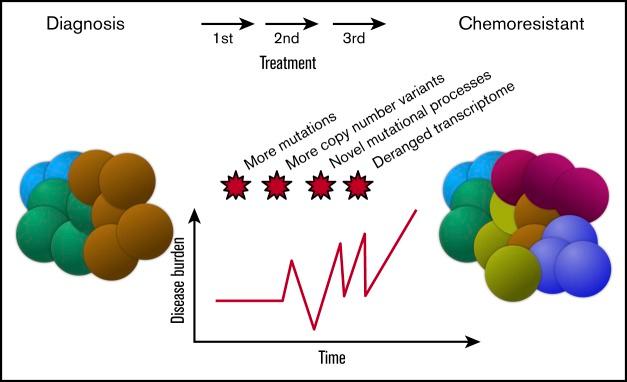
In multiple myeloma, novel treatments with proteasome inhibitors (PIs) and immunomodulatory agents (IMiDs) have prolonged survival but the disease remains incurable. At relapse, next-generation sequencing has shown occasional mutations of drug targets but has failed to identify unifying features that underlie chemotherapy resistance. We studied 42 patients refractory to both PIs and IMiDs. Whole-exome sequencing was performed in 40 patients, and RNA sequencing (RNA-seq) was performed in 27. We found more mutations than were reported at diagnosis and more subclonal mutations, which implies ongoing evolution of the genome of myeloma cells during treatment. The mutational landscape was different from that described in published studies on samples taken at diagnosis. The TP53 pathway was the most frequently inactivated (in 45% of patients). Conversely, point mutations of genes associated with resistance to IMiDs were rare and were always subclonal. Refractory patients were uniquely characterized by having a mutational signature linked to exposure to alkylating agents, whose role in chemotherapy resistance and disease progression remains to be elucidated. RNA-seq analysis showed that treatment or mutations had no influence on clustering, which was instead influenced by karyotypic events. We describe a cluster with both amp(1q) and del(13) characterized by CCND2 upregulation and also overexpression of MCL1, which represents a novel target for experimental treatments. Overall, high-risk features were found in 65% of patients. However, only amp(1q) predicted survival. Gene mutations of IMiD and PI targets are not a preferred mode of drug resistance in myeloma. Chemotherapy resistance of the bulk tumor population is likely attained through differential, yet converging evolution of subclones that are overall variable from patient to patient and within the same patient.
在多发性骨髓瘤中,新型蛋白酶体抑制剂 (PI) 和免疫调节剂 (IMiD) 的治疗方法延长了患者的生存时间,但疾病仍然无法治愈。在复发时,下一代测序显示偶尔会出现药物靶点的突变,但未能确定导致化疗耐药的统一特征。我们研究了 42 例对 PI 和 IMiD 均耐药的患者。对 40 例患者进行了全外显子组测序,对 27 例患者进行了 RNA 测序 (RNA-seq)。我们发现了比诊断时报告的更多的突变和更多的亚克隆突变,这意味着骨髓瘤细胞的基因组在治疗过程中不断进化。突变景观与已发表的诊断样本研究中描述的不同。TP53 通路是最常失活的 (占 45%的患者)。相反,与 IMiD 耐药相关的基因突变很少见,而且总是亚克隆的。耐药患者的特征是具有与接触烷化剂相关的突变特征,其在化疗耐药和疾病进展中的作用仍有待阐明。RNA-seq 分析表明,治疗或突变对聚类没有影响,聚类受核型事件的影响。我们描述了一个同时具有 amp(1q)和 del(13)的簇,其特征是 CCND2 上调,以及 MCL1 的过表达,这代表了一个新的实验治疗靶点。总体而言,65%的患者存在高危特征。然而,只有 amp(1q)预测了生存。骨髓瘤中 IMiD 和 PI 靶基因的突变不是耐药的首选模式。大多数肿瘤群体的化疗耐药性可能是通过亚克隆的不同但趋同的进化实现的,这些亚克隆在不同患者和同一患者内总体上是不同的。
 Zotero 插件