
SNAP 假说:染色体重排可能源于生态位适应过程中的正选择。
The SNAP hypothesis: Chromosomal rearrangements could emerge from positive Selection during Niche Adaptation.
机构信息
Department of Medical Biochemistry and Microbiology, Biomedical Center, Uppsala University, Uppsala, Sweden.
出版信息
PLoS Genet. 2020 Mar 4;16(3):e1008615. doi: 10.1371/journal.pgen.1008615. eCollection 2020 Mar.
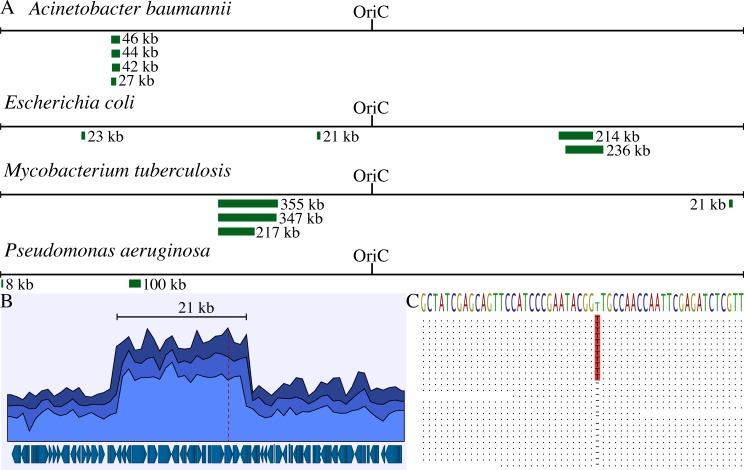
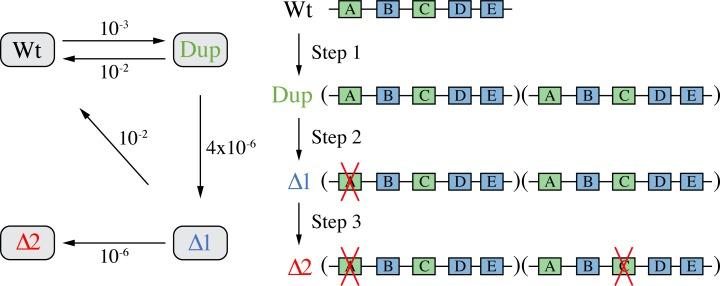
The relative linear order of most genes on bacterial chromosomes is not conserved over evolutionary timescales. One explanation is that selection is weak, allowing recombination to randomize gene order by genetic drift. However, most chromosomal rearrangements are deleterious to fitness. In contrast, we propose the hypothesis that rearrangements in gene order are more likely the result of selection during niche adaptation (SNAP). Partial chromosomal duplications occur very frequently by recombination between direct repeat sequences. Duplicated regions may contain tens to hundreds of genes and segregate quickly unless maintained by selection. Bacteria exposed to non-lethal selections (for example, a requirement to grow on a poor nutrient) can adapt by maintaining a duplication that includes a gene that improves relative fitness. Further improvements in fitness result from the loss or inactivation of non-selected genes within each copy of the duplication. When genes that are essential in single copy are lost from different copies of the duplication, segregation is prevented even if the original selection is lifted. Functional gene loss continues until a new genetic equilibrium is reached. The outcome is a rearranged gene order. Mathematical modelling shows that this process of positive selection to adapt to a new niche can rapidly drive rearrangements in gene order to fixation. Signature features (duplication formation and divergence) of the SNAP model were identified in natural isolates from multiple species showing that the initial two steps in the SNAP process can occur with a remarkably high frequency. Further bioinformatic and experimental analyses are required to test if and to which extend the SNAP process acts on bacterial genomes.
在进化时间尺度上,细菌染色体上大多数基因的相对线性顺序并不保守。一种解释是选择较弱,允许重组通过遗传漂变随机化基因顺序。然而,大多数染色体重排对适应性是有害的。相比之下,我们提出了一个假设,即基因顺序的重排更可能是适应生态位选择(SNAP)的结果。通过直接重复序列之间的重组,部分染色体重复经常发生。重复区域可能包含数十到数百个基因,如果没有选择的维持,它们会迅速分离。暴露于非致死性选择(例如,在营养较差的环境中生长的要求)下的细菌可以通过维持一个包含提高相对适应性的基因的重复来适应。在每个重复的拷贝中,非选择基因的丢失或失活会导致适应性的进一步提高。当单拷贝中必需的基因从重复的不同拷贝中丢失时,即使原始选择被解除,分离也会被阻止。功能基因的丢失会持续到达到新的遗传平衡。结果是基因顺序的重排。数学模型表明,这种适应新生态位的正选择过程可以迅速推动基因顺序的重排达到固定。在来自多个物种的自然分离株中发现了 SNAP 模型的特征(重复形成和分歧),表明 SNAP 过程的最初两个步骤可以以非常高的频率发生。需要进一步的生物信息学和实验分析来测试 SNAP 过程是否以及在多大程度上作用于细菌基因组。


 Zotero 插件