
ALEPH:一种面向网络的方法,用于生成基于片段的文库和结构解释。
ALEPH: a network-oriented approach for the generation of fragment-based libraries and for structure interpretation.
机构信息
Crystallographic Methods, Institute of Molecular Biology of Barcelona (IBMB-CSIC), Barcelona Science Park, Helix Building, Baldiri Reixac 15, 08028 Barcelona, Spain.
Department of Haematology, Cambridge Institute for Medical Research, University of Cambridge, Hills Road, Cambridge CB2 0XY, England.
出版信息
Acta Crystallogr D Struct Biol. 2020 Mar 1;76(Pt 3):193-208. doi: 10.1107/S2059798320001679. Epub 2020 Feb 26.
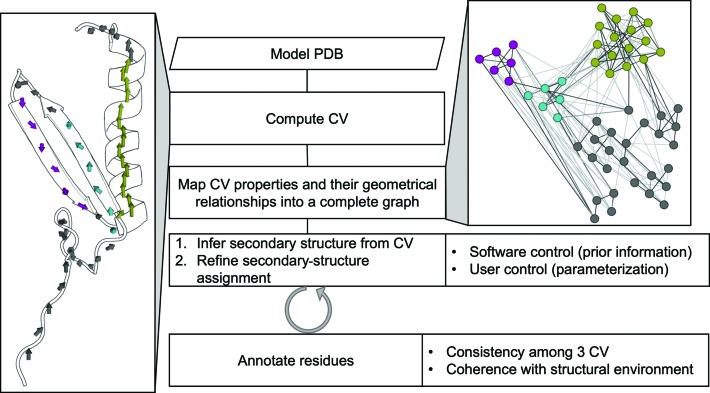
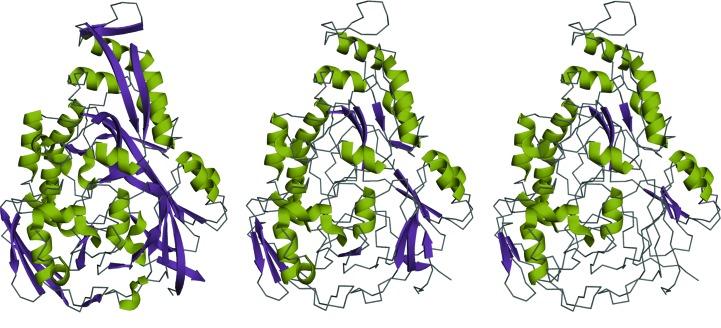
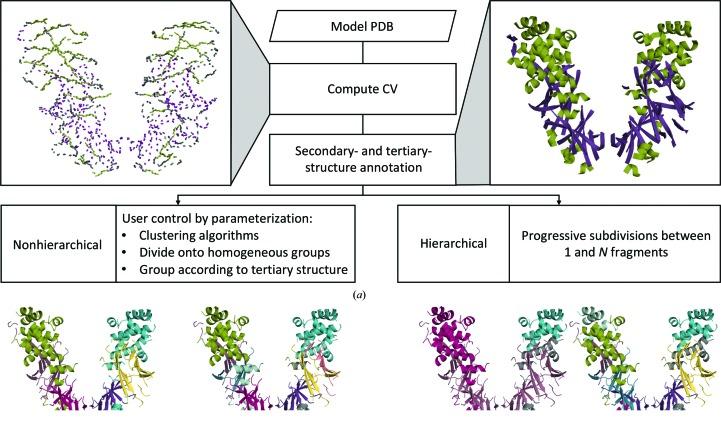
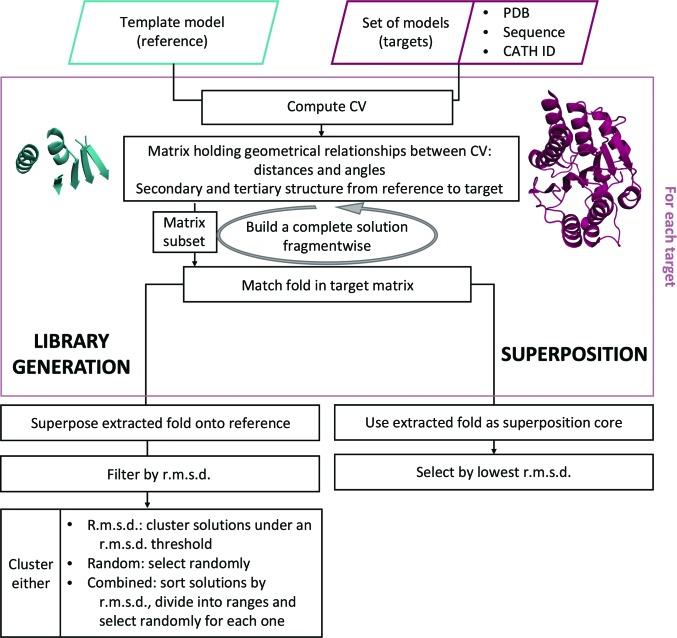
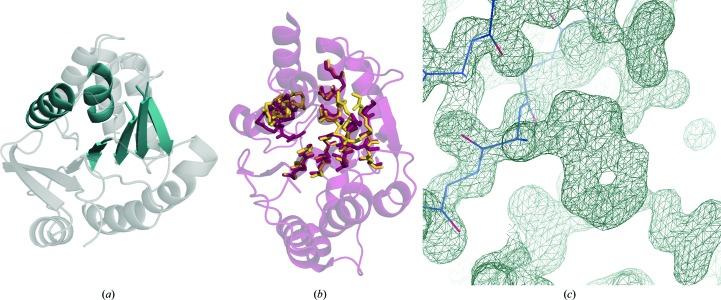
The analysis of large structural databases reveals general features and relationships among proteins, providing useful insight. A different approach is required to characterize ubiquitous secondary-structure elements, where flexibility is essential in order to capture small local differences. The ALEPH software is optimized for the analysis and the extraction of small protein folds by relying on their geometry rather than on their sequence. The annotation of the structural variability of a given fold provides valuable information for fragment-based molecular-replacement methods, in which testing alternative model hypotheses can succeed in solving difficult structures when no homology models are available or are successful. ARCIMBOLDO_BORGES combines the use of composite secondary-structure elements as a search model with density modification and tracing to reveal the rest of the structure when both steps are successful. This phasing method relies on general fold libraries describing variations around a given pattern of β-sheets and helices extracted using ALEPH. The program introduces characteristic vectors defined from the main-chain atoms as a way to describe the geometrical properties of the structure. ALEPH encodes structural properties in a graph network, the exploration of which allows secondary-structure annotation, decomposition of a structure into small compact folds, generation of libraries of models representing a variation of a given fold and finally superposition of these folds onto a target structure. These functions are available through a graphical interface designed to interactively show the results of structure manipulation, annotation, fold decomposition, clustering and library generation. ALEPH can produce pictures of the graphs, structures and folds for publication purposes.
从大型结构数据库的分析中可以揭示蛋白质的一般特征和关系,提供有用的见解。要描述普遍存在的二级结构元素,需要采用不同的方法,因为为了捕捉小的局部差异,灵活性是必不可少的。ALEPH 软件通过依赖于其几何形状而不是序列来优化分析和提取小蛋白折叠。给定折叠结构可变性的注释为基于片段的分子置换方法提供了有价值的信息,在没有同源模型或成功的情况下,测试替代模型假设可以成功解决困难的结构。ARCIMBOLDO_BORGES 将复合二级结构元素用作搜索模型,结合密度修饰和追踪,当这两个步骤都成功时,可以揭示结构的其余部分。这种相位确定方法依赖于一般的折叠文库,这些文库描述了使用 ALEPH 提取的给定β-sheet 和螺旋图案周围的变化。该程序引入了从主链原子定义的特征向量,作为描述结构几何特性的一种方式。ALEPH 将结构属性编码在图网络中,探索该网络允许进行二级结构注释、将结构分解为小的紧凑折叠、生成表示给定折叠变化的模型库,最后将这些折叠叠加到目标结构上。这些功能通过一个图形界面提供,该界面旨在交互式显示结构操作、注释、折叠分解、聚类和库生成的结果。ALEPH 可以为出版目的生成图形、结构和折叠的图片。




 Zotero 插件