
脂肪生成调控与内分泌干扰物:肥胖症研究的新视角。
Adipogenesis Regulation and Endocrine Disruptors: Emerging Insights in Obesity.
机构信息
Instituto de Ciencias Biomédicas, Facultad de Ciencias de la Salud, Universidad Autónoma de Chile, Santiago, Chile.
Programa de Nutrición y Dietética, Departamento de Nutrición Humana, Facultad de Medicina, Universidad Nacional de Colombia, Bogotá, Colombia.
出版信息
Biomed Res Int. 2020 Feb 18;2020:7453786. doi: 10.1155/2020/7453786. eCollection 2020.
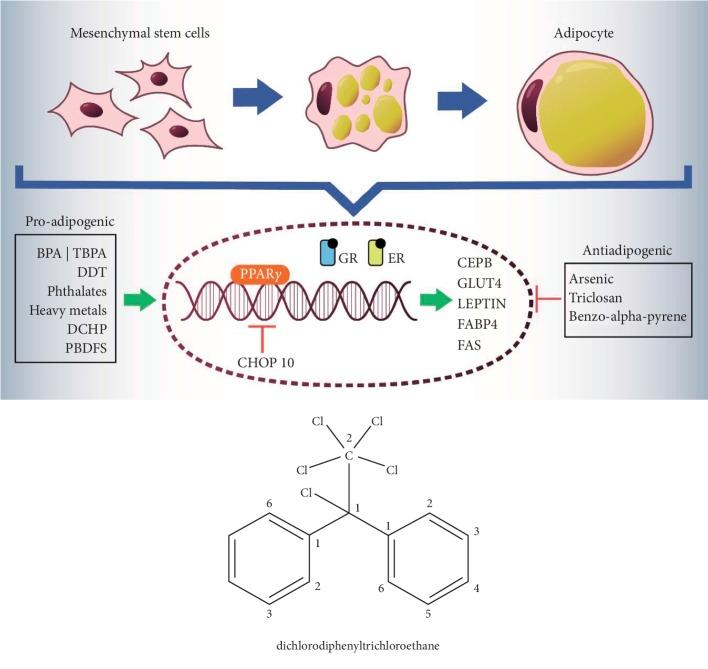
Endocrine disruptors (EDs) are defined as environmental pollutants capable of interfering with the functioning of the hormonal system. They are environmentally distributed as synthetic fertilizers, electronic waste, and several food additives that are part of the food chain. They can be considered as obesogenic compounds since they have the capacity to influence cellular events related to adipose tissue, altering lipid metabolism and adipogenesis processes. This review will present the latest scientific evidence of different EDs such as persistent organic pollutants (POPs), heavy metals, "nonpersistent" phenolic compounds, triclosan, polybrominated diphenyl ethers (PBDEs), and smoke-derived compounds (benzo -alpha-pyrene) and their influence on the differentiation processes towards adipocytes in both and models.
内分泌干扰物(EDs)被定义为能够干扰激素系统功能的环境污染物。它们作为合成肥料、电子垃圾和食物链中的几种食品添加剂在环境中分布。它们可以被认为是致肥胖化合物,因为它们具有影响与脂肪组织有关的细胞事件的能力,改变脂质代谢和脂肪生成过程。本综述将介绍不同 EDs 的最新科学证据,如持久性有机污染物(POPs)、重金属、“非持久性”酚类化合物、三氯生、多溴联苯醚(PBDEs)和烟雾衍生化合物(苯并-α-芘),以及它们对脂肪细胞分化过程的影响在 和 模型中。
 Zotero 插件