
肽基精氨酸脱氨酶III对人S100A3蛋白精氨酸51位点进行瓜氨酸化修饰的最佳突变体模型及其溶液结构特性
Optimal Mutant Model of Human S100A3 Protein Citrullinated at Arg51 by Peptidylarginine Deiminase Type III and Its Solution Structural Properties.
作者信息
Ite Kenji, Yonezawa Kento, Kitanishi Kenichi, Shimizu Nobutaka, Unno Masaki
机构信息
Graduate School of Science and Engineering, Ibaraki University, 4-12-1 Nakanarusawa, Hitachi, Ibaraki 316-8511, Japan.
Frontier Research Center for Applied Atomic Sciences, Ibaraki University, 162-1 Shirakata, Naka, Ibaraki 319-1106, Japan.
出版信息
ACS Omega. 2020 Feb 18;5(8):4032-4042. doi: 10.1021/acsomega.9b03618. eCollection 2020 Mar 3.
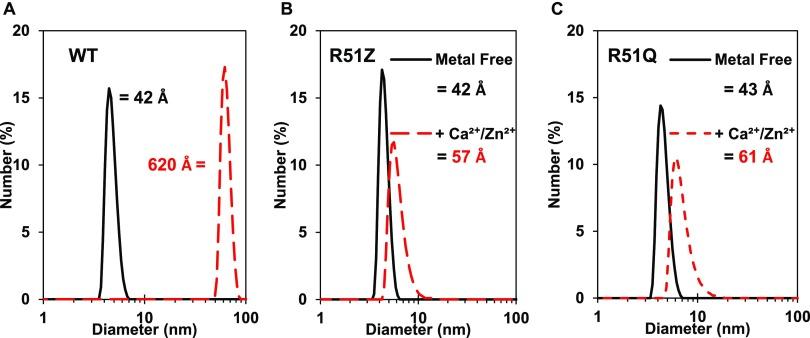
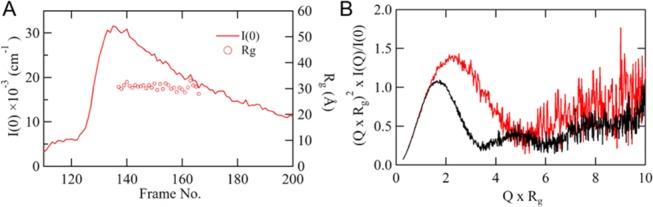
S100A3 protein, a member of the EF-hand-type Ca-binding S100 protein family, undergoes a Ca-/Zn-induced structural change to a tetrameric state upon specific citrullination of R51 in human hair cuticular cells. To elucidate the underlying mechanism, we prepared recombinant mutant S100A3 proteins, including R51A, R51C, R51E, R51K, and R51Q, as potential models of post-translationally modified S100A3 and evaluated their biophysical and biochemical properties relative to wild-type (WT) S100A3 and WT citrullinated in vitro. Size exclusion chromatography (SEC) showed that R51Q formed a tetramer in the presence of Ca, while Ca titration monitored by Trp fluorescence indicated that R51Q had Ca-binding properties similar to those of citrullinated S1003A. We therefore concluded that R51Q is the optimal mutant model of post-translationally modified S100A3. We compared the solution structure of WT S100A3 and the R51Q mutant in the absence and presence of Ca and Zn by SEC-small-angle X-ray scattering. The radius of gyration of R51Q in the metal-free state was almost the same as that of WT; however, it increased by ∼1.5-fold in the presence of Ca/Zn, indicating a large expansion in molecular size. By contrast, addition of Ca/Zn to WT led to nonspecific aggregation in SEC analysis and dynamic light scattering, suggesting that citrullination of S100A3 is essential for stabilization of the Ca-/Zn-bound state. These findings will lead to the further development of structural analyses for the Ca-/Zn-bound S100A3.
S100A3蛋白是EF手型钙结合S100蛋白家族的成员,在人毛发角质形成细胞中,R51发生特异性瓜氨酸化后,会在钙/锌诱导下发生结构变化形成四聚体状态。为阐明其潜在机制,我们制备了重组突变体S100A3蛋白,包括R51A、R51C、R51E、R51K和R51Q,作为翻译后修饰S100A3的潜在模型,并评估了它们相对于野生型(WT)S100A3以及体外瓜氨酸化的WT的生物物理和生化特性。尺寸排阻色谱(SEC)显示,R51Q在有钙存在的情况下形成四聚体,而通过色氨酸荧光监测的钙滴定表明,R51Q具有与瓜氨酸化S1003A相似的钙结合特性。因此,我们得出结论,R51Q是翻译后修饰S100A3的最佳突变体模型。我们通过SEC-小角X射线散射比较了无钙和有钙、锌存在时WT S100A3和R51Q突变体的溶液结构。R51Q在无金属状态下的回转半径与WT几乎相同;然而,在有钙/锌存在时它增加了约1.5倍,表明分子大小有很大扩展。相比之下,向WT中添加钙/锌会导致SEC分析和动态光散射中的非特异性聚集,这表明S100A3的瓜氨酸化对于钙/锌结合状态的稳定至关重要。这些发现将推动对钙/锌结合的S100A3进行进一步的结构分析。



 Zotero 插件