
钠摄入量正常人群中尿钠水平与超重及中心性肥胖的关联
Associations of urinary sodium levels with overweight and central obesity in a population with a sodium intake.
作者信息
Lee Juyeon, Hwang Yunji, Kim Kyoung-Nam, Ahn Choonghyun, Sung Ho Kyung, Ko Kwang-Pil, Oh Kook-Hwan, Ahn Curie, Park Young Joo, Kim Suhnggwon, Lim Young-Khi, Park Sue K
机构信息
1Department of Preventive Medicine, College of Medicine, Seoul National University, 103 Daehakro, Seoul, Jongnogu 03080 South Korea.
2Department of Biomedical Science, College of Medicine, Seoul National University, 103 Daehakro, Seoul, Jongnogu 03080 South Korea.
出版信息
BMC Nutr. 2018 Nov 21;4:47. doi: 10.1186/s40795-018-0255-6. eCollection 2018.
BACKGROUND
Previous studies have reported an association between dietary sodium intake and overweight/central obesity. However, dietary survey methods were prone to underestimate sodium intake. Therefore, this study investigated the associations of calculated 24-h urinary sodium excretion, an index of dietary sodium intake, with various obesity parameters including body mass index (BMI) and waist circumference (WC) in a population with a relatively high sodium intake.
METHODS
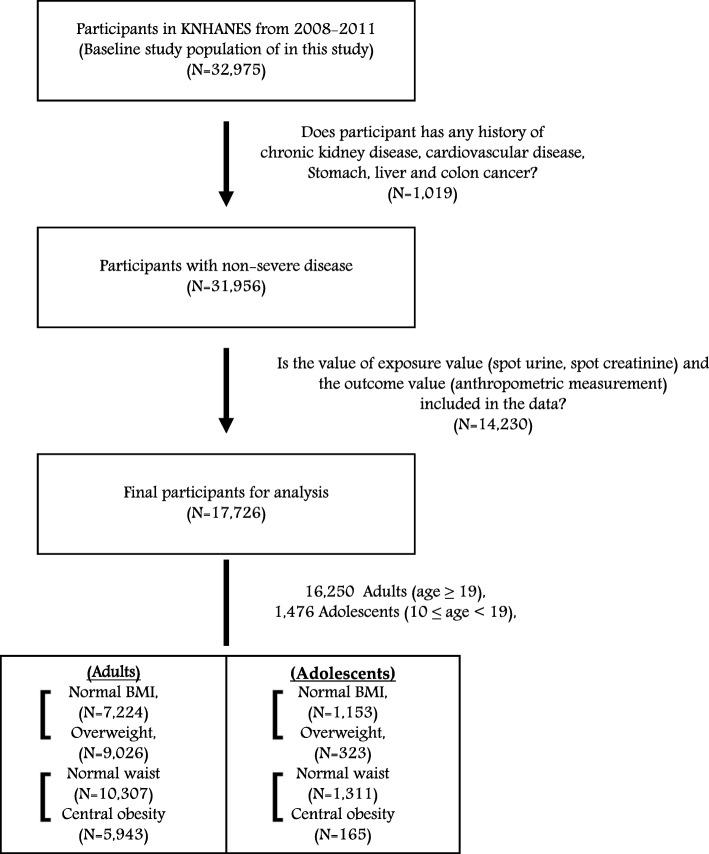
A total of 16,250 adults (aged ≥19 years) and 1476 adolescents (aged 10-18 years), with available information on spot urine sodium levels and anthropometric measurements from the Korea National Health and Nutrition Examination Survey (KNHANES) were included in this study. We calculated 24-h urine sodium excretion levels from spot urine sodium levels using the Tanaka formula.
RESULTS
In adults, those with high sodium excretion levels (≥ 3200 mg) showed increased odds of overweight and central obesity compared to those with low urinary sodium excretion level (< 2200 mg) (odds ratio [OR] = 2.17, 95% confidence interval [CI] = 1.90-2.49 for overweight; OR = 2.50, 95% CI = 2.13-2.94 for central obesity). These associations were also observed in adolescents (OR = 5.80, 95% CI = 3.17-10.60 for overweight; OR = 4.19, 95% CI = 1.78-9.89 for central obesity).
CONCLUSIONS
The present study suggests that reducing salt intake might be important for preventing overweight and central obesity, especially in adolescents. However, because the present study was conducted with cross-sectional study design, further longitudinal studies are warranted to confirm the causal relationship between urinary sodium excretion and overweight/central obesity.
背景
既往研究报告了膳食钠摄入量与超重/中心性肥胖之间的关联。然而,膳食调查方法容易低估钠摄入量。因此,本研究在钠摄入量相对较高的人群中,调查了膳食钠摄入量指标——计算得出的24小时尿钠排泄量与包括体重指数(BMI)和腰围(WC)在内的各种肥胖参数之间的关联。
方法
本研究纳入了韩国国家健康与营养检查调查(KNHANES)中16250名成年人(年龄≥19岁)和1476名青少年(年龄10 - 18岁),这些人有即时尿钠水平和人体测量数据的可用信息。我们使用田中公式从即时尿钠水平计算24小时尿钠排泄量。
结果
在成年人中,与低尿钠排泄水平(<2200毫克)者相比,高钠排泄水平(≥3200毫克)者超重和中心性肥胖的几率增加(超重的优势比[OR]=2.17,95%置信区间[CI]=1.90 - 2.49;中心性肥胖的OR = 2.50,95% CI = 2.13 - 2.94)。在青少年中也观察到了这些关联(超重的OR = 5.80,95% CI = 3.17 - 10.60;中心性肥胖的OR = 4.19,95% CI = 1.78 - 9.89)。
结论
本研究表明,减少盐摄入量可能对预防超重和中心性肥胖很重要,尤其是在青少年中。然而,由于本研究采用横断面研究设计,需要进一步进行纵向研究以确认尿钠排泄与超重/中心性肥胖之间的因果关系。

 Zotero 插件