
血清循环无细胞肿瘤 DNA 突变作为高级别浆液性卵巢癌的纵向生物标志物。
Mutations in Serum Circulating Cell-Free Tumor DNA As Longitudinal Biomarker for High-Grade Serous Ovarian Cancer.
机构信息
Department of Medical Oncology, Erasmus MC Cancer Institute, Erasmus University Medical Center, 3015 CN Rotterdam, The Netherlands.
Department of Clinical and Experimental Medicine, University of Catania, 95123 Catania, Italy.
出版信息
Biomolecules. 2020 Mar 7;10(3):415. doi: 10.3390/biom10030415.
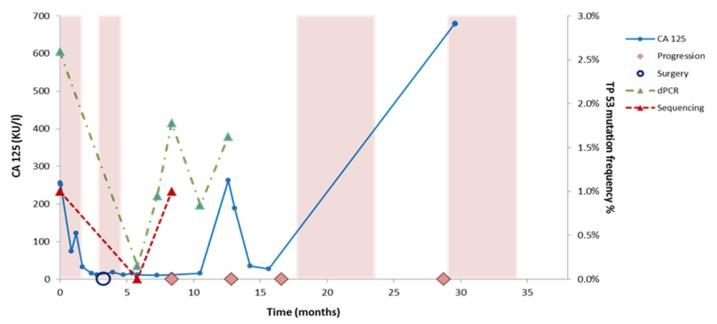
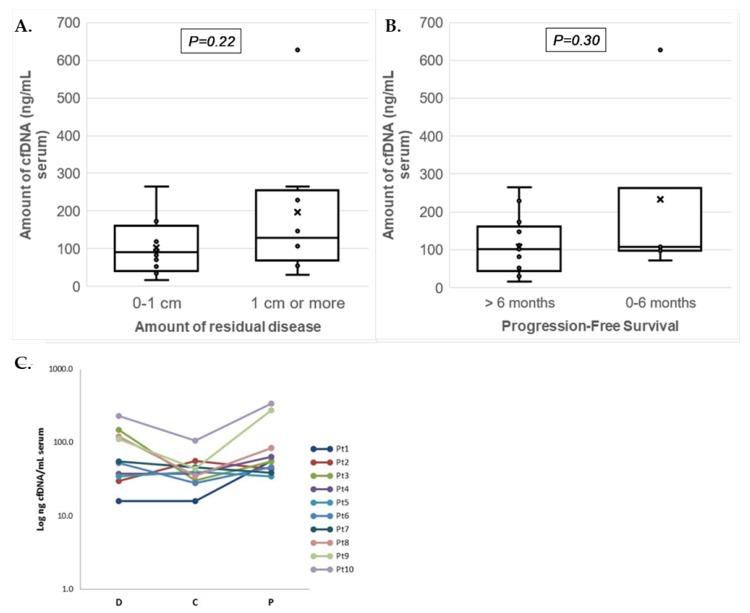
The aim of this study was to determine an optimal workflow to detect mutations in baseline and longitudinal serum cell free DNA (cfDNA) from high-grade serous ovarian carcinomas (HGSOC) patients and to define whether mutations are suitable as biomarker for disease. was investigated in tissue and archived serum from 20 HGSOC patients by a next-generation sequencing (NGS) workflow alone or combined with digital PCR (dPCR). AmpliSeq™-focused NGS panels and customized dPCR assays were used for tissue DNA and longitudinal cfDNAs, and Oncomine NGS panel with molecular barcoding was used for baseline cfDNAs. missense mutations were observed in 17 tissue specimens and in baseline cfDNA for 4/8 patients by AmpliSeq, 6/9 patients by Oncomine, and 4/6 patients by dPCR. Mutations in cfDNA were detected in 4/6 patients with residual disease and 3/4 patients with disease progression within six months, compared to 5/11 patients with no residual disease and 6/13 patients with progression after six months. Finally, mutations were detected at progression in 5/6 patients, but not during chemotherapy. NGS with molecular barcoding and dPCR were most optimal workflows to detect TP53 mutations in baseline and longitudinal serum cfDNA, respectively. mutations were undetectable in cfDNA during treatment but re-appeared at disease progression, illustrating its promise as a biomarker for disease monitoring.
本研究旨在确定一种最佳的工作流程,以检测高级别浆液性卵巢癌(HGSOC)患者基线和纵向血清游离 DNA(cfDNA)中的突变,并确定这些突变是否适合作为疾病的生物标志物。通过单独的下一代测序(NGS)工作流程或与数字 PCR(dPCR)联合,在 20 名 HGSOC 患者的组织和存档血清中对进行了研究。AmpliSeq™-聚焦 NGS 面板和定制的 dPCR 检测用于组织 DNA 和纵向 cfDNA,而 Oncomine NGS 面板与分子条形码用于基线 cfDNA。AmpliSeq 观察到 17 个组织标本和 4/8 名患者的基线 cfDNA 中存在错义突变,Oncomine 检测到 6/9 名患者,dPCR 检测到 4/6 名患者。与 6/13 名在六个月后有进展的患者相比,在有残留疾病的 4/6 名患者和在六个月内有疾病进展的 3/4 名患者中检测到 cfDNA 中的突变。最后,在 5/6 名进展的患者中检测到突变,但在化疗期间没有检测到。具有分子条形码的 NGS 和 dPCR 分别是检测基线和纵向血清 cfDNA 中 TP53 突变的最佳工作流程。在治疗期间,cfDNA 中无法检测到突变,但在疾病进展时再次出现,这表明其作为疾病监测生物标志物具有很大的潜力。
 Zotero 插件