
谷氨酰胺酶-1(GLS1)抑制作用可限制骨肉瘤的转移进展。
Glutaminase-1 (GLS1) inhibition limits metastatic progression in osteosarcoma.
作者信息
Ren L, Ruiz-Rodado V, Dowdy T, Huang S, Issaq S H, Beck J, Wang H, Tran Hoang C, Lita A, Larion M, LeBlanc A K
机构信息
1Comparative Oncology Program, Center for Cancer Research, National Cancer Institute, National Institutes of Health, Bethesda, MD 20892 USA.
2Metabolomics Section, NeuroOncology Branch, Center for Cancer Research, National Cancer Institute, National Institutes of Health, Bethesda, MD 20892 USA.
出版信息
Cancer Metab. 2020 Mar 5;8:4. doi: 10.1186/s40170-020-0209-8. eCollection 2020.
BACKGROUND
Osteosarcoma (OS) is a malignant bone tumor that often develops during the period of rapid growth associated with adolescence. Despite successful primary tumor control accompanied by adjuvant chemotherapy, death from pulmonary metastases occurs in approximately 30% of patients within 5 years. As overall survival in patients remains unchanged over the last 30 years, urgent needs for novel therapeutic strategies exist. Cancer metastasis is characterized by complex molecular events which result from alterations in gene and protein expression/function. Recent studies suggest that metabolic adaptations, or "metabolic reprogramming," may similarly contribute to cancer metastasis. The goal of this study was to specifically interrogate the metabolic vulnerabilities of highly metastatic OS cell lines in a series of in vitro and in vivo experiments, in order to identify a tractable metabolically targeted therapeutic strategy for patients.
METHODS
Nutrient deprivation and drug treatment experiments were performed in MG63.3, 143B, and K7M2 OS cell lines to identify the impact of glutaminase-1 (GLS1) inhibition and metformin treatment on cell proliferation. We functionally validated the impact of drug treatment with extracellular flux analysis, nuclear magnetic resonance (NMR) spectroscopy, and mass spectrometry. C-glucose and C-glutamine tracing was employed to identify specific contributions of these nutrients to the global metabolic profiles generated with GLS1 inhibition and metformin treatment in vivo.
RESULTS
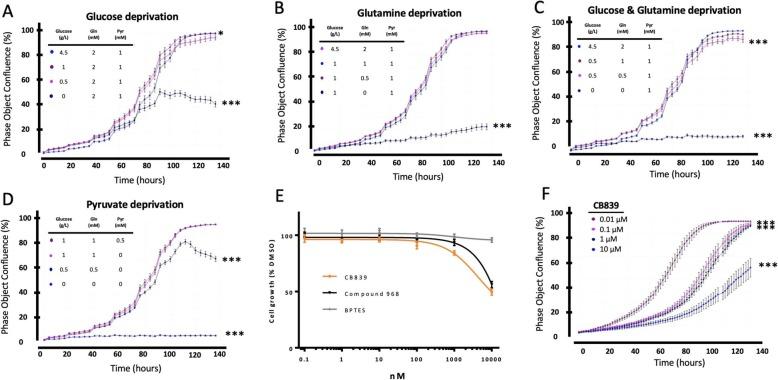
Highly metastatic OS cell lines require glutamine for proliferation, and exposure to CB-839, in combination with metformin, induces both primary tumor growth inhibition and a distinct reduction in metastatic outgrowth in vivo. Further, combination-treated OS cells showed a reduction in cellular mitochondrial respiration, while NMR confirmed the pharmacodynamic effects of glutaminase inhibition in tumor tissues. We observed global decreases in glycolysis and tricarboxylic acid (TCA) cycle functionality, alongside an increase in fatty acid oxidation and pyrimidine catabolism.
CONCLUSIONS
This data suggests combination-treated cells cannot compensate for metformin-induced electron transport chain inhibition by upregulating glutaminolysis to generate TCA cycle intermediates required for cell proliferation, translating into significant reductions in tumor growth and metastatic progression. This therapeutic approach could be considered for future clinical development for OS patients presenting with or at high risk of developing metastasis.
背景
骨肉瘤(OS)是一种恶性骨肿瘤,常发生于与青春期相关的快速生长时期。尽管辅助化疗成功控制了原发肿瘤,但约30%的患者会在5年内因肺转移而死亡。由于患者的总体生存率在过去30年中没有变化,因此迫切需要新的治疗策略。癌症转移的特征是复杂的分子事件,这些事件是由基因和蛋白质表达/功能的改变引起的。最近的研究表明,代谢适应或“代谢重编程”可能同样有助于癌症转移。本研究的目的是在一系列体外和体内实验中专门探究高转移性OS细胞系的代谢脆弱性,以便为患者确定一种易于处理的代谢靶向治疗策略。
方法
在MG63.3、143B和K7M2 OS细胞系中进行营养剥夺和药物治疗实验,以确定谷氨酰胺酶-1(GLS1)抑制和二甲双胍治疗对细胞增殖的影响。我们通过细胞外通量分析、核磁共振(NMR)光谱和质谱对药物治疗的影响进行了功能验证。采用¹³C-葡萄糖和¹³C-谷氨酰胺示踪来确定这些营养素对体内GLS1抑制和二甲双胍治疗产生的整体代谢谱的具体贡献。
结果
高转移性OS细胞系的增殖需要谷氨酰胺,联合使用CB-839和二甲双胍可抑制体内原发肿瘤生长,并显著减少转移灶的生长。此外,联合治疗的OS细胞的细胞线粒体呼吸减少,而NMR证实了肿瘤组织中谷氨酰胺酶抑制的药效学作用。我们观察到糖酵解和三羧酸(TCA)循环功能整体下降,同时脂肪酸氧化和嘧啶分解代谢增加。
结论
该数据表明,联合治疗的细胞无法通过上调谷氨酰胺分解来生成细胞增殖所需的TCA循环中间体,以补偿二甲双胍诱导的电子传递链抑制,从而导致肿瘤生长和转移进展显著减少。对于出现转移或有转移高风险的OS患者,这种治疗方法可考虑用于未来的临床开发。



 Zotero 插件