
玛咖根(Maerua subcordata(Gilg)DeWolf)诱导过氧化物酶体增殖物激活受体 γ(PPARγ)介导的基因表达和抑制诱导型一氧化氮产生。
Induction of peroxisome proliferator activated receptor γ (PPARγ) mediated gene expression and inhibition of induced nitric oxide production by Maerua subcordata (Gilg) DeWolf.
机构信息
Division of Toxicology, Wageningen University & Research, Stippeneng 4, 6708, WE, Wageningen, The Netherlands.
Department of Pharmacognosy, School of Pharmacy, College of Health Sciences, Mekelle University, 231, Mekelle, Ethiopia.
出版信息
BMC Complement Med Ther. 2020 Mar 12;20(1):80. doi: 10.1186/s12906-020-2856-2.
BACKGROUND
The health benefits of botanicals is linked to their phytochemicals that often exert pleiotropic effects via targeting multiple molecular signaling pathways such as the peroxisome proliferator-activated receptors (PPARs) and the nuclear factor kappaB (NFκB). The PPARs are transcription factors that control metabolic homeostasis and inflammation while the NF-κB is a master regulator of inflammatory genes such as the inducible nitric-oxide synthase that result in nitric oxide (NO) overproduction.
METHODS
Extracts of Maerua subcordata (MS) and selected candidate constituents thereof, identified by liquid chromatography coupled to mass spectroscopy, were tested for their ability to induce PPARγ mediated gene expression in U2OS-PPARγ cells using luciferase reporter gene assay and also for their ability to inhibit lipopolysaccharide (LPS) induced NO production in RAW264.7 macrophages. While measuring the effect of test samples on PPARγ mediated gene expression, a counter assay that used U2OS-Cytotox cells was performed to monitor cytotoxicity or any non-specific changes in luciferase activity.
RESULTS
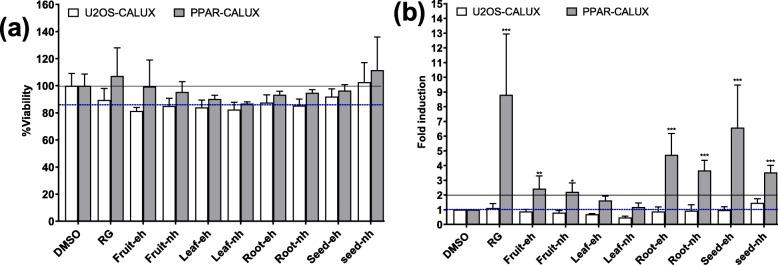
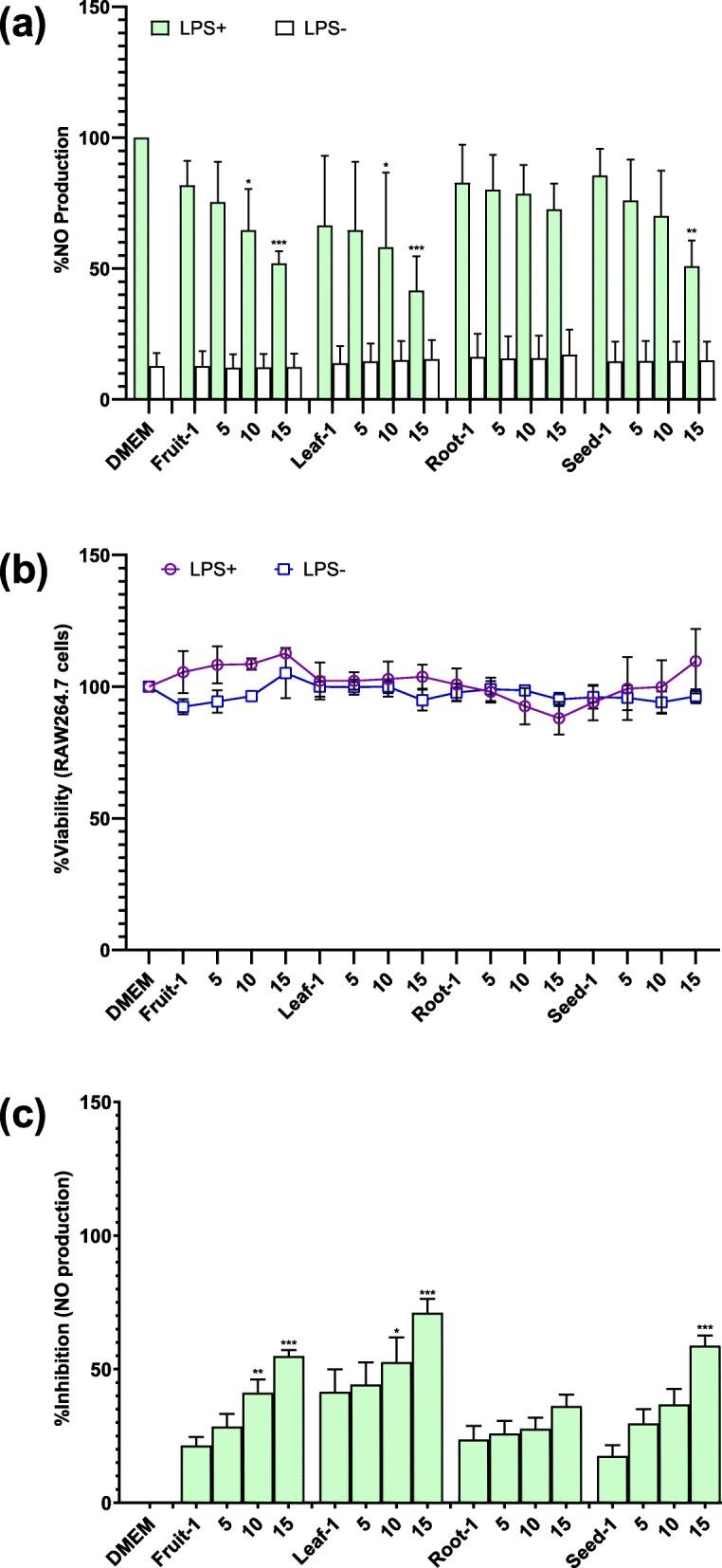
The results revealed that the fruit, root, and seed extracts were non-cytotoxic up to a concentration of 30 g dry weight per litre (gDW/L) and induced PPARγ mediated gene expression but the leaf extract showed some cytotoxicity and exhibited minimal induction. Instead, all extracts showed concentration (1-15 gDW/L) dependent inhibition of LPS induced NO production. The root extract showed weaker inhibition. Among the candidate constituents, agmatine, stachydrine, trigonelline, indole-3-carboxyaldehyde, plus ethyl-, isobutyl-, isopropyl, and methyl-isothiocyanates showed similar inhibition, and most showed increased inhibition with increasing concentration (1-100 μM) although to a lesser potency than the positive control, aminoguanidine.
CONCLUSION
The present study demonstrated for the first time the induction of PPARγ mediated gene expression by MS fruit, root, and seed extracts and the inhibition of LPS induced NO production by MS fruit, leaf, root, and seed extracts and some candidate constituents thereof.
背景
植物药的健康益处与其植物化学物质有关,这些物质通常通过靶向多种分子信号通路,如过氧化物酶体增殖物激活受体(PPARs)和核因子 kappaB(NFκB),发挥多效性作用。PPARs 是转录因子,可控制代谢稳态和炎症,而 NF-κB 是诱导型一氧化氮合酶等炎症基因的主要调节剂,导致一氧化氮(NO)过度产生。
方法
使用 luciferase 报告基因检测,通过液相色谱与质谱联用鉴定出的 Maerua subcordata(MS)提取物及其选定的候选成分,检测其在 U2OS-PPARγ 细胞中诱导 PPARγ 介导基因表达的能力,并检测其抑制脂多糖(LPS)诱导 RAW264.7 巨噬细胞中 NO 产生的能力。在测量测试样品对 PPARγ 介导基因表达的影响时,进行了对照实验,使用 U2OS-Cytotox 细胞监测细胞毒性或 luciferase 活性的任何非特异性变化。
结果
结果表明,果实、根和种子提取物在浓度高达 30g 干重/升(gDW/L)时无细胞毒性,并诱导 PPARγ 介导的基因表达,但叶提取物显示出一些细胞毒性,诱导作用最小。相反,所有提取物均表现出浓度(1-15gDW/L)依赖性抑制 LPS 诱导的 NO 产生。根提取物的抑制作用较弱。在候选成分中,胍丁胺、水苏碱、三羚碱、吲哚-3-羧醛,加上乙基、异丁基、异丙基和甲基异硫氰酸盐表现出相似的抑制作用,并且大多数随着浓度(1-100μM)的增加而显示出更强的抑制作用,尽管其效力低于阳性对照物氨基胍。
结论
本研究首次证明了 MS 果实、根和种子提取物对 PPARγ 介导基因表达的诱导作用,以及 MS 果实、叶、根和种子提取物及其某些候选成分对 LPS 诱导的 NO 产生的抑制作用。


 Zotero 插件