
泰国结直肠癌患者的饮食模式与疾病复发之间的关联。
Association between dietary patterns and disease recurrence in Thai colorectal cancer patients.
作者信息
Kunnavuttivanich Vorraaud, Pramyothin Pornpoj, Ithimakin Suthinee
机构信息
Division of Medical Oncology.
Division of Nutrition, Department of Medicine, Faculty of Medicine Siriraj Hospital, Mahidol University, Bangkok, Thailand.
出版信息
Medicine (Baltimore). 2020 Mar;99(11):e19522. doi: 10.1097/MD.0000000000019522.
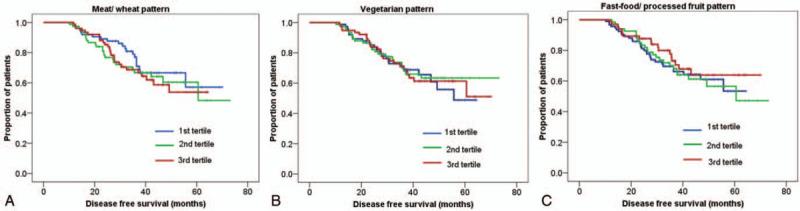
Beside established anti-cancer treatment, dietary modification is one of the most promising approaches for reducing the probability of colorectal cancer (CRC) recurrence. Many Western studies showed a relationship between shortened survival and increased amounts of Western diet (meat and processed meat). Given that Thai food is dissimilar to Western diet, we aimed to explore the association between dietary patterns and disease recurrence among Thai CRC patients.Early-stage CRC patients who were disease-free at the end of a 2-year period or patients with disease recurrence within 2 years were enrolled. Patients were administered a food frequency questionnaire to evaluate their dietary lifestyle. Quantitative comparison within individual food groups among patients who were disease-free and among those with recurrence was performed. Proportion of patients with recurrence and disease-free survival was compared between patients who had consumed the lowest and highest tertile of each dietary pattern.A total of 225 CRC patients were enrolled (151 disease-free and 74 recurrence). There were no significant differences in demographic or tumor parameters between patients with or without disease recurrence. From the questionnaire, 45 food items were assigned to 1 of 12 food groups according to similarity in nutritional profile. Patients who consumed high amounts of pickled fish or chili-paste had significantly lower recurrence rates compared to patients who had never eaten those foods (P < .01). From the factor analysis, meat/wheat, vegetarian, and fast-food/processed fruit patterns were identified as the major dietary patterns. There was no significant association between intakes of individual dietary patterns and CRC recurrence.Among CRC patients with Thai dietary lifestyles there was no association between meat/wheat, fast-food/processed fruit, or vegetarian dietary patterns and CRC recurrence. Greater consumption of some unique Thai foods, such as chili-paste or pickled fish, may relate to better outcomes for CRC patients.
除了既定的抗癌治疗外,饮食调整是降低结直肠癌(CRC)复发概率最有前景的方法之一。许多西方研究表明,西式饮食(肉类和加工肉类)摄入量增加与生存期缩短之间存在关联。鉴于泰国食物与西式饮食不同,我们旨在探讨泰国CRC患者的饮食模式与疾病复发之间的关联。
纳入在2年期末无疾病的早期CRC患者或2年内疾病复发的患者。对患者进行食物频率问卷调查以评估其饮食生活方式。对无疾病患者和复发患者的各个食物组进行定量比较。比较每种饮食模式摄入量处于最低和最高三分位数的患者之间的复发患者比例和无病生存期。
共纳入225例CRC患者(151例无疾病,74例复发)。有无疾病复发的患者在人口统计学或肿瘤参数方面无显著差异。根据营养成分相似性,从问卷中将45种食物分配到12个食物组中的1个。与从未食用过腌制鱼或辣椒酱的患者相比,食用大量腌制鱼或辣椒酱的患者复发率显著更低(P<0.01)。通过因子分析,确定肉类/小麦、素食和快餐/加工水果模式为主要饮食模式。个体饮食模式的摄入量与CRC复发之间无显著关联。
在具有泰国饮食生活方式的CRC患者中,肉类/小麦、快餐/加工水果或素食饮食模式与CRC复发之间无关联。食用一些独特的泰国食物,如辣椒酱或腌制鱼,可能与CRC患者更好的预后相关。
 Zotero 插件