
影响产后早期护理参与的因素:对 2016 年乌干达人口与健康调查的分析。
Determinants of early postnatal care attendance: analysis of the 2016 Uganda demographic and health survey.
机构信息
Department of Population Studies, School of Statistics and Planning, Makerere University, Kampala, Uganda.
Uganda Bureau of Statistics, Kampala, Uganda.
出版信息
BMC Pregnancy Childbirth. 2020 Mar 16;20(1):163. doi: 10.1186/s12884-020-02866-3.
BACKGROUND
The first 2 days after childbirth present the highest risk of dying for a mother. Providing postnatal care within the first 2 days after childbirth can help avert maternal mortality because it allows early detection of problems that could result in adverse maternal health outcomes. Unfortunately, knowledge of the uptake of early postnatal care (EPNC), which is imperative for informing policies aimed at reducing maternal mortality, remains low in Uganda. Therefore, the purpose of this study is to investigate the determinants of early postnatal care attendance among Ugandan women.
METHODS
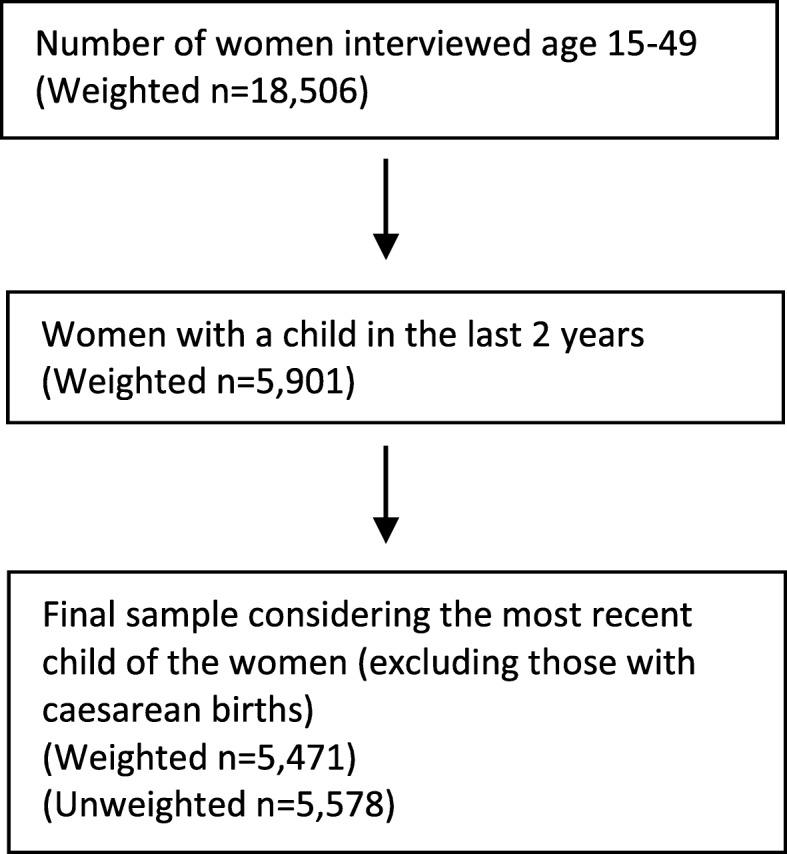
This study was based on nationally representative data from the 2016 Uganda Demographic and Health Survey. The study sample comprised 5471 women (age 15-49) who delivered a child in the 2 years preceding the survey. We used logistic regression to identify factors associated with use of early postnatal care.
RESULTS
Our findings showed that 50% of mothers used EPNC services for their most recent delivery in the 2 years preceding the survey. Women's residence, education level, religion, wealth status, marital status, occupation, antenatal care attendance, place of delivery, birth order, perceived accessibility of health facilities, and access to mass media messages were associated with greater use of EPNC. The percentage of women receiving EPNC was much higher among women who delivered at a health facility, either a public facility (63%) or private facility (65%), versus only 9% among women who delivered at home. Multivariate analysis showed that delivery at a health facility was the most important determinant of early postnatal care attendance.
CONCLUSIONS
To increase mothers' use of EPNC services and improve maternal survival in Uganda, programs could promote and strengthen health facility delivery and ensure that EPNC services are provided to all women before discharge. Even so, the fact that only about two-thirds of women who delivered at a health facility received early postpartum care shows substantial room for improvement. Interventions should target women who deliver at home, women who attend fewer than four antenatal care visits, and women with a primary education.
背景
产妇分娩后头 2 天的死亡风险最高。在分娩后头 2 天提供产后护理有助于避免产妇死亡,因为这可以及早发现可能导致产妇健康状况恶化的问题。不幸的是,乌干达对早期产后护理(EPNC)的知晓率很低,而这对于制定旨在降低产妇死亡率的政策至关重要。因此,本研究旨在调查乌干达妇女接受早期产后护理的决定因素。
方法
本研究基于 2016 年乌干达人口与健康调查的全国代表性数据。研究样本包括在调查前 2 年内分娩的 5471 名(年龄在 15-49 岁之间)妇女。我们使用逻辑回归来确定与使用早期产后护理相关的因素。
结果
我们的研究结果显示,在调查前 2 年内,50%的母亲最近一次分娩时使用了 EPNC 服务。妇女的居住地、教育水平、宗教信仰、财富状况、婚姻状况、职业、产前护理、分娩地点、出生顺序、对卫生设施的可及性的认知以及对大众媒体信息的获取均与 EPNC 的使用相关。在卫生机构分娩的妇女中,EPNC 的使用率要高得多,无论是在公立机构(63%)还是私立机构(65%),而在家中分娩的妇女中,只有 9%接受了 EPNC。多变量分析表明,在卫生机构分娩是接受早期产后护理的最重要决定因素。
结论
为了提高乌干达母亲对 EPNC 服务的使用率并改善产妇的生存状况,计划可以促进和加强医疗机构分娩,并确保所有妇女在出院前都能获得 EPNC 服务。即便如此,只有大约三分之二在卫生机构分娩的妇女接受了早期产后护理,这表明仍有很大的改进空间。干预措施应针对在家中分娩的妇女、接受不到四次产前护理的妇女和接受小学教育的妇女。


 Zotero 插件