
5 个南亚国家按社会经济地位划分的 24 至 59 月龄儿童营养不良的双重负担:来自人口与健康调查的证据。
Double burden of malnutrition in children aged 24 to 59 months by socioeconomic status in five South Asian countries: evidence from demographic and health surveys.
机构信息
Independent Researcher, Dhaka, Bangladesh
Nuffield Department of Population Health, Oxford University, Oxford, Oxfordshire, UK.
出版信息
BMJ Open. 2020 Mar 16;10(3):e032866. doi: 10.1136/bmjopen-2019-032866.
OBJECTIVES
We aimed to investigate the socioeconomic inequalities in the burden of underweight and overweight among children in South Asia. We also examined other factors that were associated with these outcomes independently of household's socioeconomic status.
DESIGN
Nationally-representative surveys.
SETTINGS
Demographic and Health Surveys from Bangladesh, India, Pakistan, Maldives and Nepal, which were conducted between 2009 and 2016.
PARTICIPANTS
Children aged 24 to 59 months with valid measurement for height and weight (n=146 996).
PRIMARY EXPOSURE AND OUTCOME MEASURES
Primary exposures were household's wealth index and level of education. Underweight and overweight were defined according to the WHO and International Obesity Task Force definitions, respectively.
RESULTS
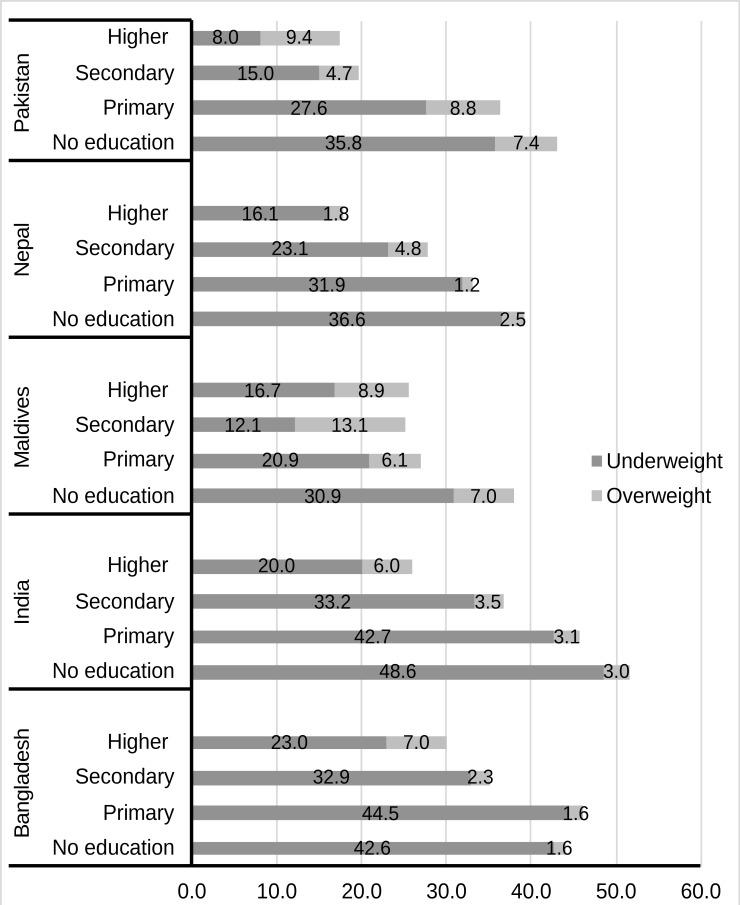
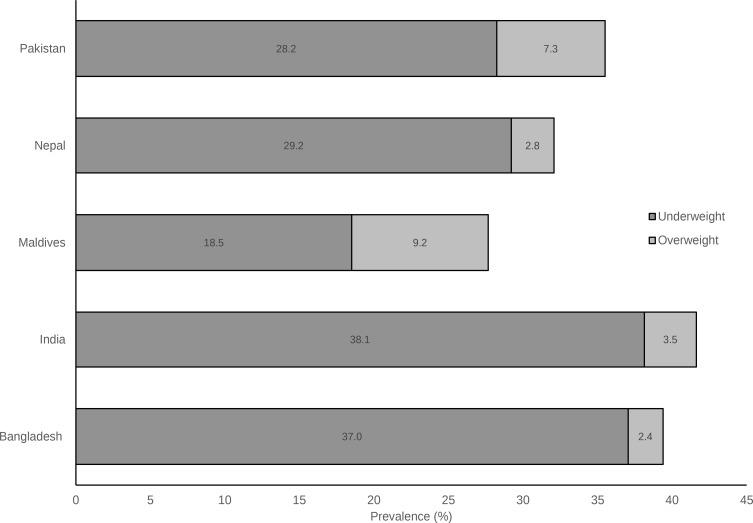
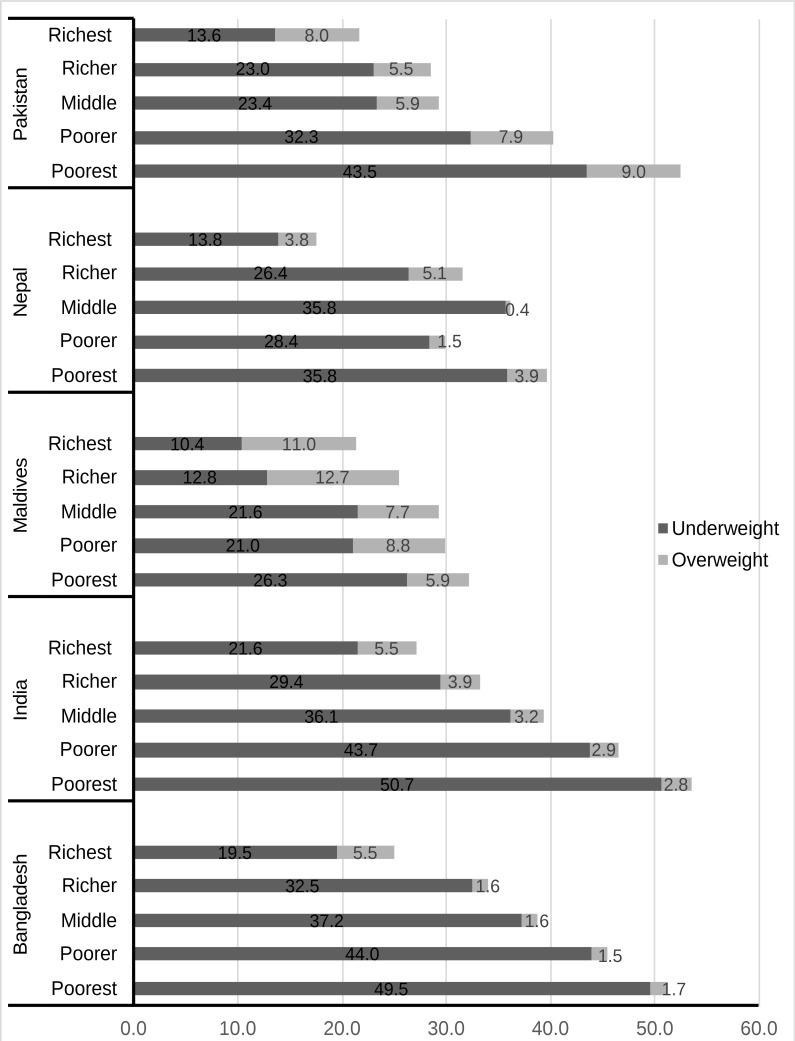
Underweight prevalence was 37% in Bangladesh, 38% in India, 19% in Maldives, 29% in Nepal and 28% in Pakistan. Bangladesh, India and Nepal had similar overweight prevalence (between 2% and 4%) whereas Pakistan (7%) and Maldives (9%) had higher prevalence. Households with higher wealth index or education had lower odds of having underweight children. Adjusted ORs of underweight for richest versus poorest households were 0.4 (95% CI: 0.3 to 0.5), 0.5 (95% CI: 0.5 to 0.6), 0.5 (95% CI: 0.2 to 1.4), 0.5 (95% CI: 0.3 to 0.8) and 0.7 (95% CI: 0.5 to 1.1) for Bangladesh, India, Maldives, Nepal and Pakistan, respectively. Compared with poorest households, richest households were more likely to have overweight children in all countries except Pakistan, but such associations were not significant after adjustment for other factors. There were higher odds of having overweight children in households with higher education in Bangladesh (OR 2.1 (95% CI: 1.3 to 3.5)), India (OR 1.2 (95% CI: 1.2 to 1.3)) and Pakistan (OR 1.8 (95% CI: 1.1 to 2.9)) when compared with households with no education. Maternal nutritional status was consistently associated with children's nutritional outcomes after adjustments for socioeconomic status.
CONCLUSIONS
Our study provides evidence for socioeconomic inequalities for childhood underweight and overweight in South Asian countries, although the directions of associations for underweight and overweight might be different.
目的
本研究旨在调查南亚儿童体重不足和超重负担的社会经济不平等现象。我们还研究了其他与这些结果相关的因素,这些因素独立于家庭的社会经济地位。
设计
具有全国代表性的调查。
地点
孟加拉国、印度、巴基斯坦、马尔代夫和尼泊尔在 2009 年至 2016 年期间进行的人口与健康调查。
参与者
24 至 59 个月龄、身高和体重测量值有效的儿童(n=146996)。
主要暴露和结局指标
主要暴露因素是家庭的财富指数和教育水平。体重不足和超重分别按照世卫组织和国际肥胖问题工作组的定义进行定义。
结果
孟加拉国、印度和尼泊尔的体重不足患病率相似(37%至 38%),马尔代夫(19%)、尼泊尔(29%)和巴基斯坦(28%)的体重不足患病率较低。孟加拉国、印度和尼泊尔的超重患病率相似(2%至 4%),而巴基斯坦(7%)和马尔代夫(9%)的超重患病率较高。财富指数较高或受教育程度较高的家庭,其体重不足儿童的比例较低。最富有家庭与最贫穷家庭相比,体重不足的调整比值比(OR)分别为 0.4(95%可信区间:0.3 至 0.5)、0.5(95%可信区间:0.5 至 0.6)、0.5(95%可信区间:0.2 至 1.4)、0.5(95%可信区间:0.3 至 0.8)和 0.7(95%可信区间:0.5 至 1.1),孟加拉国、印度、马尔代夫、尼泊尔和巴基斯坦分别如此。除巴基斯坦外,与最贫穷家庭相比,最富有家庭的超重儿童比例在所有国家均较高,但在调整其他因素后,这种关联并不显著。与没有受过教育的家庭相比,孟加拉国(OR 2.1(95%可信区间:1.3 至 3.5))、印度(OR 1.2(95%可信区间:1.2 至 1.3))和巴基斯坦(OR 1.8(95%可信区间:1.1 至 2.9))的家庭中,儿童超重的可能性更高。在调整社会经济地位后,母亲的营养状况与儿童的营养状况始终相关。
结论
本研究提供了南亚国家儿童体重不足和超重的社会经济不平等证据,尽管体重不足和超重的关联方向可能不同。
 Zotero 插件