
IDO 靶向治疗肉瘤:生物学和临床意义。
IDO Targeting in Sarcoma: Biological and Clinical Implications.
机构信息
Explicyte Immuno-Oncology, Bordeaux, France.
Department of Medical Oncology, Institut Bergonié, Bordeaux, France.
出版信息
Front Immunol. 2020 Mar 5;11:274. doi: 10.3389/fimmu.2020.00274. eCollection 2020.
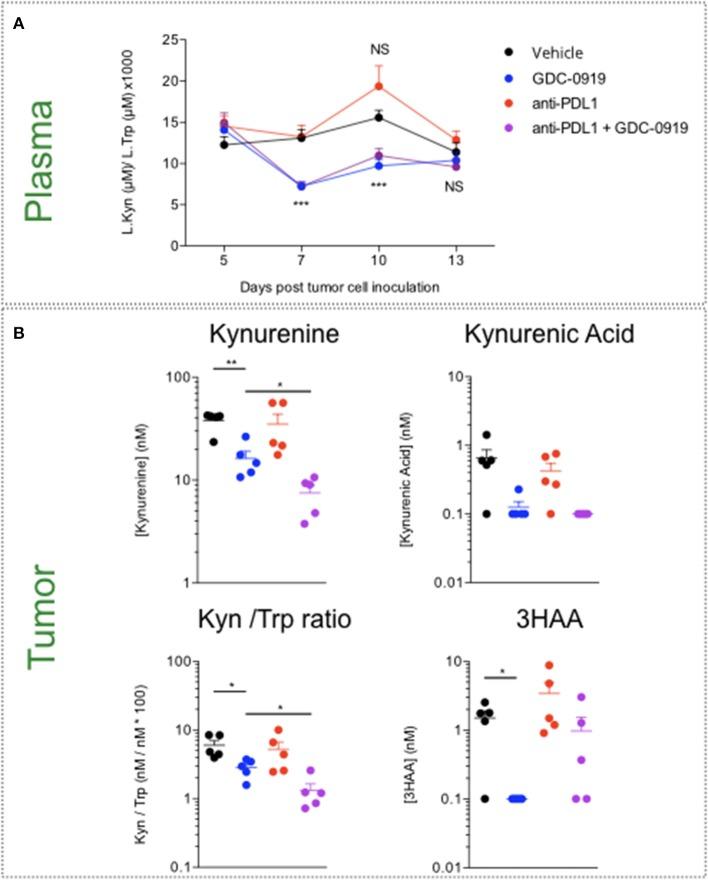
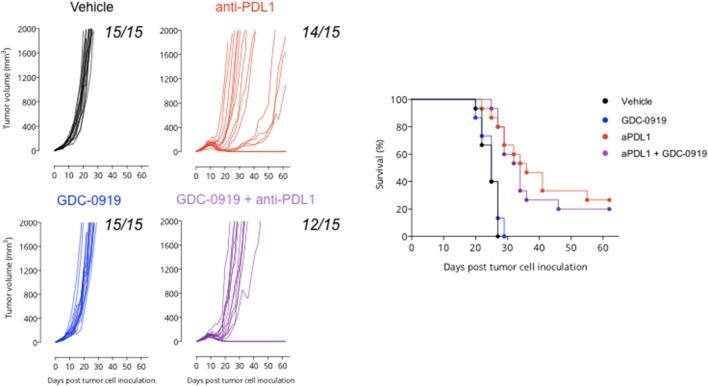
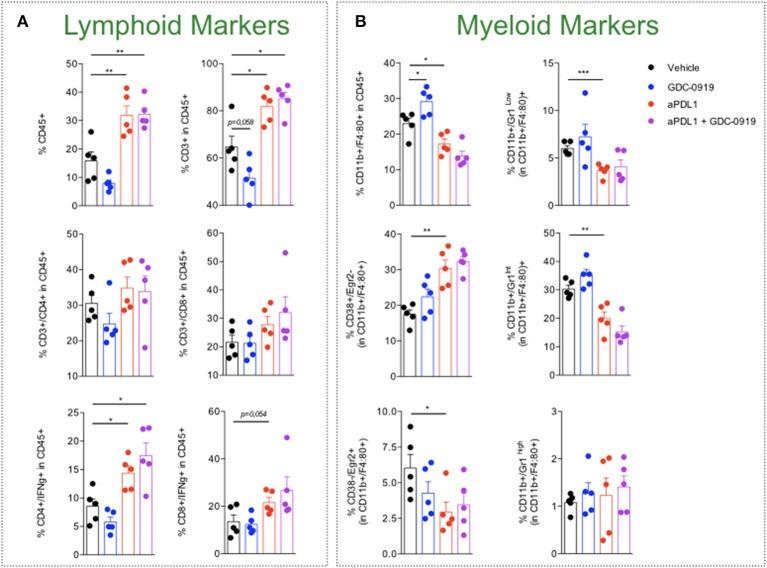
Sarcomas are heterogeneous malignant mesenchymal neoplasms with limited sensitivity to immunotherapy. We recently demonstrated an increase in Kynurenine Pathway (KP) activity in the plasma of sarcoma patients treated with pembrolizumab. While the KP has already been described to favor immune escape through the degradation of L-Tryptophan and production of metabolites including L-Kynurenine, Indoleamine 2,3 dioxygenase (IDO1), a first rate-limiting enzyme of the KP, still represents an attractive therapeutic target, and its blockade had not yet been investigated in sarcomas. Using immunohistochemistry, IDO1 and CD8, expression profiles were addressed within 203 cases of human sarcomas. At a preclinical level, we investigated the modulation of the KP upon PDL1 blockade in a syngeneic model of sarcoma through mRNA quantification of key KP enzymes within the tumor. Furthermore, in order to evaluate the possible anti-tumor effect of IDO blockade in combination with PDL1 blockade, an innovative IDO inhibitor (GDC-0919) was used. Its effect was first assessed on Kynurenine to Tryptophan ratio at plasmatic level and also within the tumor. Following GDC-0919 treatment, alone or in combination with anti-PDL1 antibody, tumor growth, immune cell infiltration, and gene expression profiling were measured. IDO1 expression was observed in 39.1% of human sarcoma cases and was significantly higher in tumors with high CD8 infiltration. In the pre-clinical setting, blockade of PDL1 led to a strong anti-tumor effect and was associated with an intratumoral inflammatory cytokines signature driven by Ifng but also with a modulation of the KP enzymes including Ido1 and Ido2. IDO1 inhibition using GDC-0919 resulted in (i) a significant decrease of plasmatic Kynurenine to Tryptophan ratio and in (ii) a decrease of tumoral Kynurenine. However, GDC-0919 used alone or combined with anti-PDL1, did not show anti-tumoral activity and did not affect the tumor immune cell infiltrate. In order to elucidate the mechanism(s) underlying the lack of effect of GDC-0919, we analyzed the gene expression profile of intratumoral biopsies. Interestingly, we have found that GDC-0919 induced a downregulation of the expression of pvr and granzymes, and an upregulation of inhba and Dtx4 suggesting a potential role of the IDO pathway in the control of NK function.
肉瘤是一种异质性恶性间叶肿瘤,对免疫治疗的敏感性有限。我们最近发现,接受派姆单抗治疗的肉瘤患者血浆中的犬尿氨酸途径 (KP) 活性增加。虽然 KP 已经被描述为通过降解 L-色氨酸和产生包括 L-犬尿氨酸在内的代谢产物来促进免疫逃逸,但吲哚胺 2,3 双加氧酶 (IDO1),KP 的限速酶之一,仍然是一个有吸引力的治疗靶点,其阻断作用尚未在肉瘤中得到研究。我们使用免疫组织化学方法,在 203 例人类肉瘤病例中分析了 IDO1 和 CD8 的表达谱。在临床前水平,我们通过肿瘤内 KP 关键酶的 mRNA 定量,研究了 PD-L1 阻断后 KP 的调节。此外,为了评估 IDO 阻断联合 PD-L1 阻断的可能抗肿瘤作用,我们使用了一种新型 IDO 抑制剂 (GDC-0919)。首先评估了 GDC-0919 对血浆中犬尿氨酸与色氨酸比值的影响,以及在肿瘤内的影响。单独使用 GDC-0919 或与抗 PD-L1 抗体联合使用后,测量肿瘤生长、免疫细胞浸润和基因表达谱。在 39.1%的人类肉瘤病例中观察到 IDO1 表达,在高 CD8 浸润的肿瘤中表达显著更高。在临床前环境中,PD-L1 阻断导致强烈的抗肿瘤作用,并与 Ifng 驱动的肿瘤内炎症细胞因子特征相关,还与 KP 酶包括 IDO1 和 IDO2 的调节相关。使用 GDC-0919 抑制 IDO1 导致 (i) 血浆犬尿氨酸与色氨酸比值显著降低,(ii) 肿瘤犬尿氨酸降低。然而,单独使用 GDC-0919 或与抗 PD-L1 联合使用,均没有抗肿瘤活性,也没有影响肿瘤免疫细胞浸润。为了阐明 GDC-0919 缺乏疗效的机制,我们分析了肿瘤内活检的基因表达谱。有趣的是,我们发现 GDC-0919 诱导 pvr 和 granzymes 的表达下调,inhba 和 Dtx4 的表达上调,这表明 IDO 途径在控制 NK 功能方面可能发挥作用。


 Zotero 插件