
增强的纯化结合生物物理分析表明,交叉-β结构是变形链球菌功能淀粉样蛋白的核心结构模块。
Enhanced purification coupled with biophysical analyses shows cross-β structure as a core building block for Streptococcus mutans functional amyloids.
机构信息
Department of Oral Biology, University of Florida, Gainesville, Florida, USA.
Department of Physics, University of Florida, Gainesville, Florida, USA.
出版信息
Sci Rep. 2020 Mar 20;10(1):5138. doi: 10.1038/s41598-020-62115-7.
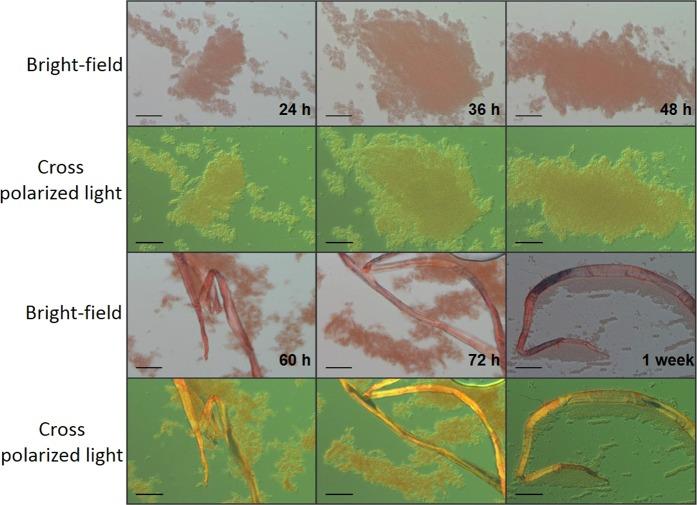
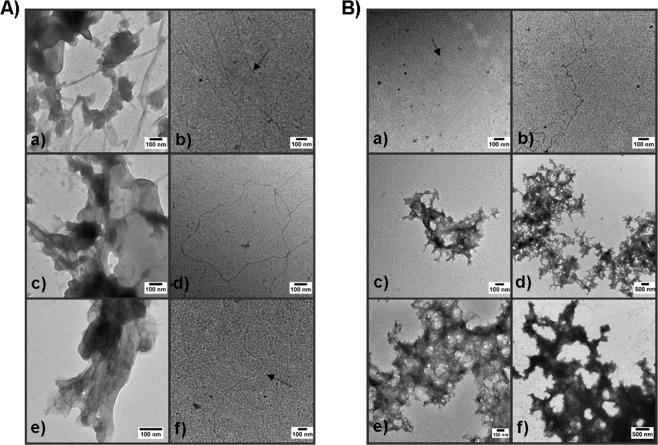
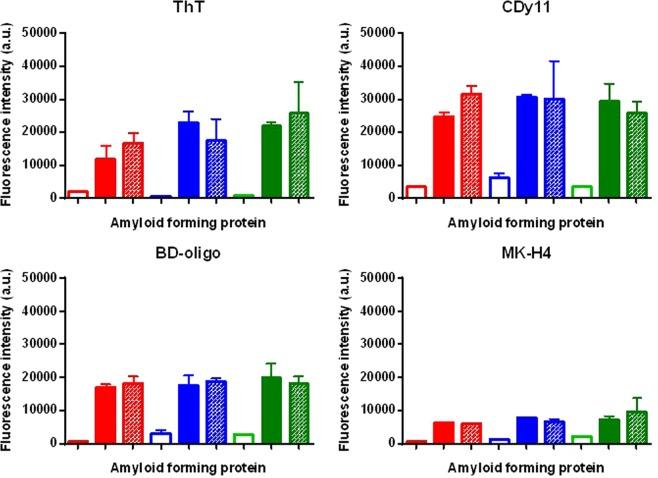
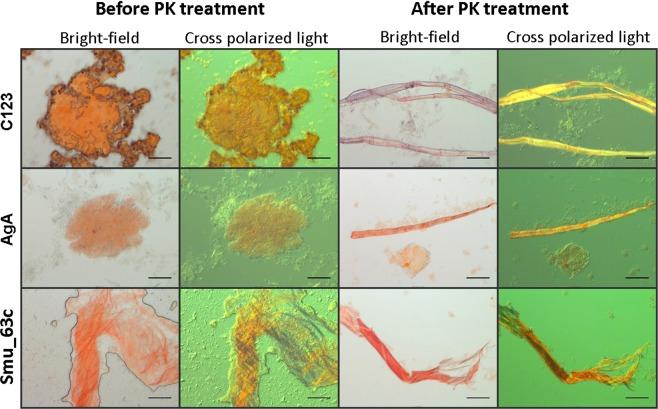
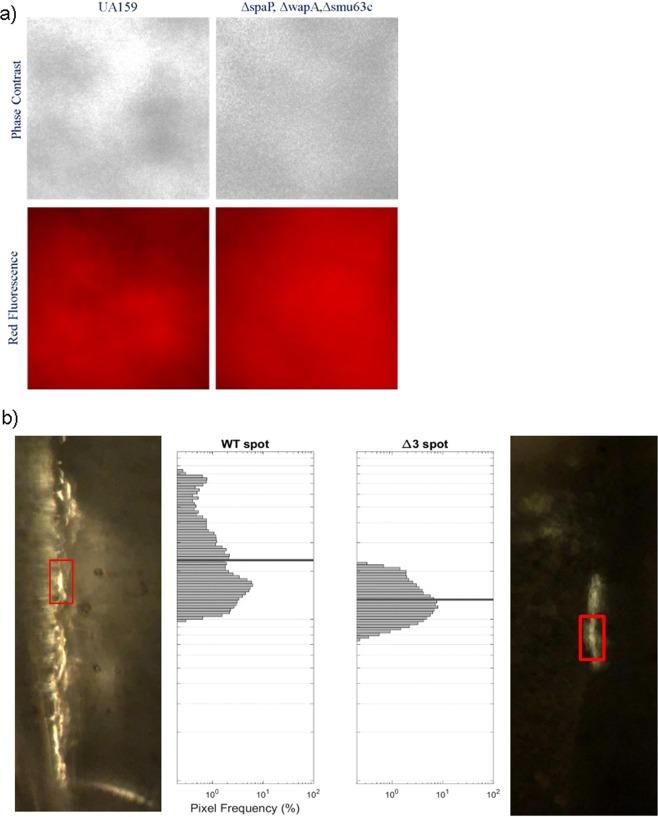
Streptococcus mutans is an etiologic agent of human dental caries that forms dental plaque biofilms containing functional amyloids. Three amyloidogenic proteins, P1, WapA, and Smu_63c were previously identified. C123 and AgA are naturally occurring amyloid-forming fragments of P1 and WapA, respectively. We determined that four amyloidophilic dyes, ThT, CDy11, BD-oligo, and MK-H4, differentiate C123, AgA, and Smu_63c amyloid from monomers, but non-specific binding to bacterial cells in the absence of amyloid precludes their utility for identifying amyloid in biofilms. Congo red-induced birefringence is a more specific indicator of amyloid formation and differentiates biofilms formed by wild-type S. mutans from a triple ΔP1/WapA/Smu_63c mutant with reduced biofilm forming capabilities. Amyloid accumulation is a late event, appearing in older S. mutans biofilms after 60 hours of growth. Amyloid derived from pure preparations of all three proteins is visualized by electron microscopy as mat-like structures. Typical amyloid fibers become evident following protease digestion to eliminate non-specific aggregates and monomers. Amyloid mats, similar in appearance to those reported in S. mutans biofilm extracellular matrices, are reconstituted by co-incubation of monomers and amyloid fibers. X-ray fiber diffraction of amyloid mats and fibers from all three proteins demonstrate patterns reflective of a cross-β amyloid structure.
变形链球菌是人类龋齿的病原体,它形成含有功能淀粉样蛋白的牙菌斑生物膜。先前已经鉴定出三种淀粉样蛋白原性蛋白,即 P1、WapA 和 Smu_63c。C123 和 AgA 分别是 P1 和 WapA 的天然淀粉样形成片段。我们确定了四种淀粉样亲和染料,ThT、CDy11、BD-oligo 和 MK-H4,可将 C123、AgA 和 Smu_63c 淀粉样蛋白与单体区分开来,但在没有淀粉样蛋白的情况下,非特异性结合细菌细胞会妨碍它们用于识别生物膜中的淀粉样蛋白。刚果红诱导的双折射是淀粉样形成的更特异性指标,可区分野生型变形链球菌形成的生物膜与生物膜形成能力降低的三重ΔP1/WapA/Smu_63c 突变体。淀粉样蛋白的积累是一个晚期事件,在生长 60 小时后出现在较老的变形链球菌生物膜中。来自三种蛋白质的纯制剂的淀粉样蛋白通过电子显微镜作为类似垫子的结构可视化。在消除非特异性聚集体和单体后,典型的淀粉样纤维变得明显。淀粉样垫类似于在变形链球菌生物膜细胞外基质中报道的那些,通过单体和淀粉样纤维的共孵育重新构成。来自所有三种蛋白质的淀粉样垫和纤维的 X 射线纤维衍射显示出反映交叉-β淀粉样结构的图案。

 Zotero 插件