
从2009年、2014年和2019年全国药剂师劳动力调查中识别出的药剂师群体:对药学组织和人员的启示。
Pharmacist Segments Identified from 2009, 2014, and 2019 National Pharmacist Workforce Surveys: Implications for Pharmacy Organizations and Personnel.
作者信息
Schommer Jon, Doucette William, Witry Matthew, Arya Vibhuti, Bakken Brianne, Gaither Caroline, Kreling David, Mott David
机构信息
College of Pharmacy, University of Minnesota, 308 Harvard Street, S.E., Minneapolis, MN 55455, USA.
College of Pharmacy, University of Iowa, S518 PHAR, Iowa City, IA 52242, USA.
出版信息
Pharmacy (Basel). 2020 Mar 26;8(2):49. doi: 10.3390/pharmacy8020049.
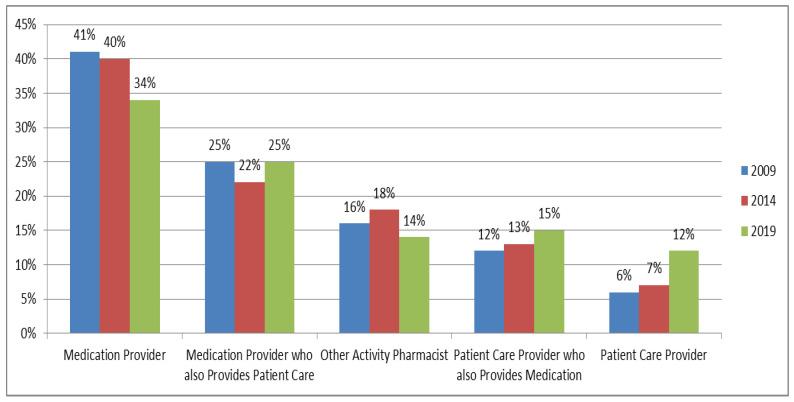
Findings from the 2009 and 2014 National Pharmacist Workforce Surveys showed that approximately 40% of U.S. pharmacists devoted their time primarily to medication providing, 40% contributed a significant portion of their time to patient care service provision, and the remaining 20% contributed most of their time to other health-system improvement activities. The objective of this study was to characterize the U.S. pharmacist workforce into segments based on the proportion of time they spend in medication providing and patient care services and compare changes in these segments between 2009, 2014, and 2019. Data from 2009, 2014, and 2019 National Pharmacist Workforce Surveys were analyzed. Responses from 1200 pharmacists in 2009, 1382 in 2014, and 4766 in 2019 were used for analysis. Respondents working in the pharmacy or pharmacy-related fields reported both their percent time devoted to medication providing and to patient care services. Medication providing included preparing, distributing, and administering medication products, including associated professional services. Patient care services were professional services designed for assessing and evaluating medication-related needs, monitoring and adjusting patient's treatments, and other services designed for patient care. For each year of data, pharmacist segments were identified using a two-step cluster analysis. Descriptive statistics were used for describing the characteristics of the segments. For each year, five segments of pharmacists were identified. The proportions of pharmacists in each segment for the three surveys (2009, 2014, 2019) were: (1) medication providers (41%, 40%, 34%), (2) medication providers who also provide patient care (25%, 22%, 25%), (3) other activity pharmacists (16%, 18%, 14%), (4) patient care providers who also provide medication (12%, 13%, 15%), and (5) patient care providers (6%, 7%, 12%). In 2019, other activity pharmacists worked over 45 hours per week, on average, with 12 of these hours worked remotely. Patient care providers worked 41 hours per week, on average, with six of these hours worked remotely. Medication providers worked less than 40 hours per week, on average, with just one of these hours worked remotely. Regarding the number of patients with whom a respondent interacted on a typical day, medication providers reported 18 per day, patient care providers reported 11 per day, and other activity pharmacists reported 6 per day. In 2009, 8% of patient care providers worked in a setting that was not licensed as a pharmacy. In 2019, this grew to 17%. : The 2019 findings showed that 34% of U.S. pharmacists devoted their time primarily to medication providing (compared to 40% in 2009 and 2014), 52% contributed a significant portion of their time to patient care service provision (compared to 40% in 2009 and 2014), and the remaining 14% contributed most of their time to other health-system improvement activities. Distinguishing characteristics of the segments suggested that recent growth in the pharmacist workforce has been in the patient care services, with more being provided through remote means in organizations that are not licensed as pharmacies. The findings have implications for pharmacist training, continuing education, labor monitoring, regulations, work systems, and process designs. These changes will create new roles and tasks for pharmacy organizations and personnel that will be needed to support emerging patient care services provided by pharmacists.
2009年和2014年全国药剂师劳动力调查结果显示,约40%的美国药剂师主要将时间用于药品供应,40%将其大部分时间用于提供患者护理服务,其余20%将大部分时间用于其他卫生系统改进活动。本研究的目的是根据美国药剂师在药品供应和患者护理服务上花费的时间比例,将药剂师劳动力划分为不同类别,并比较2009年、2014年和2019年这些类别之间的变化。分析了2009年、2014年和2019年全国药剂师劳动力调查的数据。使用了2009年1200名药剂师、2014年1382名药剂师和2019年4766名药剂师的回复进行分析。在药房或与药房相关领域工作的受访者报告了他们用于药品供应和患者护理服务的时间百分比。药品供应包括制备、分发和给药产品,以及相关专业服务。患者护理服务是旨在评估和评价与药物相关的需求、监测和调整患者治疗以及为患者护理设计的其他服务的专业服务。对于每年的数据,使用两步聚类分析确定药剂师类别。描述性统计用于描述这些类别的特征。每年确定了五类药剂师。三次调查(2009年、2014年、2019年)中每类药剂师的比例分别为:(1)药品供应者(41%、40%、34%),(2)既提供药品供应又提供患者护理的人员(25%、22%、25%),(3)从事其他活动的药剂师(16%~18%、14%),(4)既提供患者护理又提供药品供应的人员(12%、13%、15%),以及(5)患者护理提供者(6%、7%、12%)。2019年,从事其他活动的药剂师平均每周工作超过45小时,其中12小时为远程工作。患者护理提供者平均每周工作41小时,其中6小时为远程工作。药品供应者平均每周工作少于40小时,其中只有1小时为远程工作。关于受访者在典型一天中与之互动的患者数量,药品供应者报告为每天18名,患者护理提供者报告为每天11名,从事其他活动的药剂师报告为每天6名。2009年,8%的患者护理提供者在未获得药房许可的场所工作。2019年,这一比例增至17%。2019年的调查结果显示,34%的美国药剂师主要将时间用于药品供应(2009年和2014年为40%),52%将其大部分时间用于提供患者护理服务(2009年和2014年为40%),其余14%将大部分时间用于其他卫生系统改进活动。这些类别的显著特征表明,药剂师劳动力最近的增长集中在患者护理服务领域,并且在未获得药房许可的组织中,通过远程方式提供的服务更多。这些发现对药剂师培训、继续教育、劳动力监测、监管、工作系统和流程设计具有启示意义。这些变化将为药房组织和人员创造新的角色和任务,以支持药剂师提供的新兴患者护理服务。
 Zotero 插件