
刚果民主共和国基桑图的非伤寒沙门氏菌血流感染:O5 型阴性沙门氏菌肠炎和广泛耐药性的出现。
Non-typhoidal Salmonella bloodstream infections in Kisantu, DR Congo: Emergence of O5-negative Salmonella Typhimurium and extensive drug resistance.
机构信息
Department of Clinical Sciences, Institute of Tropical Medicine, Antwerp, Belgium.
Department of Microbiology and Immunology, KU Leuven, Belgium.
出版信息
PLoS Negl Trop Dis. 2020 Apr 2;14(4):e0008121. doi: 10.1371/journal.pntd.0008121. eCollection 2020 Apr.
BACKGROUND
Non-typhoidal Salmonella (NTS) are a major cause of bloodstream infection (BSI) in sub-Saharan Africa. This study aimed to assess its longitudinal evolution as cause of BSI, its serotype distribution and its antibiotic resistance pattern in Kisantu, DR Congo.
METHODS
As part of a national surveillance network, blood cultures were sampled in patients with suspected BSI admitted to Kisantu referral hospital from 2015-2017. Blood cultures were worked-up according to international standards. Results were compared to similar data from 2007 onwards.
RESULTS
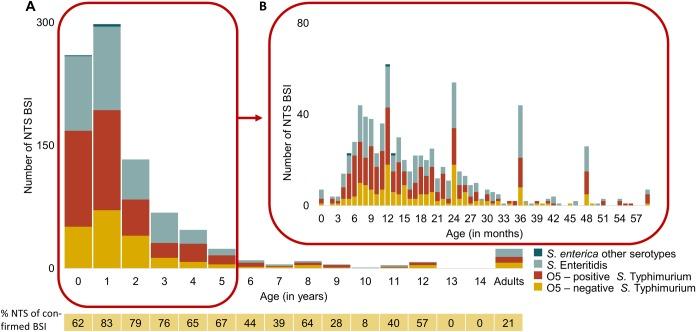
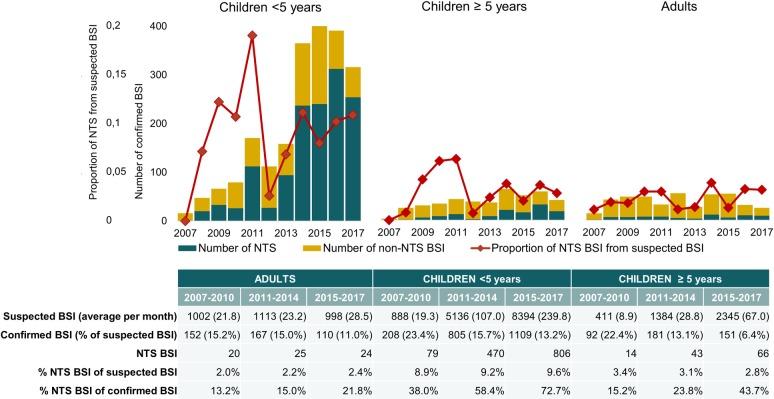
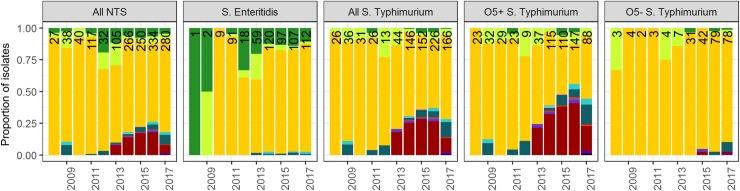
In 2015-2017, NTS (n = 896) represented the primary cause of BSI. NTS were isolated from 7.6% of 11,764 suspected and 65.4% of 1371 confirmed BSI. In children <5 years, NTS accounted for 9.6% of suspected BSI. These data were in line with data from previous surveillance periods, except for the proportion of confirmed BSI, which was lower in previous surveillance periods. Salmonella Typhimurium accounted for 63.1% of NTS BSI and Salmonella Enteritidis for 36.4%. Of all Salmonella Typhimurium, 36.9% did not express the O5-antigen (i.e. variant Copenhagen). O5-negative Salmonella Typhimurium were rare before 2013, but increased gradually from then onwards. Multidrug resistance was observed in 87.4% of 864 NTS isolates, decreased ciprofloxacin susceptibility in 7.3%, ceftriaxone resistance in 15.7% and azithromycin resistance in 14.9%. A total of 14.2% of NTS isolates, that were all Salmonella Typhimurium, were multidrug resistant and ceftriaxone and azithromycin co-resistant. These Salmonella isolates were called extensively drug resistant. Compared to previous surveillance periods, proportions of NTS isolates with resistance to ceftriaxone and azithromycin and decreased ciprofloxacin susceptibility increased.
CONCLUSION
As in previous surveillance periods, NTS ranked first as the cause of BSI in children. The emergence of O5-negative Salmonella Typhimurium needs to be considered in the light of vaccine development. The high proportions of antibiotic resistance are worrisome.
背景
非伤寒沙门氏菌(NTS)是撒哈拉以南非洲地区血流感染(BSI)的主要原因。本研究旨在评估其作为 BSI 病因的纵向演变、血清型分布以及在刚果民主共和国 Kisantu 的抗生素耐药模式。
方法
作为国家监测网络的一部分,2015-2017 年从 Kisantu 转诊医院疑似 BSI 患者中采集血培养样本。根据国际标准进行血培养。结果与 2007 年以来的类似数据进行比较。
结果
2015-2017 年,NTS(n=896)是 BSI 的主要病因。在 11764 例疑似 BSI 和 1371 例确诊 BSI 中,NTS 的分离率分别为 7.6%和 65.4%。在<5 岁的儿童中,NTS 占疑似 BSI 的 9.6%。这些数据与之前的监测期间的数据一致,除了确诊 BSI 的比例较低,而这在之前的监测期间更为常见。NTS BSI 中,鼠伤寒沙门氏菌占 63.1%,肠炎沙门氏菌占 36.4%。所有鼠伤寒沙门氏菌中,36.9%不表达 O5 抗原(即变异型哥本哈根)。2013 年之前,O5 阴性鼠伤寒沙门氏菌很少见,但从那时起逐渐增加。864 株 NTS 分离株中观察到 87.4%的多药耐药性,7.3%的环丙沙星敏感性降低,15.7%的头孢曲松耐药性和 14.9%的阿奇霉素耐药性。14.2%的 NTS 分离株,均为鼠伤寒沙门氏菌,为多药耐药且头孢曲松和阿奇霉素共同耐药。这些沙门氏菌分离株被称为广泛耐药。与之前的监测期间相比,耐头孢曲松和阿奇霉素以及环丙沙星敏感性降低的 NTS 分离株的比例增加。
结论
与之前的监测期间一样,NTS 是儿童 BSI 的首要原因。需要根据疫苗开发情况考虑 O5 阴性鼠伤寒沙门氏菌的出现。高比例的抗生素耐药性令人担忧。


 Zotero 插件