
口腔扁平苔藓患者唾液微生物组失调。
Dysbiosis of saliva microbiome in patients with oral lichen planus.
机构信息
Department of Oral Medicine, Shanxi Medical University School and Hospital of Stomatology, Taiyuan, 030001, Shanxi, China.
Department of Periodontology, Shanxi Medical University School and Hospital of Stomatology, No. 63, New South Road, Yingze District, Taiyuan, Shanxi, 030001, People's Republic of China.
出版信息
BMC Microbiol. 2020 Apr 3;20(1):75. doi: 10.1186/s12866-020-01733-7.
BACKGROUND
Oral microbiota is not only important for maintaining oral health but also plays a role in various oral diseases. However, studies regarding microbiome changes in oral lichen planus (OLP) are very limited. To the best of our knowledge, there has been only two studies investigating salivary microbiome changes in OLP. Therefore, the purpose of this study was to identify the characteristic microbial profile in the saliva of OLP patients, with or without erosive lesions, and compare that with recurrent aphthous ulcer (RAU), a common oral immunological disorder that also shows multiple erosive/ulcerative lesions. Whole saliva samples were collected from 20 patients with OLP (erosive E, n = 10 and non-erosive NE, n = 10), 10 patients with RAU (U) and 10 healthy controls (C). DNA was extracted from the saliva samples, and the 16S rDNA gene V4 hypervariable region was analyzed using Illumina sequencing.
RESULTS
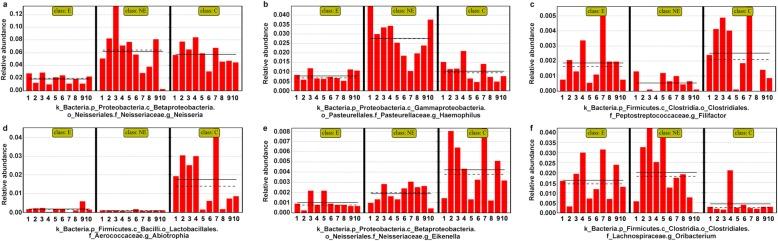
We obtained 4949 operational taxonomic units (OTUs) from the V4 region in all saliva samples. Community composition analysis showed a clear decreased relative abundance of genera Streptococcus and Sphingomonas in saliva from RAU patients when compared to the other three groups. Relative abundance of Lautropia and Gemella were higher in E group, whereas relative abundance of Haemophilus and Neisseria were higher in NE group when compared to C group. Abiotrophia and Oribacterium were higher in OLP (combining E and NE groups), while Eikenella and Aggregatibacter were lower when compared to C group. There was statistically significance in α-diversity between E and RAU groups(p < 0.05). Significant differences in β-diversity were detected in bacteria between E and C; NE and C; as well as E and NE groups. The LDA effect size algorithm identified the g_Haemophilus might be the potential biomarker in NE group.
CONCLUSIONS
We found that salivary microbiome in erosive OLP was significantly different from that found in RAU; and these changes may be related to the underlying disease process rather than presence of ulcerative/erosive lesions clinically. In addition, our findings in bacterial relative abundance in OLP were significantly different from the previously reported findings, which points to the need for further research in salivary microbiome of OLP.
背景
口腔微生物群不仅对维持口腔健康很重要,而且在各种口腔疾病中也发挥作用。然而,关于口腔扁平苔藓(OLP)微生物组变化的研究非常有限。据我们所知,仅有两项研究调查了 OLP 患者唾液微生物组的变化。因此,本研究的目的是确定 OLP 患者(有或无糜烂病变)唾液中特征性微生物谱,并与复发性阿弗他溃疡(RAU)进行比较,RAU 是一种常见的口腔免疫性疾病,也表现出多个糜烂/溃疡病变。从 20 例 OLP 患者(糜烂 E 组,n = 10 和非糜烂 NE 组,n = 10)、10 例 RAU 患者(U 组)和 10 例健康对照者(C 组)中收集全唾液样本。从唾液样本中提取 DNA,并使用 Illumina 测序分析 16S rDNA 基因 V4 高变区。
结果
我们从所有唾液样本的 V4 区获得了 4949 个操作分类单元(OTU)。群落组成分析显示,与其他三组相比,RAU 患者唾液中链球菌属和鞘氨醇单胞菌属的相对丰度明显降低。与 C 组相比,E 组中乳杆菌属和真杆菌属的相对丰度较高,而 NE 组中嗜血杆菌属和奈瑟菌属的相对丰度较高。与 C 组相比,OLP(E 组和 NE 组合并)组中拟杆菌属和奥利沃氏菌属的相对丰度较高,而 E ikenella 和Aggregatibacter 的相对丰度较低。E 组与 RAU 组之间的α多样性有统计学意义(p < 0.05)。在 E 组与 C 组、NE 组与 C 组以及 E 组与 NE 组之间检测到细菌β多样性的显著差异。LDA 效应大小算法确定 g_Haemophilus 可能是 NE 组的潜在生物标志物。
结论
我们发现糜烂性 OLP 的唾液微生物群与 RAU 明显不同;这些变化可能与潜在的疾病过程有关,而不是临床存在的溃疡性/糜烂性病变。此外,我们在 OLP 中细菌相对丰度的发现与以前的报告结果显著不同,这表明需要进一步研究 OLP 的唾液微生物组。


 Zotero 插件