
在 42998 个人中,儿童期精神病理学与成年期抑郁和相关特征之间的遗传关联:一项荟萃分析。
Genetic Associations Between Childhood Psychopathology and Adult Depression and Associated Traits in 42 998 Individuals: A Meta-analysis.
机构信息
Department of Biological Psychology, Vrije Universiteit Amsterdam, Amsterdam, the Netherlands.
Amsterdam Public Health Research Institute, Amsterdam, the Netherlands.
出版信息
JAMA Psychiatry. 2020 Jul 1;77(7):715-728. doi: 10.1001/jamapsychiatry.2020.0527.
IMPORTANCE
Adult mood disorders are often preceded by behavioral and emotional problems in childhood. It is yet unclear what explains the associations between childhood psychopathology and adult traits.
OBJECTIVE
To investigate whether genetic risk for adult mood disorders and associated traits is associated with childhood disorders.
DESIGN, SETTING, AND PARTICIPANTS: This meta-analysis examined data from 7 ongoing longitudinal birth and childhood cohorts from the UK, the Netherlands, Sweden, Norway, and Finland. Starting points of data collection ranged from July 1985 to April 2002. Participants were repeatedly assessed for childhood psychopathology from ages 6 to 17 years. Data analysis occurred from September 2017 to May 2019.
EXPOSURES
Individual polygenic scores (PGS) were constructed in children based on genome-wide association studies of adult major depression, bipolar disorder, subjective well-being, neuroticism, insomnia, educational attainment, and body mass index (BMI).
MAIN OUTCOMES AND MEASURES
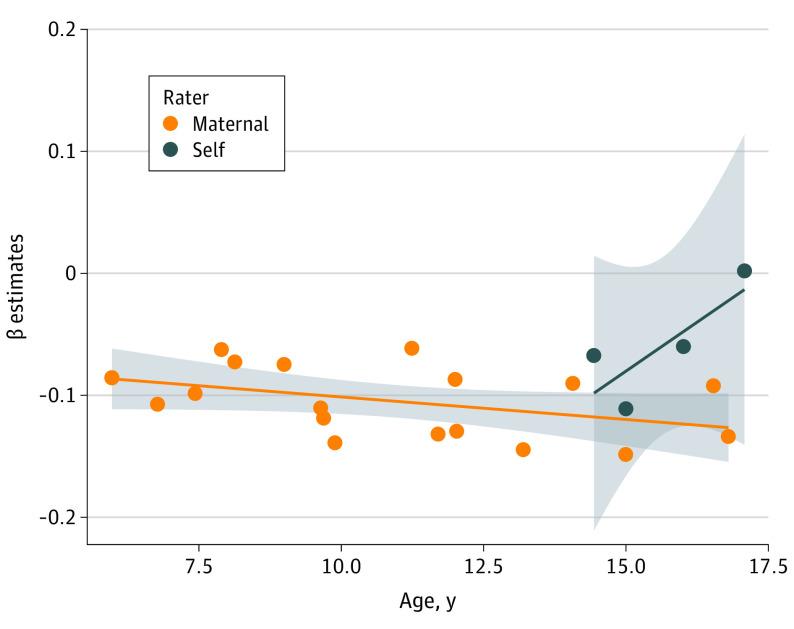
Regression meta-analyses were used to test associations between PGS and attention-deficit/hyperactivity disorder (ADHD) symptoms and internalizing and social problems measured repeatedly across childhood and adolescence and whether these associations depended on childhood phenotype, age, and rater.
RESULTS
The sample included 42 998 participants aged 6 to 17 years. Male participants varied from 43.0% (1040 of 2417 participants) to 53.1% (2434 of 4583 participants) by age and across all cohorts. The PGS of adult major depression, neuroticism, BMI, and insomnia were positively associated with childhood psychopathology (β estimate range, 0.023-0.042 [95% CI, 0.017-0.049]), while associations with PGS of subjective well-being and educational attainment were negative (β, -0.026 to -0.046 [95% CI, -0.020 to -0.057]). There was no moderation of age, type of childhood phenotype, or rater with the associations. The exceptions were stronger associations between educational attainment PGS and ADHD compared with internalizing problems (Δβ, 0.0561 [Δ95% CI, 0.0318-0.0804]; ΔSE, 0.0124) and social problems (Δβ, 0.0528 [Δ95% CI, 0.0282-0.0775]; ΔSE, 0.0126), and between BMI PGS and ADHD and social problems (Δβ, -0.0001 [Δ95% CI, -0.0102 to 0.0100]; ΔSE, 0.0052), compared with internalizing problems (Δβ, -0.0310 [Δ95% CI, -0.0456 to -0.0164]; ΔSE, 0.0074). Furthermore, the association between educational attainment PGS and ADHD increased with age (Δβ, -0.0032 [Δ 95% CI, -0.0048 to -0.0017]; ΔSE, 0.0008).
CONCLUSIONS AND RELEVANCE
Results from this study suggest the existence of a set of genetic factors influencing a range of traits across the life span with stable associations present throughout childhood. Knowledge of underlying mechanisms may affect treatment and long-term outcomes of individuals with psychopathology.
重要性
成人情绪障碍通常在儿童时期就有行为和情绪问题。目前尚不清楚是什么解释了儿童期精神病理学与成人特征之间的关联。
目的
研究成人情绪障碍和相关特征的遗传风险是否与儿童时期的障碍有关。
设计、地点和参与者:本荟萃分析研究了来自英国、荷兰、瑞典、挪威和芬兰的 7 个正在进行的纵向出生和儿童队列的数据。数据收集的起点从 1985 年 7 月到 2002 年 4 月不等。参与者从 6 岁到 17 岁被反复评估儿童期精神病理学。数据分析于 2017 年 9 月至 2019 年 5 月进行。
暴露因素
根据成人重度抑郁症、双相情感障碍、主观幸福感、神经质、失眠、受教育程度和体重指数(BMI)的全基因组关联研究,在儿童中构建个体多基因评分(PGS)。
主要结果和测量
回归荟萃分析用于检验 PGS 与注意力缺陷/多动障碍(ADHD)症状以及贯穿儿童和青少年时期反复测量的内部问题和社会问题之间的关联,以及这些关联是否取决于儿童期表型、年龄和评分者。
结果
样本包括 42998 名年龄在 6 至 17 岁的参与者。男性参与者的年龄从 43.0%(2417 名参与者中的 1040 名)到 53.1%(4583 名参与者中的 2434 名)不等,并且跨越了所有队列。成人重度抑郁症、神经质、BMI 和失眠的 PGS 与儿童期精神病理学呈正相关(β 估计值范围,0.023-0.042[95%CI,0.017-0.049]),而与主观幸福感和教育程度 PGS 的关联为负(β,-0.026 至-0.046[95%CI,-0.020 至-0.057])。年龄、儿童期表型类型或评分者没有调节这些关联。例外情况是,与内部问题相比,教育程度 PGS 与 ADHD 的关联更强(Δβ,0.0561[Δ95%CI,0.0318-0.0804];ΔSE,0.0124)和社会问题(Δβ,0.0528[Δ95%CI,0.0282-0.0775];ΔSE,0.0126),以及 BMI PGS 与 ADHD 和社会问题(Δβ,-0.0001[Δ95%CI,-0.0102 至 0.0100];ΔSE,0.0052)与内部问题(Δβ,-0.0310[Δ95%CI,-0.0456 至-0.0164];ΔSE,0.0074)。此外,教育程度 PGS 与 ADHD 的关联随年龄增加而增加(Δβ,-0.0032[Δ95%CI,-0.0048 至-0.0017];ΔSE,0.0008)。
结论和相关性
这项研究的结果表明,存在一组影响整个生命周期多种特征的遗传因素,这些特征在整个儿童期都存在稳定的关联。对潜在机制的了解可能会影响有精神病理学个体的治疗和长期结果。

 Zotero 插件