
亚临床甲状腺功能亢进症:甲状腺癌患者接受甲状腺切除术时胆固醇向 HDL 的转移和脂蛋白代谢相关其他参数的状况。
Subclinical Hyperthyroidism: Status of the Cholesterol Transfers to HDL and Other Parameters Related to Lipoprotein Metabolism in Patients Submitted to Thyroidectomy for Thyroid Cancer.
机构信息
Lipid Metabolism Laboratory, Heart Institute (InCor) of the Medical School Hospital, University of São Paulo, São Paulo, Brazil.
Clinical Cardiology Division, Heart Institute (InCor) of the Medical School Hospital, University of São Paulo, São Paulo, Brazil.
出版信息
Front Endocrinol (Lausanne). 2020 Apr 2;11:176. doi: 10.3389/fendo.2020.00176. eCollection 2020.
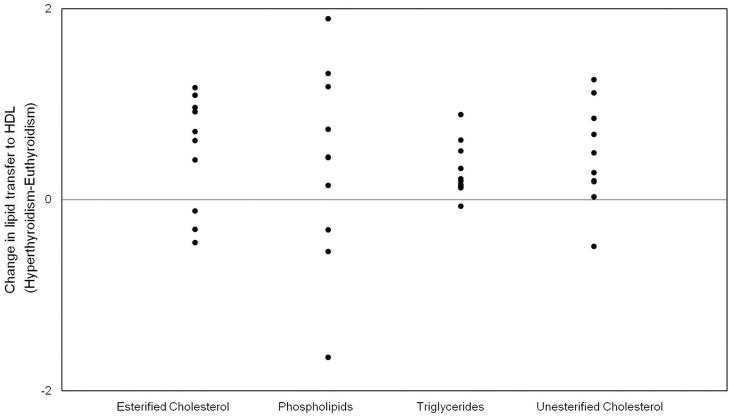
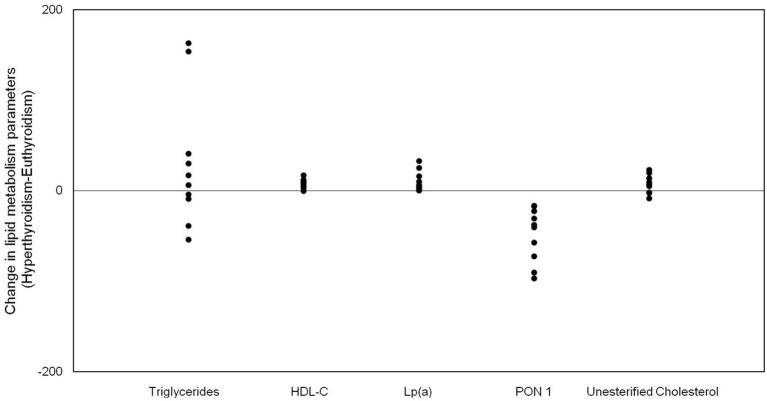
Lipid metabolism has been poorly explored in subclinical hyperthyroidism. The aim was to examine the effects of exogenous subclinical hyperthyroidism in women under levothyroxine treatment upon plasma lipids and aspects of HDL metabolism. Ten women were studied in euthyroidism and again in exogenous subclinical hyperthyroidism. Thyroid function tests and plasma lipids were studied. HDL-cholesterol (increased 21.6%, = 0.0004), unesterified cholesterol (increased 12.3%, = 0.04) and Lp(a) (increased 33,3%, = 0.02) plasma concentrations were higher in subclinical hyperthyroidism compared to euthyroidism, but total cholesterol, LDL, non-HDL cholesterol, triglycerides, apo A-I, apo B were unchanged. PON1 activity (decreased 75%, = 0.0006) was lower in subclinical hyperthyroidism. There were no changes in HDL particle size, CETP and LCAT concentrations. The assay that estimates the lipid transfers to HDL showed that esterified cholesterol (increased 7.1%, = 0.03), unesterified cholesterol (increased 7.8%, = 0.02) and triglycerides (increased 6.8%, = 0.006) transfers were higher in subclinical hyperthyroidism. There were no changes in phospholipid transfers to HDL in subclinical hyperthyroidism. Several alterations in the plasma lipid metabolism were observed in the subclinical hyperthyroidism state that highlight the importance of this aspect in the follow-up of those patients. The increase in HDL-C and in the transfer of unesterified and esterified cholesterol to HDL, an important anti-atherogenic HDL function are consistently protective for cardiovascular health. The increase in Lp(a) and the decrease in PON-1 activity that are important risk factors were documented here in subclinical hyperthyroidism and these results should be confirmed in larger studies due to great data variation but should not be neglected in the follow-up of those patients.
亚临床甲状腺功能亢进症患者的脂代谢研究甚少。本研究旨在探讨左旋甲状腺素治疗下的亚临床甲状腺功能亢进症女性患者的外源性亚临床甲状腺功能亢进症对血浆脂质和高密度脂蛋白(HDL)代谢的影响。 研究了 10 名女性在甲状腺功能正常和外源性亚临床甲状腺功能亢进时的甲状腺功能和血浆脂质。 HDL-胆固醇(增加 21.6%, = 0.0004)、游离胆固醇(增加 12.3%, = 0.04)和 Lp(a)(增加 33.3%, = 0.02)血浆浓度在亚临床甲状腺功能亢进时高于甲状腺功能正常,但总胆固醇、LDL、非 HDL 胆固醇、甘油三酯、载脂蛋白 A-I 和载脂蛋白 B 未改变。PON1 活性(降低 75%, = 0.0006)在亚临床甲状腺功能亢进时降低。HDL 颗粒大小、CETP 和 LCAT 浓度没有变化。估计脂质向 HDL 转移的测定表明,酯化胆固醇(增加 7.1%, = 0.03)、游离胆固醇(增加 7.8%, = 0.02)和甘油三酯(增加 6.8%, = 0.006)转移在亚临床甲状腺功能亢进时增加。亚临床甲状腺功能亢进时 HDL 向磷脂的转移没有变化。 亚临床甲状腺功能亢进状态下观察到几种血浆脂质代谢的改变,这突出了这方面在这些患者随访中的重要性。HDL-C 的增加以及未酯化和酯化胆固醇向 HDL 的转移,这是重要的抗动脉粥样硬化的 HDL 功能,一直对心血管健康具有保护作用。本研究中记录了亚临床甲状腺功能亢进时 Lp(a)的增加和 PON-1 活性的降低,这些都是重要的危险因素,由于数据变化较大,这些结果需要在更大的研究中证实,但不应在这些患者的随访中忽视。
 Zotero 插件