
在推特上将新型冠状病毒称为“中国病毒”从而制造新冠病毒污名化:社交媒体数据的定量分析
Creating COVID-19 Stigma by Referencing the Novel Coronavirus as the "Chinese virus" on Twitter: Quantitative Analysis of Social Media Data.
作者信息
Budhwani Henna, Sun Ruoyan
机构信息
Department of Health Care Organization and Policy, School of Public Health, University of Alabama at Birmingham, Birmingham, AL, United States.
出版信息
J Med Internet Res. 2020 May 6;22(5):e19301. doi: 10.2196/19301.
BACKGROUND
Stigma is the deleterious, structural force that devalues members of groups that hold undesirable characteristics. Since stigma is created and reinforced by society-through in-person and online social interactions-referencing the novel coronavirus as the "Chinese virus" or "China virus" has the potential to create and perpetuate stigma.
OBJECTIVE
The aim of this study was to assess if there was an increase in the prevalence and frequency of the phrases "Chinese virus" and "China virus" on Twitter after the March 16, 2020, US presidential reference of this term.
METHODS
Using the Sysomos software (Sysomos, Inc), we extracted tweets from the United States using a list of keywords that were derivatives of "Chinese virus." We compared tweets at the national and state levels posted between March 9 and March 15 (preperiod) with those posted between March 19 and March 25 (postperiod). We used Stata 16 (StataCorp) for quantitative analysis, and Python (Python Software Foundation) to plot a state-level heat map.
RESULTS
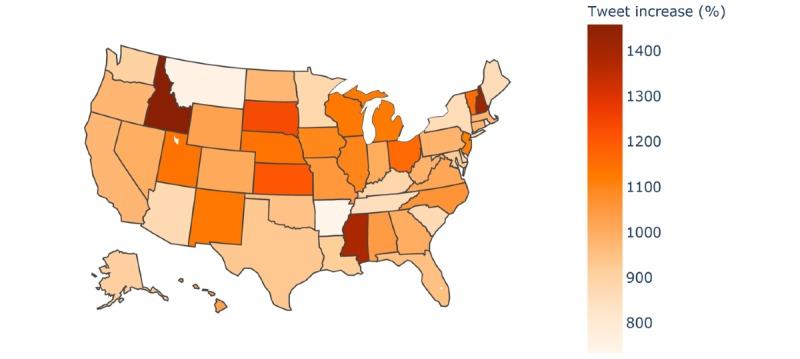
A total of 16,535 "Chinese virus" or "China virus" tweets were identified in the preperiod, and 177,327 tweets were identified in the postperiod, illustrating a nearly ten-fold increase at the national level. All 50 states witnessed an increase in the number of tweets exclusively mentioning "Chinese virus" or "China virus" instead of coronavirus disease (COVID-19) or coronavirus. On average, 0.38 tweets referencing "Chinese virus" or "China virus" were posted per 10,000 people at the state level in the preperiod, and 4.08 of these stigmatizing tweets were posted in the postperiod, also indicating a ten-fold increase. The 5 states with the highest number of postperiod "Chinese virus" tweets were Pennsylvania (n=5249), New York (n=11,754), Florida (n=13,070), Texas (n=14,861), and California (n=19,442). Adjusting for population size, the 5 states with the highest prevalence of postperiod "Chinese virus" tweets were Arizona (5.85), New York (6.04), Florida (6.09), Nevada (7.72), and Wyoming (8.76). The 5 states with the largest increase in pre- to postperiod "Chinese virus" tweets were Kansas (n=697/58, 1202%), South Dakota (n=185/15, 1233%), Mississippi (n=749/54, 1387%), New Hampshire (n=582/41, 1420%), and Idaho (n=670/46, 1457%).
CONCLUSIONS
The rise in tweets referencing "Chinese virus" or "China virus," along with the content of these tweets, indicate that knowledge translation may be occurring online and COVID-19 stigma is likely being perpetuated on Twitter.
背景
污名是一种有害的结构性力量,它会贬低那些具有不受欢迎特征的群体成员的价值。由于污名是由社会通过面对面和在线社交互动形成并强化的,将新型冠状病毒称为“中国病毒”或“中国的病毒”有可能制造并延续污名。
目的
本研究的目的是评估在2020年3月16日美国总统提及该词之后,推特上“中国病毒”和“中国的病毒”这两个短语的出现频率和使用 prevalence 是否有所增加。
方法
我们使用Sysomos软件(Sysomos公司),通过一系列衍生自“中国病毒”的关键词列表,从美国提取推文。我们将3月9日至3月15日(前期)发布的全国和州级推文与3月19日至3月25日(后期)发布的推文进行比较。我们使用Stata 16(StataCorp公司)进行定量分析,并使用Python(Python软件基金会)绘制州级热图。
结果
前期共识别出16535条包含“中国病毒”或“中国的病毒”的推文,后期识别出177327条,表明在全国范围内增加了近十倍。所有50个州提及“中国病毒”或“中国的病毒”而非冠状病毒病(COVID-19)或冠状病毒的推文数量均有所增加。前期在州一级,每10000人平均发布0.38条提及“中国病毒”或“中国的病毒”的推文,后期发布了4.08条此类污名化推文,也表明增加了十倍。后期“中国病毒”推文数量最多的五个州是宾夕法尼亚州(n = 5249)、纽约州(n = 11754)、佛罗里达州(n = 13070)、得克萨斯州(n = 14861)和加利福尼亚州(n = 19442)。按人口规模调整后,后期“中国病毒”推文 prevalence 最高的五个州是亚利桑那州(5.85)、纽约州(6.04)、佛罗里达州(6.09)、内华达州(7.72)和怀俄明州(8.76)。前期到后期“中国病毒”推文增加最多的五个州是堪萨斯州(n = 697/58,增长1202%)、南达科他州(n = 185/15,增长1233%)、密西西比州(n = 749/54,增长1387%)、新罕布什尔州(n = 582/41,增长1420%)和爱达荷州(n = 670/46,增长1457%)。
结论
提及“中国病毒”或“中国的病毒”的推文数量增加,以及这些推文的内容,表明知识传播可能正在网上发生,并且COVID-19污名可能在推特上持续存在。
 Zotero 插件