
糖尿病通过依赖 AMPK 的方式激活 Nox2 相关程序性细胞死亡加重心肌缺血再灌注损伤。
Diabetes aggravates myocardial ischaemia reperfusion injury via activating Nox2-related programmed cell death in an AMPK-dependent manner.
机构信息
Department of Anesthesiology, Shenzhen People's Hospital and Shenzhen Anesthesiology Engineering Center, The Second Clinical Medical College of Jinan University, Shenzhen, China.
Department of Pathophysiology, School of Medicine, Shenzhen University, Shenzhen, China.
出版信息
J Cell Mol Med. 2020 Jun;24(12):6670-6679. doi: 10.1111/jcmm.15318. Epub 2020 Apr 29.
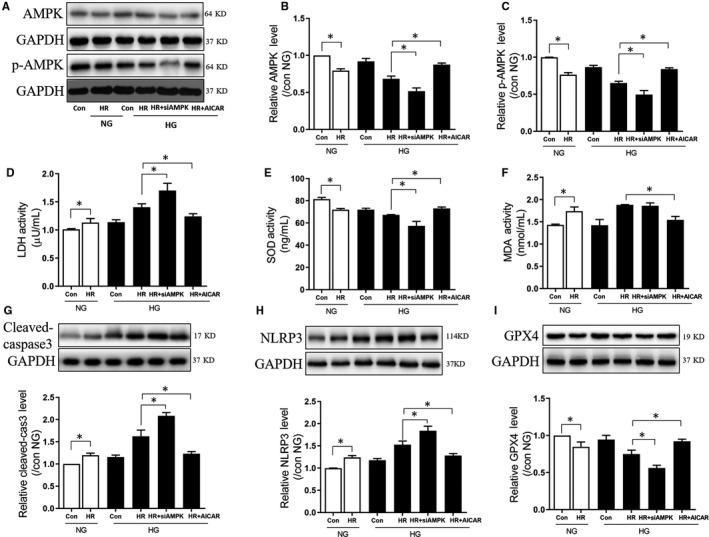
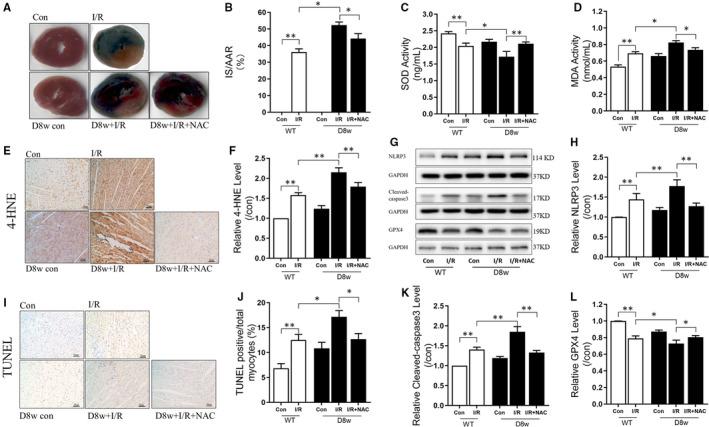
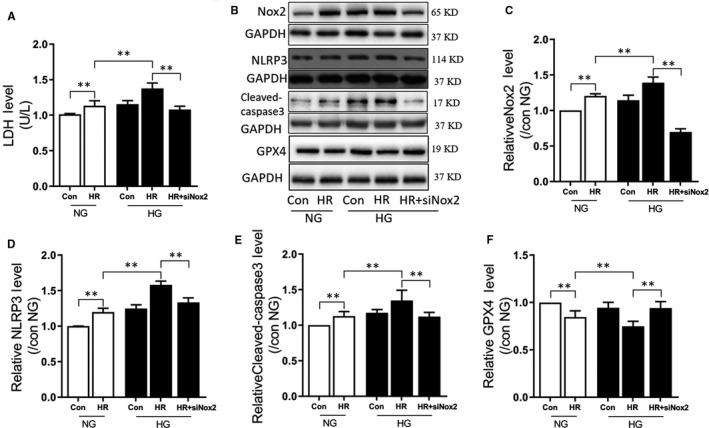
Cardiovascular diseases such as myocardial ischaemia have a high fatality rate in patients with diabetes. This study was designed to expose the crosstalk between oxidative stress and AMPK, a vital molecule that controls biological energy metabolism, in myocardial ischaemia reperfusion injury (I/RI) in diabetic rats. Diabetes was stimulated in rats using streptozotocin injection. Rats were separated on random into control, control + I/R, Diabetes, Diabetes + I/R, Diabetes + I/R + N-acetylcysteine and Diabetes + I/R + Vas2870 groups. Myocardial infarct size was determined, and the predominant Nox family isoforms were analysed. In vitro, the H9C2 cells were administered excess glucose and exposed to hypoxia/reoxygenation to mimic diabetes and I/R. The AMPK siRNA or AICAR was used to inhibit or activate AMPK expression in H9C2 cells, respectively. Then, myocardial oxidative stress and programmed cell death were measured. Diabetes or high glucose levels were found to aggravate myocardial I/RI or hypoxia/reoxygenation in H9C2 cells, as demonstrated by an increase in myocardial infarct size or lactate dehydrogenase levels, oxidative stress generation and induction of programmed cell death. In diabetic rat hearts, cardiac Nox1, Nox2 and Nox4 were all heightened. The suppression of Nox2 expression using Vas2870 or Nox2-siRNA treatment in vivo or in vitro, respectively, protected diabetic rats from myocardial I/RI. AMPK gene knockout increased Nox2 protein expression while AMPK agonist decreased Nox2 expression. Therefore, diabetes aggravates myocardial I/RI by generating of Nox2-associated oxidative stress in an AMPK-dependent manner, which led to the induction of programmed cell death such as apoptosis, pyroptosis and ferroptosis.
心血管疾病,如心肌缺血,在糖尿病患者中具有很高的死亡率。本研究旨在揭示氧化应激与 AMPK 之间的串扰,AMPK 是一种控制生物能量代谢的重要分子,在糖尿病大鼠心肌缺血再灌注损伤(I/RI)中发挥作用。通过链脲佐菌素注射刺激大鼠产生糖尿病。大鼠随机分为对照组、对照组+I/R 组、糖尿病组、糖尿病+I/R 组、糖尿病+I/R+N-乙酰半胱氨酸组和糖尿病+I/R+Vas2870 组。测定心肌梗死面积,并分析主要的 Nox 家族同工型。在体外,给予 H9C2 细胞过量葡萄糖,并使其暴露于缺氧/复氧中,以模拟糖尿病和 I/R。使用 AMPK siRNA 或 AICAR 分别抑制或激活 H9C2 细胞中的 AMPK 表达。然后,测量心肌氧化应激和程序性细胞死亡。发现糖尿病或高葡萄糖水平加重了 H9C2 细胞的心肌 I/RI 或缺氧/复氧,表现为心肌梗死面积或乳酸脱氢酶水平增加、氧化应激产生和程序性细胞死亡诱导。在糖尿病大鼠心脏中,心脏 Nox1、Nox2 和 Nox4 均升高。体内或体外分别使用 Vas2870 或 Nox2-siRNA 抑制 Nox2 表达,可保护糖尿病大鼠免受心肌 I/RI。AMPK 基因敲除增加了 Nox2 蛋白表达,而 AMPK 激动剂则降低了 Nox2 表达。因此,糖尿病通过以 AMPK 依赖性方式产生与 Nox2 相关的氧化应激,加剧心肌 I/RI,从而诱导程序性细胞死亡,如细胞凋亡、细胞焦亡和铁死亡。


 Zotero 插件