
使用含银纳米粒子的氟化钠再矿化牙本质龋:一项体外研究。
Remineralising Dentine Caries Using Sodium Fluoride with Silver Nanoparticles: An In Vitro Study.
机构信息
School of Dentistry, Shenzhen University Health Science Center, Shenzhen, People's Republic of China.
Faculty of Dentistry, The University of Hong Kong, Hong Kong, People's Republic of China.
出版信息
Int J Nanomedicine. 2020 Apr 23;15:2829-2839. doi: 10.2147/IJN.S247550. eCollection 2020.
OBJECTIVE
To investigate the remineralizing and staining effects of sodium fluoride (NaF) solution with polyethylene glycol-coated silver nanoparticles (PEG-AgNPs) on artificial dentine caries.
MATERIALS AND METHODS
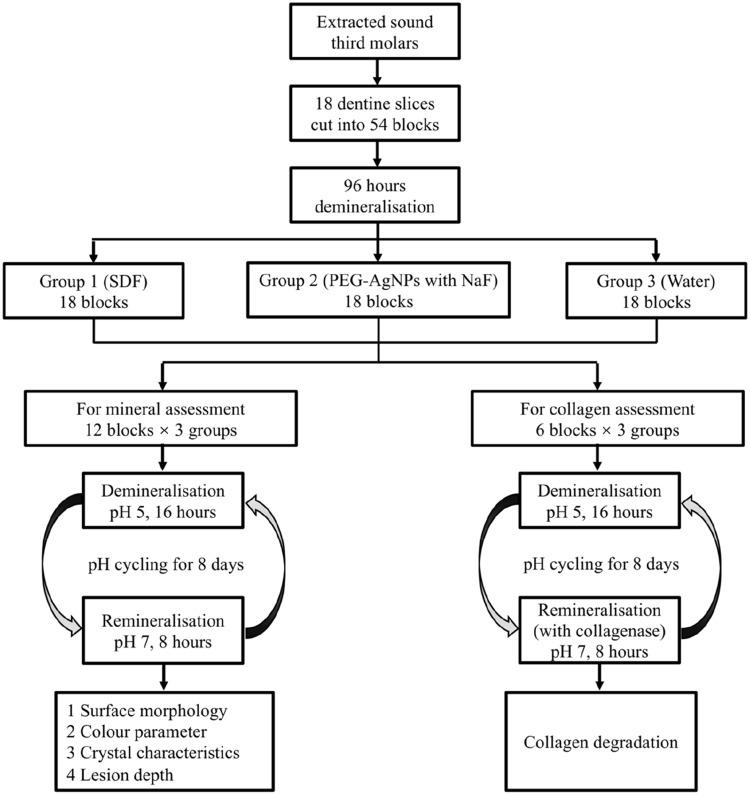
Demineralized human dentine blocks were allocated to three groups. The blocks in group 1 underwent a topical application of a 12% silver diamine fluoride (SDF, 14,150 ppm fluoride) solution. The blocks in group 2 received a topical application of a 2.5% NaF (11,310 ppm fluoride) with PEG-AgNPs (400 ppm silver). The blocks in group 3 received deionized water. All blocks were subjected to pH cycling for 8 days. The surface morphology and cross-sectional features were investigated using scanning electron microscopy (SEM). The color parameters, crystal characteristics, lesion depth, and collagen degradation of the blocks were assessed using digital spectrophotometry, X-ray diffraction (XRD), micro-computed tomography, and spectrophotometry with a hydroxyproline assay, respectively.
RESULTS
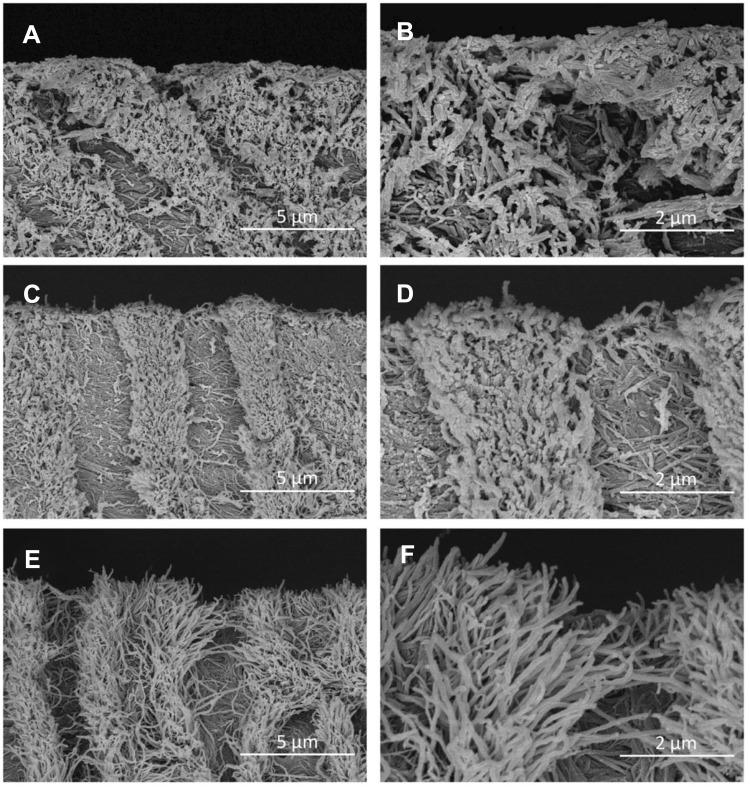
The SEM showed that dentine collagen was exposed in group 3 but not in groups 1 and 2. The mean lesion depths in groups 1 to 3 were 118±7 µm, 121±14 µm, and 339±20 µm, respectively (groups1,2<3; p<0.001). The data indicated that fluoridated PEG-AgNPs introduced no significant color effect on dentine, but SDF caused distinct discoloration. The XRD indicated that silver chloride was formed in group 1, and fluorapatite was detected in groups 1 and 2. The concentration of hydroxyproline liberated from collagen was significantly less in groups 1 and 2 than in group 3.
CONCLUSION
The use of NaF solution with PEG-AgNPs can remineralize artificial dentine caries and inhibit collagen degradation without causing significant tooth staining.
目的
研究含聚乙二醇包裹的银纳米粒子(PEG-AgNPs)的氟化钠(NaF)溶液对人工牙本质龋的再矿化和染色效果。
材料和方法
将脱矿的人牙本质块分为三组。第 1 组的牙本质块接受 12%的银胺氟化氢(SDF,14150ppm 氟化物)溶液的局部应用。第 2 组的牙本质块接受 2.5%的含 PEG-AgNPs(400ppm 银)的 NaF 溶液的局部应用。第 3 组的牙本质块接受去离子水。所有牙本质块均进行 8 天 pH 循环。使用扫描电子显微镜(SEM)研究表面形态和横截面特征。使用数字分光光度法、X 射线衍射(XRD)、微计算机断层扫描和分光光度法结合羟脯氨酸测定法评估牙本质块的颜色参数、晶体特征、病变深度和胶原蛋白降解。
结果
SEM 显示第 3 组牙本质胶原暴露,但第 1 组和第 2 组未暴露。第 1 组至第 3 组的平均病变深度分别为 118±7μm、121±14μm 和 339±20μm(组 1、2<3;p<0.001)。数据表明,含氟 PEG-AgNPs 对牙本质没有显著的颜色影响,但 SDF 会导致明显的变色。XRD 表明第 1 组形成了氯化银,第 1 组和第 2 组检测到氟磷灰石。第 1 组和第 2 组从胶原蛋白释放的羟脯氨酸浓度明显低于第 3 组。
结论
使用含 PEG-AgNPs 的 NaF 溶液可以再矿化人工牙本质龋,抑制胶原蛋白降解,而不会导致明显的牙齿染色。




 Zotero 插件