
一项基于智能手机应用程序的癌症幸存者正念干预:随机对照试验方案。
A Smartphone App-Based Mindfulness Intervention for Cancer Survivors: Protocol for a Randomized Controlled Trial.
作者信息
Subnis Utkarsh B, Farb Norman As, Piedalue Katherine-Ann Laura, Speca Michael, Lupichuk Sasha, Tang Patricia A, Faris Peter, Thoburn Mark, Saab Bechara J, Carlson Linda E
机构信息
Department of Oncology, University of Calgary, Calgary, AB, Canada.
Department of Psychology, University of Toronto Mississauga, Mississauga, ON, Canada.
出版信息
JMIR Res Protoc. 2020 May 11;9(5):e15178. doi: 10.2196/15178.
BACKGROUND
Cancer patients transitioning to survivorship after completing cancer treatments need psychosocial interventions to manage stressors such as anxiety, depression, and fear of cancer recurrence. Mindfulness-based interventions (MBIs) are effective for treating these symptoms; however, cancer survivors are often unable to participate in face-to-face interventions because of difficulties such as work and family commitments, treatment-related side-effects, scheduling conflicts, and geography. Smartphone app-based MBIs are an innovative way to deliver psychosocial cancer care and can overcome several such difficulties, since patients can participate at their own convenience.
OBJECTIVE
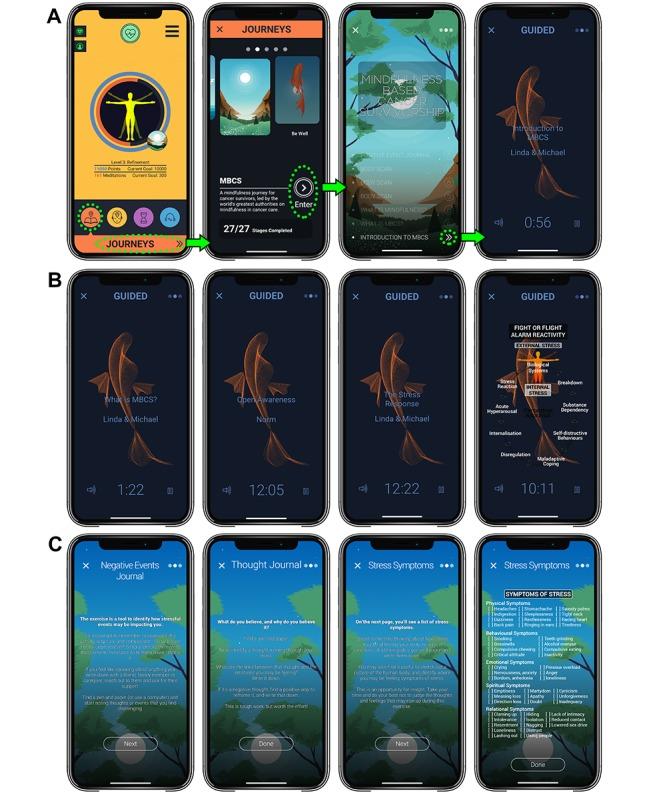
The SEAMLESS (Smartphone App-Based Mindfulness Intervention for Cancer Survivors) study aims to evaluate the efficacy of a tailored app-based mindfulness intervention for cancer survivors (the Am Mindfulness-Based Cancer Survivorship-MBCS-Journey) for treating (1) symptoms of stress (primary outcome), as well as (2) fear of cancer recurrence, anxiety, depression, fatigue, and overall physical functioning (secondary outcomes). This is the first Canadian efficacy trial of a tailored mindfulness app intervention in cancer survivors.
METHODS
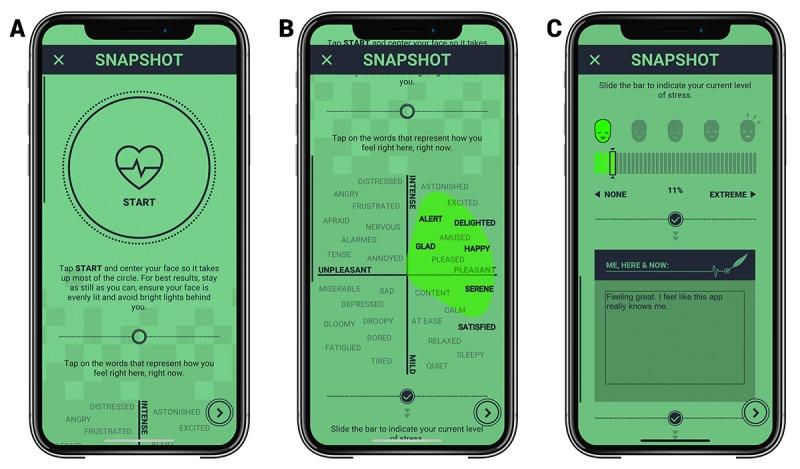
This is a randomized waitlist-controlled trial, which will evaluate the effectiveness of Am MBCS for impacting the primary and secondary outcomes in cancer survivors who have completed all their cancer treatments. Outcomes will be assessed using web-based surveys with validated psychometric instruments at (1) baseline, (2) mid-intervention (2 weeks later), (3) immediately postintervention (4 weeks), (4) 3 months postbaseline, (5) 6 months postbaseline, and (6) 12 months postbaseline. The waitlist group will complete all assessments and will cross over to the intervention condition after the 3-month assessment. In addition, data will be obtained by the smartphone app itself, which includes users' engagement with the app-based intervention, their emotional state (eg, angry and elated) from a user-inputted digital emotion-mapping board, and psychobiometric data using photoplethysmography technology.
RESULTS
The study received ethics approval in September 2018 and recruitment commenced in January 2019. Participants are being recruited through a provincial cancer registry, and the majority of participants currently enrolled are breast (44/83, 53%) or colorectal (17/83, 20%) cancer survivors, although some survivors of other cancer are also present. Data collection for analysis of the primary outcome time-point will be complete by September 2019, and the follow-up data will be collected and analyzed by September 2020. Data will be analyzed to determine group differences using linear mixed modelling statistical techniques.
CONCLUSIONS
Cancer care providers are uncertain about the efficacy of app-based mindfulness interventions for patients, which are available in great supply in today's digital world. This study will provide rigorously evaluated efficacy data for an app-based mindfulness intervention for cancer survivors, which if helpful, could be made available for psychosocial care at cancer centers worldwide.
TRIAL REGISTRATION
ClinicalTrials.gov NCT03484000; https://clinicaltrials.gov/ct2/show/NCT03484000.
INTERNATIONAL REGISTERED REPORT IDENTIFIER (IRRID): DERR1-10.2196/15178.
背景
癌症患者在完成癌症治疗后过渡到癌症康复阶段,需要心理社会干预措施来应对焦虑、抑郁和对癌症复发的恐惧等压力源。基于正念的干预措施(MBIs)对治疗这些症状有效;然而,癌症幸存者由于工作和家庭事务、治疗相关的副作用、日程冲突以及地理位置等困难,往往无法参与面对面的干预。基于智能手机应用程序的MBIs是提供心理社会癌症护理的一种创新方式,并且可以克服上述诸多困难,因为患者可以在自己方便的时候参与。
目的
SEAMLESS(基于智能手机应用程序的癌症幸存者正念干预)研究旨在评估一款为癌症幸存者量身定制的基于应用程序的正念干预(“我的基于正念的癌症幸存者护理——MBCS——旅程”)对于治疗(1)压力症状(主要结局)以及(2)癌症复发恐惧、焦虑、抑郁、疲劳和整体身体功能(次要结局)的疗效。这是加拿大首次针对癌症幸存者进行的量身定制的正念应用程序干预的疗效试验。
方法
这是一项随机等待列表对照试验,将评估“我的MBCS”对已完成所有癌症治疗的癌症幸存者的主要和次要结局的影响。结局将使用经过验证的心理测量工具,通过基于网络的调查在以下时间点进行评估:(1)基线,(2)干预中期(2周后),(3)干预后立即(4周),(4)基线后3个月,(5)基线后6个月,以及(6)基线后12个月。等待列表组将完成所有评估,并在3个月评估后转入干预组。此外,智能手机应用程序本身将获取数据,包括用户对基于应用程序的干预的参与度、通过用户输入的数字情绪映射板得出的情绪状态(如愤怒和欣喜)以及使用光电容积脉搏波描记术技术得出的心理生物测量数据。
结果
该研究于2018年9月获得伦理批准,并于2019年1月开始招募。参与者通过省级癌症登记处招募,目前登记的大多数参与者是乳腺癌(44/83,53%)或结直肠癌(17/83,20%)幸存者,不过也有其他癌症的幸存者。用于分析主要结局时间点的数据收集将于2019年9月完成,随访数据将于2020年9月收集并分析。将使用线性混合模型统计技术分析数据以确定组间差异。
结论
癌症护理提供者对于当今数字世界中大量存在的基于应用程序的正念干预对患者的疗效并不确定。本研究将为基于应用程序的癌症幸存者正念干预提供经过严格评估的疗效数据,如果该干预有帮助,可在全球癌症中心用于心理社会护理。
试验注册
ClinicalTrials.gov NCT03484000;https://clinicaltrials.gov/ct2/show/NCT03484000。
国际注册报告识别码(IRRID):DERR1-10.2196/15178。

 Zotero 插件