
开发和验证一种简短易用的成人健康素养测量工具:成人健康素养量表(HELIA)。
Development and validation of a short and easy-to-use instrument for measuring health literacy: the Health Literacy Instrument for Adults (HELIA).
机构信息
Health Metrics Research Center, Iranian Institute for Health Sciences Research, ACECR, Tehran, Iran.
Department of Public Health, School of Public Health and Safety, Shahid Beheshti University of Medical Sciences, Tehran, Iran.
出版信息
BMC Public Health. 2020 May 12;20(1):656. doi: 10.1186/s12889-020-08787-2.
BACKGROUND
Health literacy is the ability to access to, understand, evaluate and use of essential health information to make basic health decisions. This study aimed to develop and psychometrically evaluate an instrument for measuring health literacy among adults (the Health Literacy Instrument for Adults - HELIA).
METHODS
In addition to a literature review, a panel of specialists from different disciplines was formed to generate an item pool. Then, a framework was defined to develop the initial questionnaire based on a definition of health literacy and the most important global public health issues. The initial questionnaire contained 66 items. Next, 15 experts in public health were approached to assess content validity. Consequently, 19 items were removed and a provisional version of the questionnaire with 47 items was provided. Finally, a random sample of adults completed the questionnaire and psychometric properties of the instrument were assessed.
RESULTS
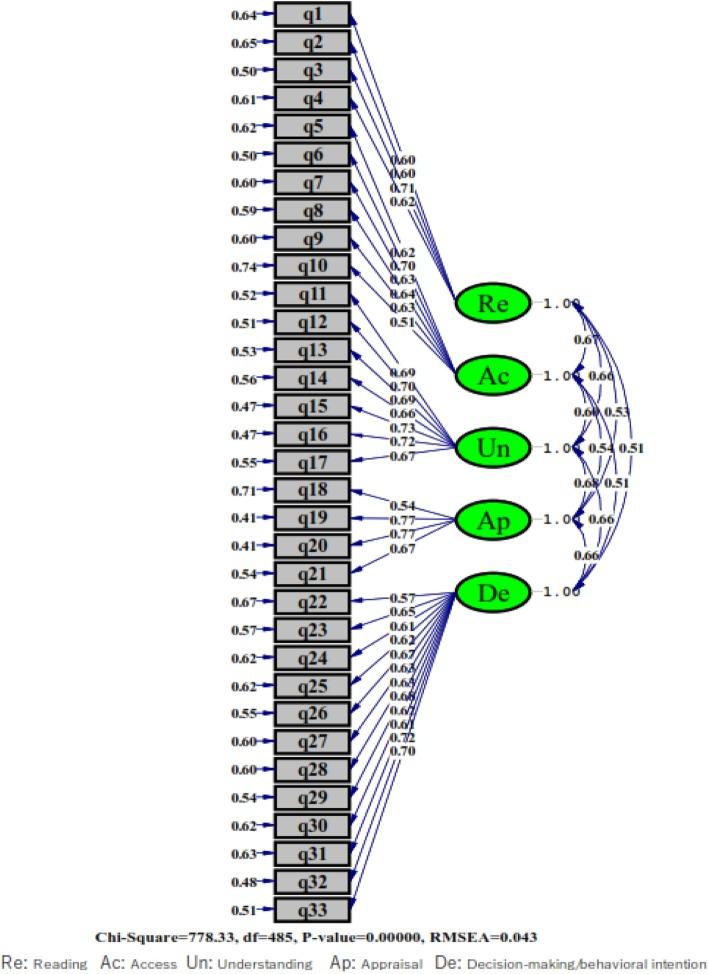
Overall, 323 adults aged 18 to 65 years old completed the questionnaire. When the exploratory factor analysis was performed, 33 items were loaded, which indicated a 5-factor solution for the questionnaire that jointly explained 52.9% of the variance observed. The factors were as follows: access to information (6 items), reading (4 items), understanding (7 items), appraisal (4 items), and decision making/behavioral intention (12 items). Confirmatory factory analysis also indicated a good fit to the data for the five-latent structure (χ2/df = 1.60, SRMR = 0.049; RMSEA = 0.043; CFI = 0.98; NFI = 0.95; NNFI = 0.98 and GFI = 0.87). Additional analysis for internal consistency showed satisfactory results with Cronbach's alpha coefficients ranging from 0.72 to 0.89. Intraclass correlation coefficient (test-retest analysis) also showed acceptable stability for the questionnaire (ICC = 0.84). The mean score for health literacy as measured by the HELIA was 76.3 (SD = 15.1) out of 100 for the study sample.
CONCLUSION
The findings suggest that the Health Literacy Instrument for Adults (HELIA) is a valid and reliable instrument for measuring health literacy. It is a short and easy-to-use instrument that could be applied in different settings.
背景
健康素养是指获取、理解、评估和使用基本健康信息以做出基本健康决策的能力。本研究旨在开发和心理测量评估一种用于测量成年人健康素养的工具(成人健康素养量表 - HELIA)。
方法
除了文献综述外,还组建了一个由不同学科的专家组成的小组来生成项目池。然后,根据健康素养的定义和最重要的全球公共卫生问题,定义了一个框架来开发初始问卷。初始问卷包含 66 个项目。接下来,邀请了 15 名公共卫生专家评估内容效度。因此,删除了 19 个项目,并提供了包含 47 个项目的暂定问卷。最后,随机抽取了一部分成年人完成了问卷,并评估了工具的心理测量特性。
结果
共有 323 名 18 至 65 岁的成年人完成了问卷。当进行探索性因素分析时,有 33 个项目被加载,表明问卷有 5 个因素解决方案,共同解释了观察到的 52.9%的方差。这些因素如下:信息获取(6 个项目)、阅读(4 个项目)、理解(7 个项目)、评估(4 个项目)和决策/行为意向(12 个项目)。验证性因素分析也表明,对于五因素结构,数据拟合良好(χ2/df=1.60,SRMR=0.049;RMSEA=0.043;CFI=0.98;NFI=0.95;NNFI=0.98 和 GFI=0.87)。内部一致性的附加分析显示,克朗巴赫的阿尔法系数在 0.72 到 0.89 之间,结果令人满意。问卷的组内相关系数(测试-再测试分析)也显示出可接受的稳定性(ICC=0.84)。HELIA 测量的健康素养平均得分为 100 分中的 76.3(SD=15.1)。
结论
研究结果表明,成人健康素养量表(HELIA)是一种测量健康素养的有效和可靠工具。它是一种简短易用的工具,可以在不同的环境中使用。
 Zotero 插件