
大根香叶醛增强环丙沙星对金黄色葡萄球菌和大肠杆菌的抗菌作用。
Cuminaldehyde potentiates the antimicrobial actions of ciprofloxacin against Staphylococcus aureus and Escherichia coli.
机构信息
Programa de Pós-graduação, Universidade Ceuma, São Luís, MA, Brazil.
Universidade Federal do Maranhão, São Luís, MA, Brazil.
出版信息
PLoS One. 2020 May 14;15(5):e0232987. doi: 10.1371/journal.pone.0232987. eCollection 2020.
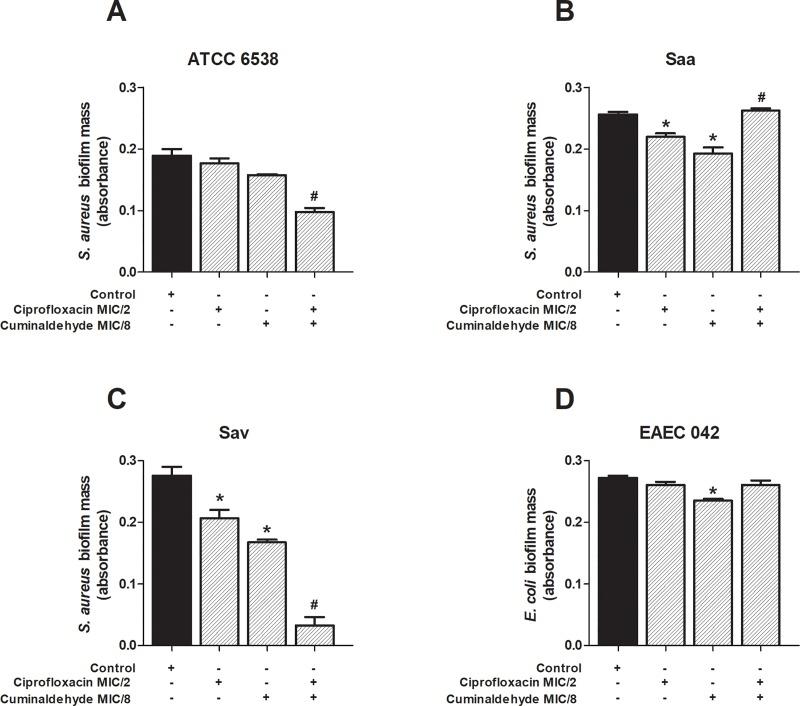
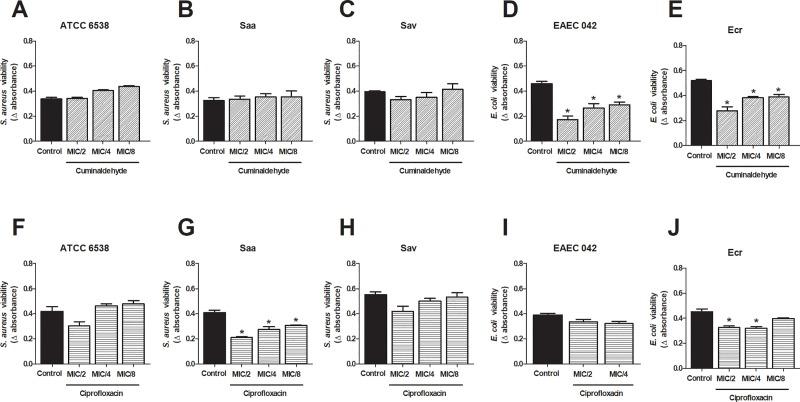
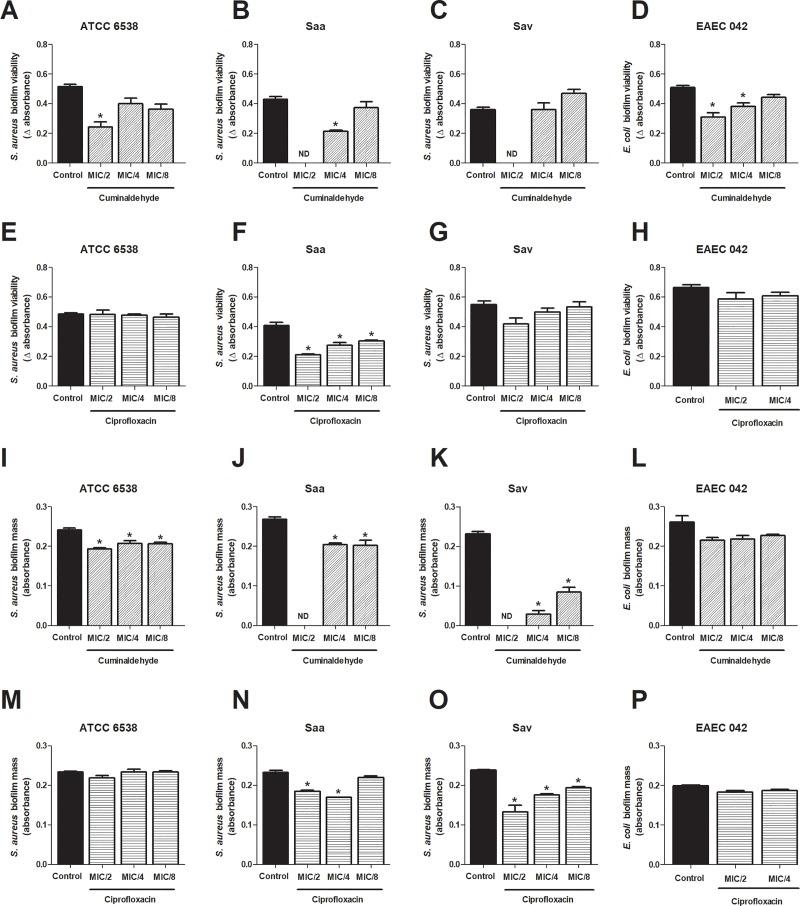
Escherichia coli and Staphylococcus aureus are important agents of urinary tract infections that can often evolve to severe infections. The rise of antibiotic-resistant strains has driven the search for novel therapies to replace the use or act as adjuvants of antibiotics. In this context, plant-derived compounds have been widely investigated. Cuminaldehyde is suggested as the major antimicrobial compound of the cumin seed essential oil. However, this effect is not fully understood. Herein, we investigated the in silico and in vitro activities of cuminaldehyde, as well as its ability to potentiate ciprofloxacin effects against S. aureus and E. coli. In silico analyses were performed by using different computational tools. The PASS online and SwissADME programmes were used for the prediction of biological activities and oral bioavailability of cuminaldehyde. For analysis of the possible toxic effects and the theoretical pharmacokinetic parameters of the compound, the Osiris, SwissADME and PROTOX programmes were used. Estimations of cuminaldehyde gastrointestinal absorption, blood brain barrier permeability and skin permeation by using SwissADME; and drug likeness and score by using Osiris, were also evaluated The in vitro antimicrobial effects of cuminaldehyde were determined by using microdilution, biofilm formation and time-kill assays. In silico analysis indicated that cuminaldehyde may act as an antimicrobial and as a membrane permeability enhancer. It was suggested to be highly absorbable by the gastrointestinal tract and likely to cross the blood brain barrier. Also, irritative and harmful effects were predicted for cuminaldehyde if swallowed at its LD50. Good oral bioavailability and drug score were also found for this compound. Cuminaldehyde presented antimicrobial and anti-biofilm effects against S. aureus and E. coli.. When co-incubated with ciprofloxacin, it enhanced the antibiotic antimicrobial and anti-biofilm actions. We suggest that cuminaldehyde may be useful as an adjuvant therapy to ciprofloxacin in S. aureus and E. coli-induced infections.
大肠埃希菌和金黄色葡萄球菌是引起尿路感染的重要病原体,常可发展为严重感染。抗生素耐药株的出现促使人们寻找新的治疗方法来替代或辅助抗生素的使用。在这种背景下,植物源性化合物已被广泛研究。枯茗醛被认为是孜然种子精油的主要抗菌化合物。然而,其作用机制尚未完全阐明。在此,我们研究了枯茗醛的体外和体内活性,以及其增强环丙沙星对金黄色葡萄球菌和大肠埃希菌作用的能力。通过使用不同的计算工具进行了计算机分析。使用 PASS 在线和 SwissADME 程序预测枯茗醛的生物活性和口服生物利用度。为分析该化合物可能的毒性作用和理论药代动力学参数,使用了 Osiris、SwissADME 和 PROTOX 程序。使用 SwissADME 预测枯茗醛的胃肠道吸收、血脑屏障通透性和皮肤渗透;使用 Osiris 预测药物相似性和评分。通过微量稀释法、生物膜形成和时间杀伤试验测定枯茗醛的体外抗菌作用。计算机分析表明,枯茗醛可能具有抗菌和膜通透性增强作用。它被认为是高度可被胃肠道吸收的,并且可能穿过血脑屏障。如果以 LD50 剂量口服,还预测枯茗醛可能具有刺激性和有害作用。该化合物还具有良好的口服生物利用度和药物评分。枯茗醛对金黄色葡萄球菌和大肠埃希菌具有抗菌和抗生物膜作用。与环丙沙星共同孵育时,增强了抗生素的抗菌和抗生物膜作用。我们认为枯茗醛可能作为金黄色葡萄球菌和大肠埃希菌感染的辅助治疗药物与环丙沙星联合使用。

 Zotero 插件