
从鸡和猪胴体及胴体处理人员中分离的金黄色葡萄球菌的分子流行病学、遗传多样性和抗菌药物耐药性
Molecular epidemiology, genetic diversity and antimicrobial resistance of Staphylococcus aureus isolated from chicken and pig carcasses, and carcass handlers.
机构信息
Department of Veterinary Public Health and Preventive Medicine, University of Nigeria, Nsukka, Enugu State, Nigeria.
Microbiology Unit, Department of Veterinary Microbiology and Pathology, University of Nigeria, Nsukka, Enugu State, Nigeria.
出版信息
PLoS One. 2020 May 14;15(5):e0232913. doi: 10.1371/journal.pone.0232913. eCollection 2020.
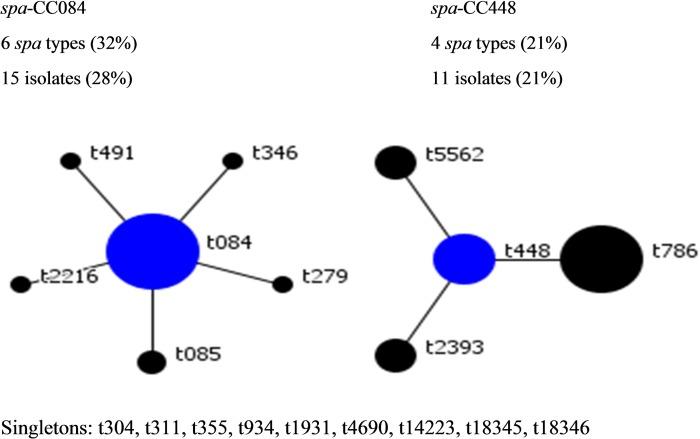
The epidemiology of Staphylococcus aureus in food animals, associated products, and their zoonotic potential in Nigeria are poorly understood. This study aimed to provide data on the prevalence, genetic characteristics and antimicrobial resistance of S. aureus isolated from chicken and pig carcasses, and persons in contact with the carcasses at slaughterhouses in Nigeria. Surface swabs were collected randomly from 600 chicken and 600 pig carcasses. Nasal swabs were collected from 45 workers in chicken slaughterhouses and 45 pig slaughterhouse workers. S. aureus isolates were analyzed by spa typing. They were also examined for presence of the Panton-Valentine Leucocidin (PVL) and mecA genes, as well as for antimicrobial resistance phenotype. Overall, 53 S. aureus isolates were recovered (28 from chicken carcasses, 17 from pig carcasses, 5 from chicken carcass handlers and 3 from pig carcass handlers). Among the isolates, 19 (35.8%) were PVL-positive and 12 (22.6%) carried the mecA gene. The 53 isolates belonged to 19 spa types. The Based Upon Repeat Pattern (BURP) algorithm separated the isolates into 2 spa-clonal complexes (spa-CC) and 9 singletons including 2 novel spa types (t18345 and t18346). The clonal complexes (CC) detected were CC1, CC5, CC8, CC15, CC88 and CC152. CC15-related isolates represented by spa type t084 (32.1%) and CC5 represented by spa type t311 (35.3%) predominated among isolates from chicken carcasses/ handlers, and pig carcasses/ handlers, respectively. Multidrug resistance exhibited by all the CC except CC8, was observed among isolates from chicken carcasses (64.3%), pig carcasses (41.2%), handlers of chicken meat (40.0%) and handlers of pork (33.3%). All the CC showed varying degrees of resistance to tetracycline while CC15 and CC5 exhibited the highest resistance to sulphamethoxazole/trimethoprim and erythromycin, respectively. The predominant antimicrobial resistance pattern observed was penicillin-tetracycline-sulphamethoxazole/trimethoprim (PEN-TET-SXT). In conclusion, food animals processed in Enugu State in Southeast Nigeria are potential vehicles for transmission of PVL-positive multiple-drug resistant S. aureus and methicillin-resistant S. aureus from farm to slaughterhouse and potentially to the human population. Public health intervention programs at pre- and post-slaughter stages should be considered in Nigerian slaughterhouses.
在尼日利亚,食品动物、相关产品中的金黄色葡萄球菌流行病学及其在人畜共患病中的潜在作用尚不清楚。本研究旨在提供尼日利亚宰前屠宰场中鸡和猪胴体及其接触者分离的金黄色葡萄球菌的流行情况、遗传特征和抗菌药物耐药性数据。随机采集 600 只鸡和 600 只猪胴体的表面拭子,采集 45 名鸡屠宰场工人和 45 名猪屠宰场工人的鼻拭子。金黄色葡萄球菌分离株通过 spa 分型进行分析。还检查了它们是否存在杀白细胞素(PVL)和 mecA 基因以及抗菌药物耐药表型。总共回收了 53 株金黄色葡萄球菌(28 株来自鸡胴体,17 株来自猪胴体,5 株来自鸡胴体处理者,3 株来自猪胴体处理者)。其中 19 株(35.8%)为 PVL 阳性,12 株(22.6%)携带 mecA 基因。53 株分离株属于 19 种 spa 型。基于重复模式(BURP)算法将分离株分为 2 个 spa 克隆复合体(spa-CC)和 9 个单克隆体,包括 2 个新的 spa 型(t18345 和 t18346)。检测到的克隆复合体(CC)包括 CC1、CC5、CC8、CC15、CC88 和 CC152。spa 型 t084(32.1%)代表的 CC15 相关分离株和 spa 型 t311(35.3%)代表的 CC5 分别在鸡胴体/处理者和猪胴体/处理者的分离株中占优势。除 CC8 外,所有 CC 均表现出不同程度的对四环素的耐药性,而鸡胴体(64.3%)、猪胴体(41.2%)、鸡肉处理者(40.0%)和猪肉处理者(33.3%)中的分离株均表现出多药耐药性。所有 CC 对磺胺甲恶唑/甲氧苄啶和红霉素的耐药性均有所不同,而 CC15 和 CC5 对磺胺甲恶唑/甲氧苄啶和红霉素的耐药性最高。观察到的主要抗菌药物耐药模式是青霉素-四环素-磺胺甲恶唑/甲氧苄啶(PEN-TET-SXT)。总之,在尼日利亚东南部的埃努古州加工的食用动物是从农场到屠宰场并可能传播到人群的 PVL 阳性多重耐药金黄色葡萄球菌和耐甲氧西林金黄色葡萄球菌的潜在载体。应考虑在尼日利亚的屠宰场实施宰前和宰后阶段的公共卫生干预措施。
 Zotero 插件