
运动训练通过TrkB信号通路调节谷氨酸脱羧酶-65/67的表达,以改善脊髓损伤大鼠的神经性疼痛。
Exercise training modulates glutamic acid decarboxylase-65/67 expression through TrkB signaling to ameliorate neuropathic pain in rats with spinal cord injury.
作者信息
Li Xiangzhe, Wang Qinghua, Ding Jie, Wang Sheng, Dong Chuanming, Wu Qinfeng
机构信息
Rehabilitation Medical Center, the Affiliated Suzhou Science & Technology Town Hospital of Nanjing Medical University, Suzhou, Jiangsu, People's Republic of China.
Laboratory Animal Center, Nantong University, Nantong, Jiangsu, People's Republic of China.
出版信息
Mol Pain. 2020 Jan-Dec;16:1744806920924511. doi: 10.1177/1744806920924511.
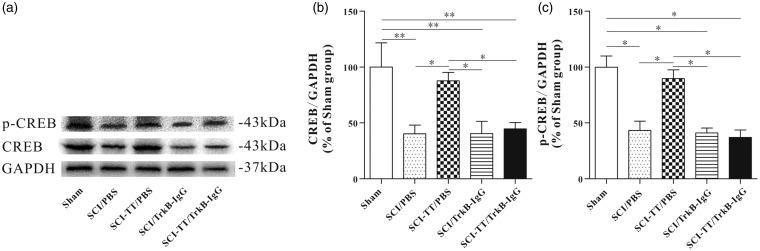
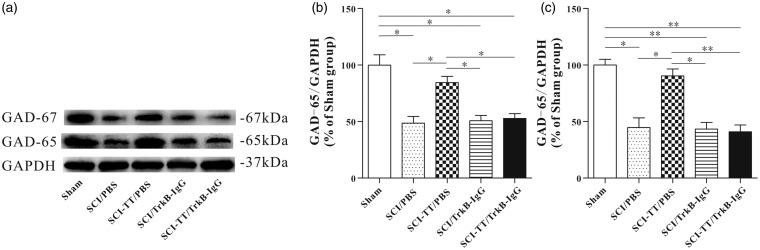
Neuropathic pain is one of the most frequently stated complications after spinal cord injury. In post-spinal cord injury, the decrease of gamma aminobutyric acid synthesis within the distal spinal cord is one of the main causes of neuropathic pain. The predominant research question of this study was whether exercise training may promote the expression of glutamic acid decarboxylase-65 and glutamic acid decarboxylase-67, which are key enzymes of gamma aminobutyric acid synthesis, within the distal spinal cord through tropomyosin-related kinase B signaling, as its synthesis assists to relieve neuropathic pain after spinal cord injury. Animal experiment was conducted, and all rats were allocated into five groups: Sham group, SCI/PBS group, SCI-TT/PBS group, SCI/tropomyosin-related kinase B-IgG group, and SCI-TT/tropomyosin-related kinase B-IgG group, and then T10 contusion SCI model was performed as well as the tropomyosin-related kinase B-IgG was used to block the tropomyosin-related kinase B activation. Mechanical withdrawal thresholds and thermal withdrawal latencies were used for assessing pain-related behaviors. Western blot analysis was used to detect the expression of brain-derived neurotrophic factor, tropomyosin-related kinase B, CREB, p-REB, glutamic acid decarboxylase-65, and glutamic acid decarboxylase-67 within the distal spinal cord. Immunohistochemistry was used to analyze the distribution of CREB, p-CREB, glutamic acid decarboxylase-65, and glutamic acid decarboxylase-67 within the distal spinal cord dorsal horn. The results showed that exercise training could significantly mitigate the mechanical allodynia and thermal hyperalgesia in post-spinal cord injury and increase the synthesis of brain-derived neurotrophic factor, tropomyosin-related kinase B, CREB, p-CREB, glutamic acid decarboxylase-65, and glutamic acid decarboxylase-67 within the distal spinal cord. After the tropomyosin-related kinase B signaling was blocked, the analgesic effect of exercise training was inhibited, and in the SCI-TT/tropomyosin-related kinase B-IgG group, the synthesis of CREB, p-CREB, glutamic acid decarboxylase-65, and glutamic acid decarboxylase-67 within the distal spinal cord were also significantly reduced compared with the SCI-TT/PBS group. This study shows that exercise training may increase the glutamic acid decarboxylase-65 and glutamic acid decarboxylase-67 expression within the spinal cord dorsal horn through the tropomyosin-related kinase B signaling, and this mechanism may play a vital role in relieving the neuropathic pain of rats caused by incomplete SCI.
神经性疼痛是脊髓损伤后最常提及的并发症之一。在脊髓损伤后,脊髓远端γ-氨基丁酸合成减少是神经性疼痛的主要原因之一。本研究的主要研究问题是运动训练是否可通过原肌球蛋白相关激酶B信号通路促进脊髓远端γ-氨基丁酸合成的关键酶谷氨酸脱羧酶-65和谷氨酸脱羧酶-67的表达,因为其合成有助于缓解脊髓损伤后的神经性疼痛。进行了动物实验,所有大鼠被分为五组:假手术组、脊髓损伤/磷酸盐缓冲液组、脊髓损伤-运动训练/磷酸盐缓冲液组、脊髓损伤/原肌球蛋白相关激酶B-免疫球蛋白G组和脊髓损伤-运动训练/原肌球蛋白相关激酶B-免疫球蛋白G组,然后建立T10挫伤性脊髓损伤模型,并使用原肌球蛋白相关激酶B-免疫球蛋白G阻断原肌球蛋白相关激酶B的激活。采用机械缩足阈值和热缩足潜伏期评估疼痛相关行为。采用蛋白质免疫印迹分析检测脊髓远端脑源性神经营养因子、原肌球蛋白相关激酶B、CREB、p-CREB、谷氨酸脱羧酶-65和谷氨酸脱羧酶-67的表达。采用免疫组织化学分析脊髓背角CREB、p-CREB、谷氨酸脱羧酶-65和谷氨酸脱羧酶-67的分布。结果表明,运动训练可显著减轻脊髓损伤后的机械性异常疼痛和热痛觉过敏,并增加脊髓远端脑源性神经营养因子、原肌球蛋白相关激酶B、CREB、p-CREB、谷氨酸脱羧酶-65和谷氨酸脱羧酶-67的合成。原肌球蛋白相关激酶B信号通路被阻断后,运动训练的镇痛作用受到抑制,且在脊髓损伤-运动训练/原肌球蛋白相关激酶B-免疫球蛋白G组中,脊髓远端CREB、p-CREB、谷氨酸脱羧酶-65和谷氨酸脱羧酶-67的合成与脊髓损伤-运动训练/磷酸盐缓冲液组相比也显著降低。本研究表明,运动训练可能通过原肌球蛋白相关激酶B信号通路增加脊髓背角谷氨酸脱羧酶-65和谷氨酸脱羧酶-67的表达,且该机制可能在缓解不完全性脊髓损伤所致大鼠神经性疼痛中起重要作用。



 Zotero 插件