
支链型表面活性剂如何稳定胶束中的 G 蛋白偶联受体?
How Do Branched Detergents Stabilize GPCRs in Micelles?
机构信息
Department of Computational and Quantitative Medicine, Beckman Research Institute of the City of Hope, 1500 East Duarte Road, Duarte, California 91010, United States.
Heptares Therapeutics Ltd., BioPark, Broadwater Road, Welwyn Garden City, AL7 3AX, U.K.
出版信息
Biochemistry. 2020 Jun 16;59(23):2125-2134. doi: 10.1021/acs.biochem.0c00183. Epub 2020 Jun 5.
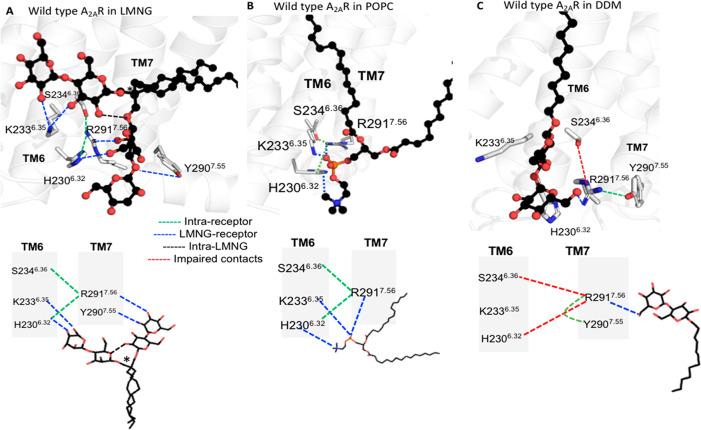
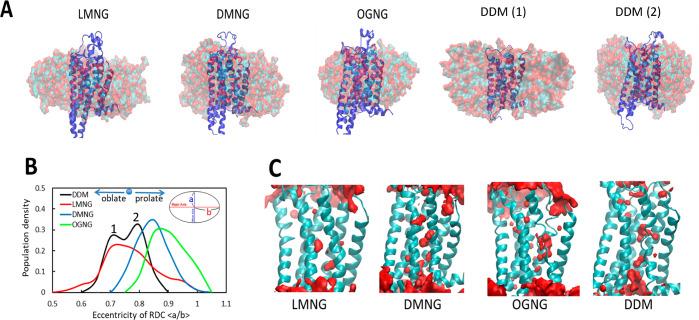
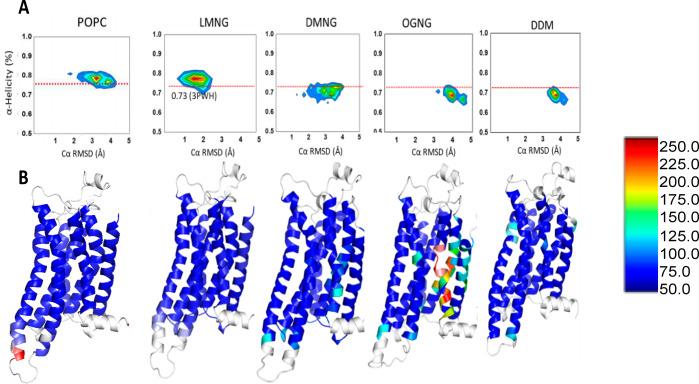
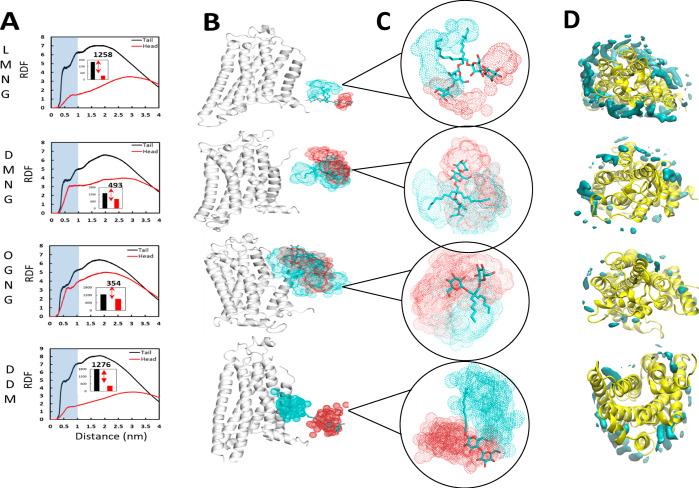
The structural and functional properties of G protein-coupled receptors (GPCRs) are often studied in a detergent micellar environment, but many GPCRs tend to denature or aggregate in short alkyl chain detergents. In our previous work [Lee, S., et al. (2016) , 15425-15433], we showed that GPCRs in alkyl glucosides were highly dynamic, resulting in the penetration of detergent molecules between transmembrane α-helices, which is the initial step in receptor denaturation. Although this was not observed for GPCRs in dodecyl maltoside (DDM, also known as lauryl maltoside), even this detergent is not mild enough to preserve the integrity of many GPCRs during purification. Lauryl maltose neopentylglycol (LMNG) detergents have been found to have significant advantages for purifying GPCRs in a native state as they impart more stability to the receptor than DDM. To gain insights into how they stabilize GPCRs, we used atomistic molecular dynamics simulations of wild type adenosine A receptor (WT-AR), thermostabilized AR (tAR), and wild type β-adrenoceptor (βAR) in a variety of detergents (LMNG, DMNG, OGNG, and DDM). Analysis of molecular dynamics simulations of tAR in LMNG, DMNG, and OGNG showed that this series of detergents exhibited behavior very similar to that of an analogous series of detergents DDM, DM, and OG in our previous study. However, there was a striking difference upon comparison of the behavior of LMNG to that of DDM. LMNG showed considerably less motion than DDM, which resulted in the enhanced density of the aliphatic chains around the hydrophobic regions of the receptor and considerably more hydrogen bond formation between the head groups. This contributed to enhanced interaction energies between both detergent molecules and between the receptor and detergent, explaining the enhanced stability of GPCRs purified in this detergent. Branched detergents occlude between transmembrane helices and reduce their flexibility. Our results provide a rational foundation to develop detergent variants for stabilizing membrane proteins.
G 蛋白偶联受体(GPCR)的结构和功能特性通常在胶束环境中进行研究,但许多 GPCR 在短链烷基洗涤剂中容易变性或聚集。在我们之前的工作中[Lee, S., et al. (2016), 15425-15433],我们表明烷基葡萄糖苷中的 GPCR 非常具有动态性,导致洗涤剂分子渗透到跨膜α-螺旋之间,这是受体变性的初始步骤。虽然十二烷基麦芽糖(DDM,也称为月桂基麦芽糖)中的 GPCR 没有观察到这种情况,但即使是这种洗涤剂也不足以在纯化过程中保持许多 GPCR 的完整性。研究发现,月桂基麦芽糖新戊二醇(LMNG)洗涤剂在保持 GPCR 天然状态方面具有显著优势,因为它们比 DDM 更能稳定受体。为了深入了解它们如何稳定 GPCR,我们使用各种洗涤剂(LMNG、DMNG、OGNG 和 DDM)中野生型腺苷 A 受体(WT-AR)、热稳定化 AR(tAR)和野生型β-肾上腺素受体(βAR)的原子分子动力学模拟。对 tAR 在 LMNG、DMNG 和 OGNG 中的分子动力学模拟分析表明,这一系列洗涤剂的行为与我们之前研究中类似系列洗涤剂 DDM、DM 和 OG 的行为非常相似。然而,当比较 LMNG 和 DDM 的行为时,存在显著差异。与 DDM 相比,LMNG 的运动性要小得多,这导致受体疏水区周围的脂肪链密度增加,头基之间形成更多的氢键。这有助于增强洗涤剂分子之间以及受体与洗涤剂之间的相互作用能,解释了在这种洗涤剂中纯化的 GPCR 稳定性增强的原因。支链洗涤剂会阻塞跨膜螺旋之间的空间,并降低其灵活性。我们的研究结果为开发稳定膜蛋白的洗涤剂变体提供了合理的基础。


 Zotero 插件