
开发一种新的预后标志物,用于预测膀胱癌患者的总生存期。
Development of a novel prognostic signature for predicting the overall survival of bladder cancer patients.
机构信息
Medical Laboratory of the Third Affiliated Hospital of Shenzhen University, Shenzhen 518001, China.
出版信息
Biosci Rep. 2020 Jun 26;40(6). doi: 10.1042/BSR20194432.
BACKGROUND
Bladder cancer is one of the most common malignancies. So far, no effective biomarker for bladder cancer prognosis has been identified. Aberrant DNA methylation is frequently observed in the bladder cancer and holds considerable promise as a biomarker for predicting the overall survival (OS) of patients.
MATERIALS AND METHODS
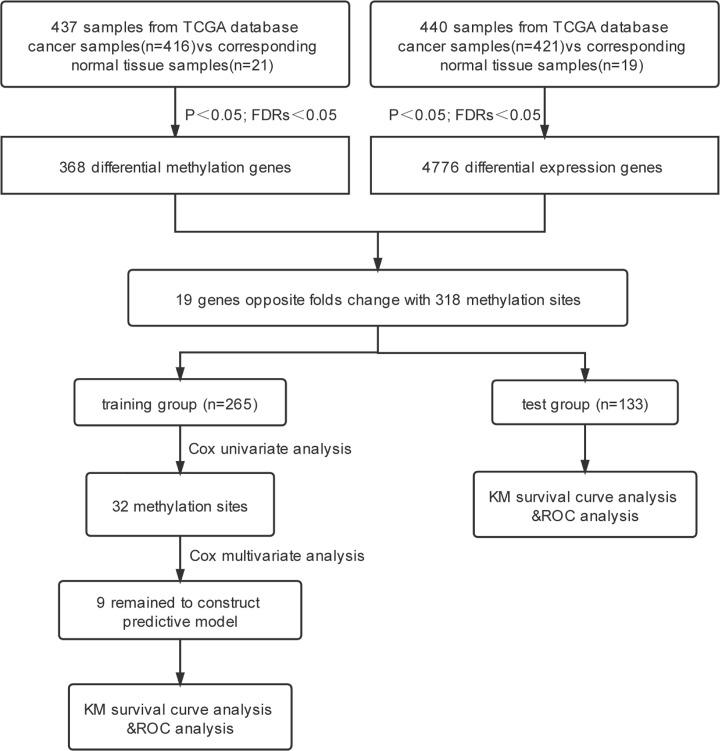
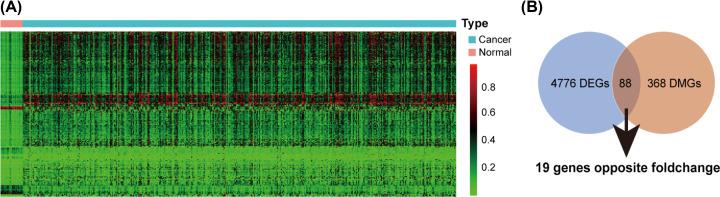
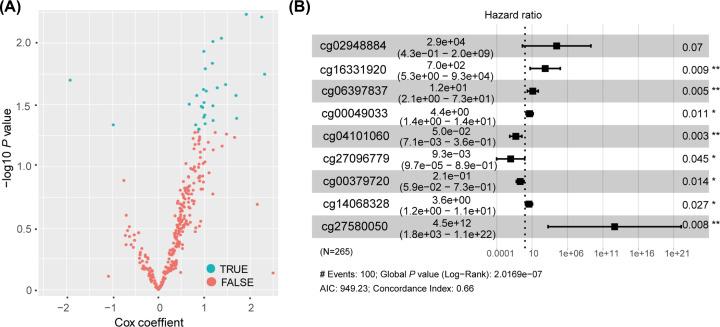
We downloaded the DNA methylation and transcriptome data for bladder cancer from The Cancer Genome Atlas (TCGA), a public database, screened hypo-methylated and up-regulated genes, similarly, hyper-methylation with low expression genes, then retrieved the relevant methylation sites. Cox regression analysis was used to identify a nine-methylation site signature of a training group. Predictive ability was validated in a test group by receiver operating characteristic (ROC) analysis.
RESULTS
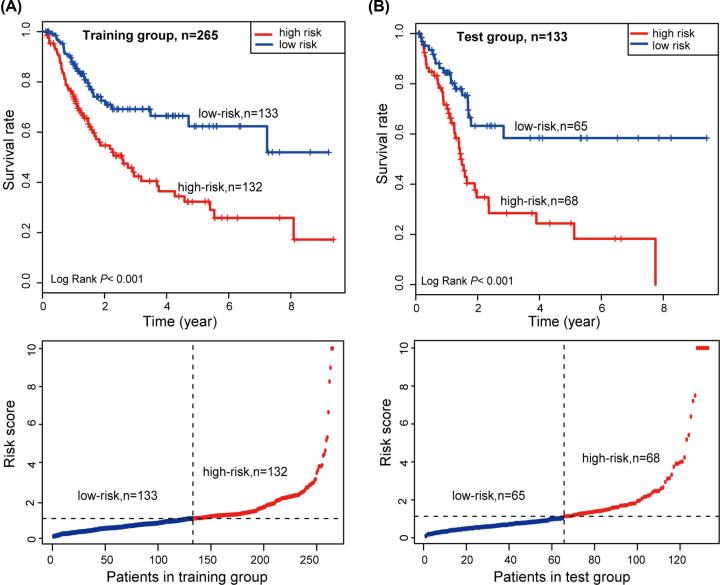
We identified nine bladder cancer-specific methylation sites as potential prognostic biomarkers and established a risk score system based on the methylation site signature to evaluate the OS. The performance of the signature was accurate, with area under curve was 0.73 in the training group and 0.71 in the test group. Taking clinical features into consideration, we constructed a nomogram consisting of the nine-methylation site signature and patients' clinical variables, and found that the signature was an independent risk factor.
CONCLUSIONS
Overall, the significant nine methylation sites could be novel prediction biomarkers, which could aid in treatment and also predict the overall survival likelihoods of bladder cancer patients.
背景
膀胱癌是最常见的恶性肿瘤之一。到目前为止,尚未发现用于膀胱癌预后的有效生物标志物。膀胱癌中经常观察到异常的 DNA 甲基化,作为预测患者总生存期(OS)的生物标志物具有很大的潜力。
材料与方法
我们从公共数据库 The Cancer Genome Atlas(TCGA)中下载了膀胱癌的 DNA 甲基化和转录组数据,筛选出低甲基化和上调的基因,同样,低甲基化和低表达的基因,然后检索相关的甲基化位点。使用 Cox 回归分析识别训练组中的九个甲基化位点特征。通过接受者操作特征(ROC)分析在测试组中验证预测能力。
结果
我们确定了九个膀胱癌特异性甲基化位点作为潜在的预后生物标志物,并基于甲基化位点特征建立了风险评分系统来评估 OS。该特征的性能准确,在训练组中的曲线下面积为 0.73,在测试组中的曲线下面积为 0.71。考虑到临床特征,我们构建了一个包含九个甲基化位点特征和患者临床变量的列线图,发现该特征是一个独立的危险因素。
结论
总体而言,这九个显著的甲基化位点可能是新的预测生物标志物,可用于辅助治疗,并预测膀胱癌患者的总体生存率。


 Zotero 插件