
补充婴儿配方奶粉对肠道生物标志物和微生物群的早期影响:一项随机临床试验。
Early Effect of Supplemented Infant Formulae on Intestinal Biomarkers and Microbiota: A Randomized Clinical Trial.
机构信息
CIC INSERM U1404, Department of Pediatric, Rouen University Hospital Charles Nicolle, 76031 Rouen, France.
Department of Neonatology, Alexandra Regional General Hospital, 11528 Athens, Greece.
出版信息
Nutrients. 2020 May 20;12(5):1481. doi: 10.3390/nu12051481.
BACKGROUND
Post-natal gut maturation in infants interrelates maturation of the morphology, digestive, and immunological functions and gut microbiota development. Here, we explored both microbiota development and markers of gut barrier and maturation in healthy term infants during their early life to assess the interconnection of gut functions during different infant formulae regimes.
METHODS
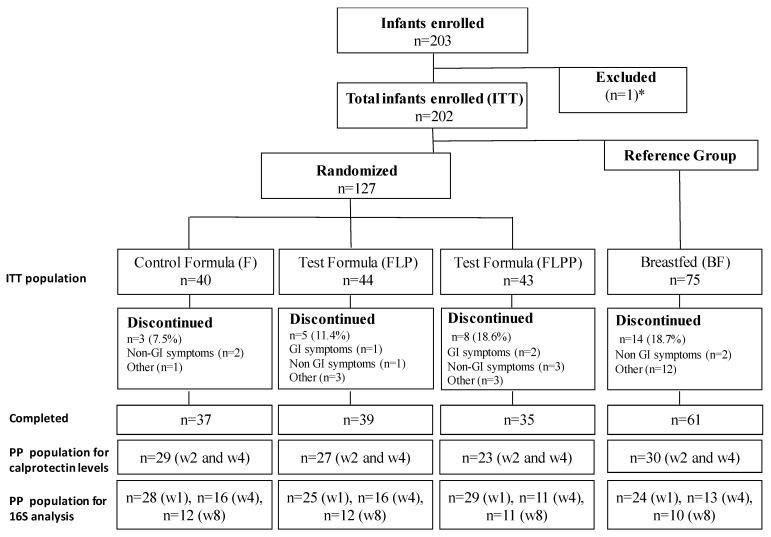
A total of 203 infants were enrolled in this randomized double-blind controlled trial including a breastfed reference group. Infants were fed starter formulae for the first four weeks of life, supplemented with different combination of nutrients (lactoferrin, probiotics ( subsp. ) and prebiotics (Bovine Milk-derived Oligosaccharides-BMOS)) and subsequently fed the control formula up to eight weeks of life. Stool microbiota profiles and biomarkers of early gut maturation, calprotectin (primary outcome), elastase, α-1 antitrypsin (AAT) and neopterin were measured in feces at one, two, four, and eight weeks.
RESULTS
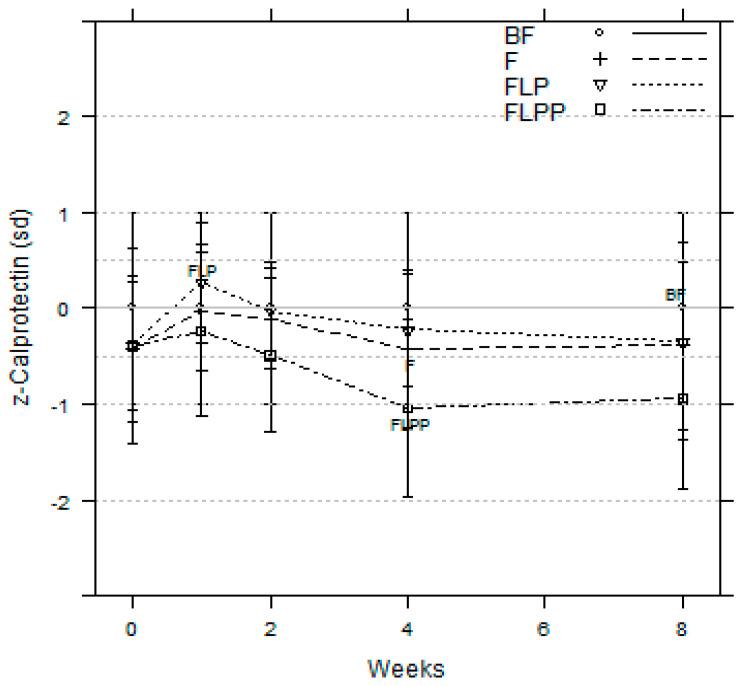
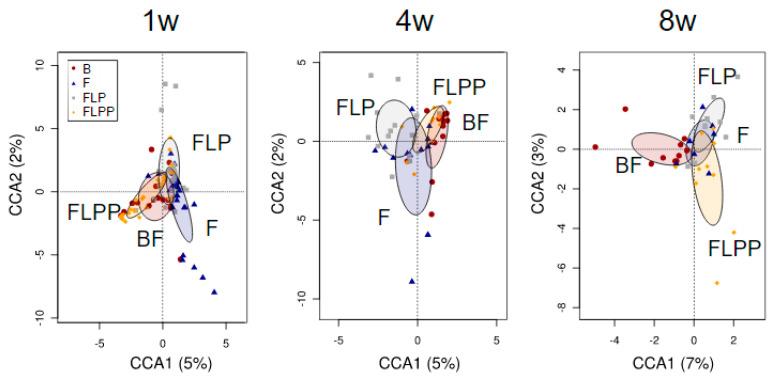
Infants fed formula containing BMOS had lower mean calprotectin levels over the first two to four weeks compared to the other formula groups. Elastase and AAT levels were closer to levels observed in breastfed infants. No differences were observed for neopterin. Global differences between the bacterial communities of all groups were assessed by constrained multivariate analysis with hypothesis testing. The canonical correspondence analysis (CCA) at genus level showed overlap between microbiota profiles at one and four weeks of age in the BMOS supplemented formula group with the breastfed reference, dominated by bifidobacteria. Microbiota profiles of all groups at four weeks were significantly associated with the calprotectin levels at 4 (CCA, = 0.018) and eight weeks of age (CCA, = 0.026).
CONCLUSION
A meaningful correlation was observed between changes in microbiota composition and gut maturation marker calprotectin. The supplementation with BMOS seems to favor gut maturation closer to that of breastfed infants.
背景
婴儿出生后的肠道成熟与形态、消化和免疫功能以及肠道微生物群的发育成熟有关。在这里,我们在生命早期探索了健康足月婴儿的微生物群发育和肠道屏障及成熟标志物,以评估不同婴儿配方奶粉喂养方案下肠道功能的相互关系。
方法
本随机双盲对照试验共纳入 203 名婴儿,包括母乳喂养参考组。婴儿在生命的前四周内喂养起始配方奶粉,并用不同组合的营养物质(乳铁蛋白、益生菌(亚种)和益生元(牛乳来源低聚糖-BMOS))进行补充,随后在八周龄内喂养对照配方奶粉。在一周、两周、四周和八周时,测量粪便中的粪便微生物群谱和早期肠道成熟标志物,钙卫蛋白(主要结局)、弹性蛋白酶、α-1 抗胰蛋白酶(AAT)和新蝶呤。
结果
与其他配方组相比,喂食含有 BMOS 的配方的婴儿在前两周至四周内的平均钙卫蛋白水平较低。弹性蛋白酶和 AAT 水平更接近母乳喂养婴儿的水平。新蝶呤没有差异。通过具有假设检验的约束多元分析评估所有组之间的细菌群落的整体差异。在 BMOS 补充配方组中,双歧杆菌为主的属水平的典范对应分析(CCA)显示出与母乳喂养参考组在 1 周和 4 周时的微生物群谱重叠。所有组在 4 周时的微生物群谱与 4 周和 8 周时的钙卫蛋白水平显著相关(CCA, = 0.018;CCA, = 0.026)。
结论
观察到微生物群组成的变化与肠道成熟标志物钙卫蛋白之间存在有意义的相关性。BMOS 的补充似乎更有利于肠道成熟,使其更接近母乳喂养婴儿。

 Zotero 插件