
基于 NMR 的化学分析、从栽培的 Heldr 中分离和评估二萜类 siderol 的细胞毒性潜力
NMR-Based Chemical Profiling, Isolation and Evaluation of the Cytotoxic Potential of the Diterpenoid Siderol from Cultivated Heldr.
机构信息
Department of Pharmacognosy & Chemistry of Natural Products, School of Pharmacy, National and Kapodistrian University of Athens, Panepistimiopolis, Zografou, 15771 Athens, Greece.
Department of Chemistry, Section of Organic Chemistry and Biochemistry, University of Ioannina, 45110 Ioannina, Greece.
出版信息
Molecules. 2020 May 20;25(10):2382. doi: 10.3390/molecules25102382.
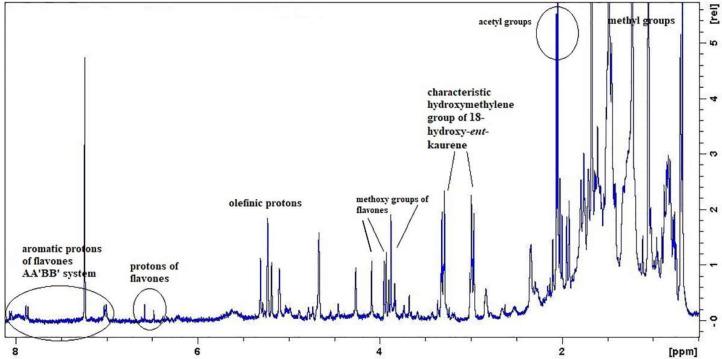
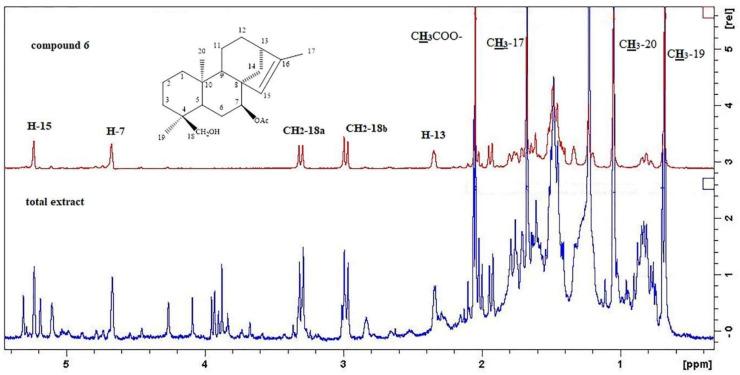
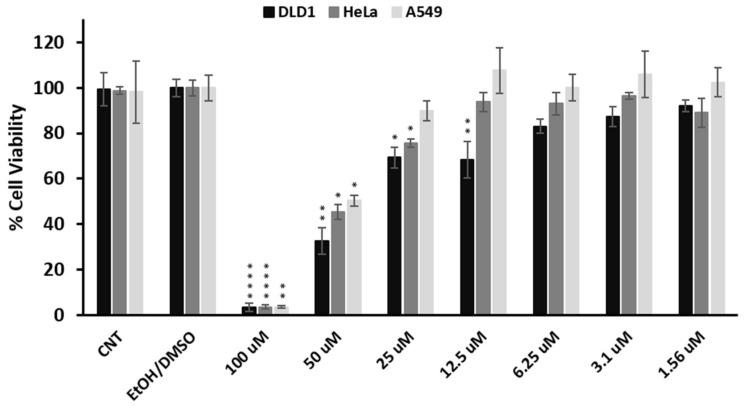
Diterpenes are characteristic compounds from the genus L., possessing an array of biological activities. Siderol is the main constituent of the -kaurene diterpenes in species. In order to isolate the specific compound and evaluate for the first time its cytotoxic activity, we explored the dichloromethane extract of cultivated Heldr. To track the specific natural bioactive agent, we applied NMR spectroscopy to the crude plant extract, since NMR can serve as a powerful and rapid tool both to navigate the targeted isolation process of bioactive constituents, and to also reveal the identity of bioactive components. Along these lines, from the rapid 1D H NMR spectrum of the total crude plant extract, we were able to determine the characteristic proton NMR signals of siderol. Furthermore, with the same NMR spectrum, we were able to categorize several secondary metabolites into chemical groups as a control of the isolation process. Therefore, this non-polar extract was explored, for the first time, revealing eleven compounds-one fatty acid ester; 2-(-hydroxyphenyl)ethylstearate (), three phytosterols; β-sitosterol (), stigmasterol (), and campesterol (); one triterpenoid; ursolic acid (), four diterpenoids; siderol (), eubol (), eubotriol (), 7-epicandicandiol () and two flavonoids; xanthomicrol () and penduletin (). The main isolated constituent was siderol. The antiproliferative potential of siderol was evaluated, using the MTT (3-(4,5-Dimethylthiazol-2-yl)-2,5-Diphenyltetrazolium Bromide) assay, on three human cancer cell lines DLD1, HeLa, and A549, where the IC values were estimated at 26.4 ± 3.7, 44.7 ± 7.2, and 46.0 ± 4.9 μΜ, respectively. The most potent activity was recorded in the human colon cancer cell line DLD1, where siderol exhibited the lowest IC. Our study unveiled the beneficial potential of siderol as a remarkable cytotoxic agent and the significant contribution of NMR spectroscopy towards the isolation and identification of this potent anticancer agent.
二萜是 属的特征化合物,具有多种生物活性。 siderol 是 种中 -kaurene 二萜的主要成分。为了分离特定的化合物并首次评估其细胞毒性活性,我们探索了栽培的 Heldr 的二氯甲烷提取物。为了追踪特定的天然生物活性物质,我们将 NMR 光谱应用于粗提植物提取物,因为 NMR 既可以作为靶向分离生物活性成分的强大快速工具,也可以揭示生物活性成分的身份。沿着这些思路,从总粗提植物提取物的快速 1D H NMR 谱中,我们能够确定 siderol 的特征质子 NMR 信号。此外,通过相同的 NMR 谱,我们能够将几种次生代谢物归类为化学基团,以控制分离过程。因此,首次对这种非极性提取物进行了探索,共分离出 11 种化合物-1 种脂肪酸酯;2-(-羟基苯基)乙基硬脂酸酯(),3 种植物甾醇;β-谷甾醇(),豆甾醇()和菜油甾醇();1 种三萜酸;熊果酸(),4 种二萜;siderol (),eubol (),eubotriol (),7-epicandicandiol ()和 2 种黄酮;黄烷酮()和 penduletin ()。主要分离的成分是 siderol。使用 MTT(3-(4,5-二甲基噻唑-2-基)-2,5-二苯基四氮唑溴化物)测定法评估 siderol 的抗增殖潜力,在三个人类癌细胞系 DLD1、HeLa 和 A549 上,IC 值分别估计为 26.4 ± 3.7、44.7 ± 7.2 和 46.0 ± 4.9 μΜ。在人类结肠癌细胞系 DLD1 中记录到最强的活性,siderol 表现出最低的 IC。我们的研究揭示了 siderol 作为一种显著的细胞毒性剂的有益潜力,以及 NMR 光谱对这种有效抗癌剂的分离和鉴定的重要贡献。

 Zotero 插件