
发热与不明原因发热:综述、最新进展及遗留的教条观念
Fever and Fever of Unknown Origin: Review, Recent Advances, and Lingering Dogma.
作者信息
Wright William F, Auwaerter Paul G
机构信息
Division of Infectious Diseases, Department of Medicine, Johns Hopkins University School of Medicine Baltimore, Maryland, USA.
出版信息
Open Forum Infect Dis. 2020 May 2;7(5):ofaa132. doi: 10.1093/ofid/ofaa132. eCollection 2020 May.
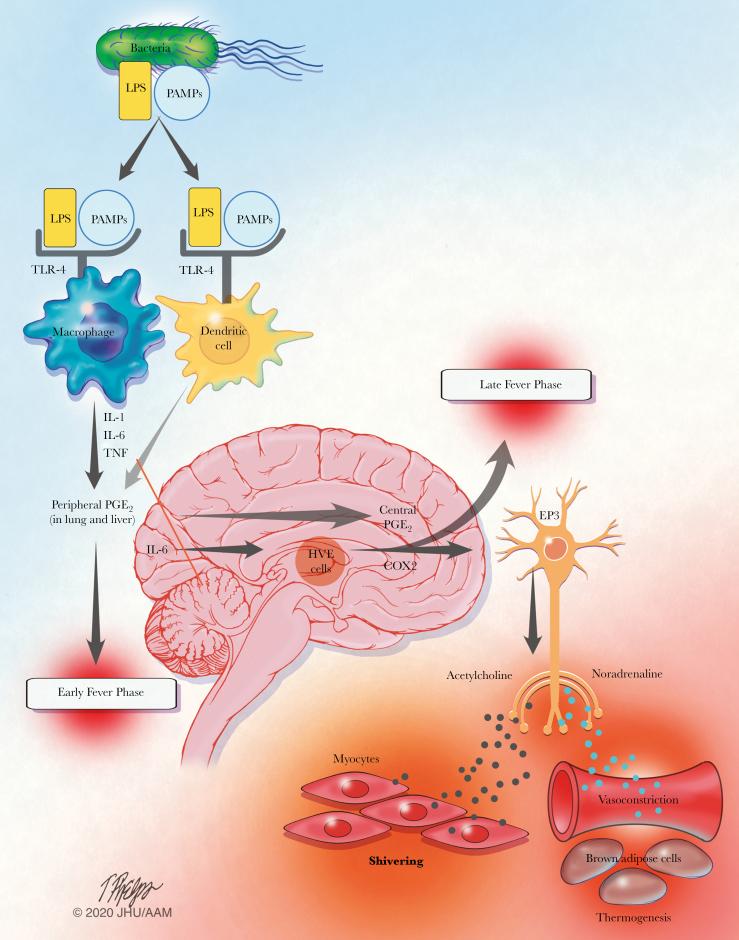
Fever has preoccupied physicians since the earliest days of clinical medicine. It has been the subject of scrutiny in recent decades. Historical convention has mostly determined that 37.0°C (98.6°F) should be regarded as normal body temperature, and more modern evidence suggests that fever is a complex physiological response involving the innate immune system and should not be characterized merely as a temperature above this threshold. Fever of unknown origin (FUO) was first defined in 1961 by Petersdorf and Beeson and continues to be a clinical challenge for physicians. Although clinicians may have some understanding of the history of clinical thermometry, how average body temperatures were established, thermoregulation, and pathophysiology of fever, new concepts are emerging. While FUO subgroups and etiologic classifications have remained unchanged since 1991 revisions, the spectrum of diseases, clinical approach to diagnosis, and management are changing. This review considers how newer data should influence both definitions and lingering dogmatic principles. Despite recent advances and newer imaging techniques such as 18-fluorodeoxyglucose-positron emission tomography, clinical judgment remains an essential component of care.
从临床医学最早期开始,发热就一直困扰着医生。近几十年来,它一直是仔细审查的对象。历史惯例大多认定37.0°C(98.6°F)应被视为正常体温,而更多现代证据表明,发热是一种涉及先天免疫系统的复杂生理反应,不应仅仅被定义为高于此阈值的体温。不明原因发热(FUO)最早于1961年由彼得斯多夫和比森定义,至今仍是医生面临的临床挑战。尽管临床医生可能对临床体温测量的历史、平均体温的确定方式、体温调节以及发热的病理生理学有所了解,但新的概念正在不断涌现。自1991年修订以来,虽然FUO的亚组和病因分类一直没有变化,但疾病谱、临床诊断方法和治疗正在发生改变。这篇综述探讨了更新的数据应如何影响定义和长期存在的教条性原则。尽管最近有了进展以及更新的成像技术,如18氟脱氧葡萄糖正电子发射断层扫描,但临床判断仍然是医疗护理的重要组成部分。

 Zotero 插件