
基线骨转换标志物水平评估及对利塞膦酸盐治疗的反应:来自一项日本III期试验的数据。
Assessment of baseline bone turnover marker levels and response to risedronate treatment: Data from a Japanese phase III trial.
作者信息
Mawatari Taro, Ikemura Satoshi, Matsui Gen, Iguchi Takahiro, Mitsuyasu Hiroaki, Kawahara Shinya, Maehara Masayuki, Muraoka Ryoichi, Iwamoto Yukihide, Nakashima Yasuharu
机构信息
Department of Orthopedic Surgery, Hamanomachi Hospital, Fukuoka, Japan.
Department of Orthopedic Surgery, Graduate School of Medical Sciences, Kyushu University, Fukuoka, Japan.
出版信息
Bone Rep. 2020 Apr 25;12:100275. doi: 10.1016/j.bonr.2020.100275. eCollection 2020 Jun.
BACKGROUND
Risedronate increases bone mineral density (BMD) and reduces fracture risk, but treatment response may depend on the baseline state of bone turnover. Data regarding the selection of therapeutic drugs or the prediction of therapeutic effects with baseline levels of bone turnover markers (BTMs) as a reference are insufficient. We hypothesized that when the baseline levels of BTMs are higher, baseline BMD might be lower, changes in BMD at 12 months after risedronate treatment might be higher, and the reduction of fracture incidence might be greater. This study aimed to analyze the data of a phase III clinical trial of risedronate from Japan to investigate the relationships between baseline BTM levels and (1) baseline BMD, (2) changes in BMD at 12 months after the start of treatment, and (3) the incidence of new vertebral fractures.
METHODS
This post-hoc analysis included 788 postmenopausal women with osteoporosis whose baseline BTM levels as well as baseline and endpoint BMDs were measured. Relationships between baseline BTM levels and BMD at baseline and 12 months after risedronate treatment and new vertebral fractures were examined. One-way analysis of variance, two-tailed Student's -test, and Fisher's exact test were used to analyze the data.
RESULTS
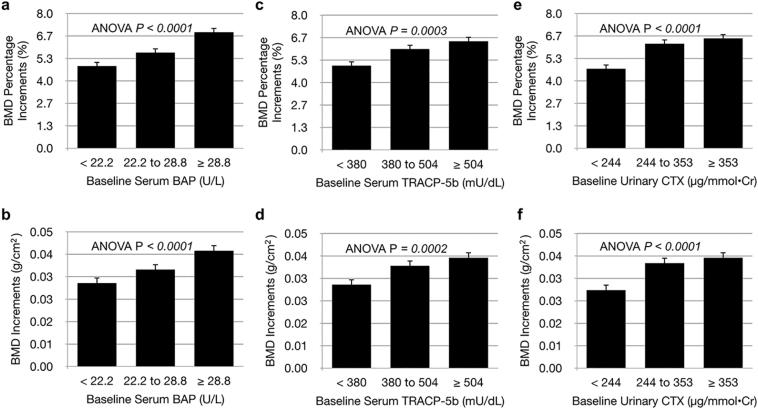
Baseline BMD showed a significant upward trend when baseline BTM levels were lower in the analysis by tertiles. New vertebral fractures tended to occur in patients with prevalent vertebral fractures, but the relationship between new fractures and BTM levels was not statistically significant. Regardless of BTM types, BMD percentage increments (%) and increments (g/cm) with the 12-month treatment were high when pretreatment BTM levels were high (P < 0.0001), and a >5.0% increase in BMD was observed even if baseline BTM levels were within the normal range. A new vertebral fracture occurred in only six patients (0.77%), and there was not enough statistical power to clarify the relationship between baseline BTM levels and fracture risk reduction.
CONCLUSIONS
When pretreatment BTM levels increased, baseline BMD tended to be lower and the increase in BMD with 12-month risedronate treatment was higher. However, BMD could still be increased even if the baseline BTM levels are within the normal range. Combined with available evidence, baseline BTMs may not have an important role in deciding the optimal therapy. To elucidate the relationship between baseline BTM levels and long-term fracture risk, it will be necessary to conduct more large-scale studies with a longer follow-up period in severe osteoporotic patients with a high fracture risk.
MINI ABSTRACT
We evaluated the significance of baseline bone turnover markers in the response to risedronate treatment. The increase in the bone mineral density (BMD) with the 12-month treatment may be higher when the state of bone turnover at baseline is higher, and BMD could still be increased even if the baseline bone turnover is within the normal range.
背景
利塞膦酸盐可增加骨矿物质密度(BMD)并降低骨折风险,但治疗反应可能取决于骨转换的基线状态。以骨转换标志物(BTMs)的基线水平作为参考来选择治疗药物或预测治疗效果的数据并不充分。我们假设,当BTMs的基线水平较高时,基线BMD可能较低,利塞膦酸盐治疗12个月后BMD的变化可能较大,且骨折发生率的降低可能更大。本研究旨在分析一项来自日本的利塞膦酸盐III期临床试验的数据,以研究基线BTM水平与(1)基线BMD、(2)治疗开始后12个月时BMD的变化以及(3)新椎体骨折发生率之间的关系。
方法
这项事后分析纳入了788名绝经后骨质疏松妇女,测量了她们的基线BTM水平以及基线和终点BMD。研究了基线BTM水平与利塞膦酸盐治疗后基线及12个月时的BMD和新椎体骨折之间的关系。采用单因素方差分析、双尾Student's检验和Fisher精确检验来分析数据。
结果
在按三分位数进行的分析中,当基线BTM水平较低时,基线BMD呈显著上升趋势。新椎体骨折往往发生在有椎体骨折病史的患者中,但新骨折与BTM水平之间的关系无统计学意义。无论BTM类型如何,当治疗前BTM水平较高时,12个月治疗后的BMD百分比增量(%)和增量(g/cm)都很高(P<0.0001),即使基线BTM水平在正常范围内,BMD也有>5.0%的增加。仅6名患者(0.77%)发生了新椎体骨折,没有足够的统计效力来阐明基线BTM水平与骨折风险降低之间的关系。
结论
当治疗前BTM水平升高时,基线BMD往往较低,利塞膦酸盐治疗12个月后BMD的增加较高。然而,即使基线BTM水平在正常范围内,BMD仍可能增加。结合现有证据,基线BTMs在决定最佳治疗方案时可能没有重要作用。为了阐明基线BTM水平与长期骨折风险之间的关系,有必要对骨折风险高的严重骨质疏松患者进行更多大规模、随访期更长的研究。
迷你摘要
我们评估了基线骨转换标志物在利塞膦酸盐治疗反应中的意义。当基线骨转换状态较高时,12个月治疗后骨矿物质密度(BMD)的增加可能更高,即使基线骨转换在正常范围内,BMD仍可能增加。
 Zotero 插件