
伊斯兰教斋戒月对青少年运动员饮食摄入和身体成分的影响:系统评价和荟萃分析。
Effects of Ramadan Observance on Dietary Intake and Body Composition of Adolescent Athletes: Systematic Review and Meta-Analysis.
机构信息
Institut Supérieur du Sport et de l'éducation physique de Sfax, Université de Sfax, Sfax 3000, Tunisia.
Research Laboratory: Education, Motricité, Sport et Santé, EM2S, LR19JS01, High Institute of Sport and Physical Education of Sfax, University of Sfax, Sfax 3000, Tunisia.
出版信息
Nutrients. 2020 May 28;12(6):1574. doi: 10.3390/nu12061574.
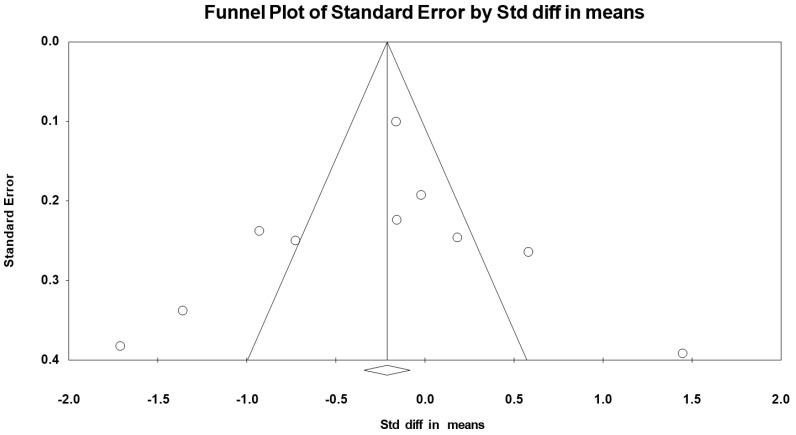
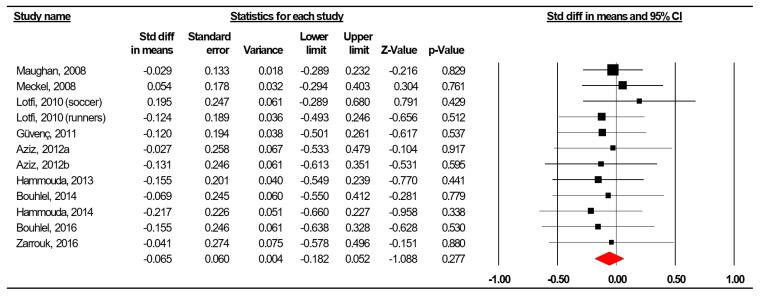
To evaluate the effects of Ramadan observance on dietary intake, body mass and body composition of adolescent athletes (design: systematic review and meta-analysis; data sources: PubMed and Web of Science; eligibility criteria for selecting studies: single-group, pre-post, with or without control-group studies, conducted in athletes aged <19 years, training at least 3 times/week, and published in any language before February 12, 2020). Studies assessing body mass and/or body composition and/or dietary intake were deemed eligible. The methodological quality was assessed using 'QualSyst'. Of the twelve selected articles evaluating body mass and/or body composition, one was of strong quality and eleven were rated as moderate. Ten articles evaluated dietary intake; four were rated as strong and the remaining moderate in quality. Continuation of training during Ramadan did not change body mass from before to the first week (trivial effect size (ES) = -0.011, = 0.899) or from before to the fourth week of Ramadan (trivial ES = 0.069, = 0.277). Additionally, Ramadan observance did not change body fat content from before to the first week (trivial ES = -0.005, = 0.947) and from before to the fourth week of Ramadan (trivial ES = -0.057, = 0.947). Lean body mass remained unchanged from before to the fourth week of Ramadan (trivial ES = -0.025, = 0.876). Dietary data showed the intake of energy (small ES = -0.272, = 0.182), fat (trivial ES = 0.044, = 0.842), protein (trivial ES = 0.069, = 0.720), carbohydrate (trivial ES = 0.075, = 0.606) and water (trivial ES = -0.115, = 0.624) remained essentially unchanged during as compared to before Ramadan. Continued training of adolescent athletes at least three times/week during Ramadan observance has no effect on body mass, body composition or dietary intake.
目的
评估青少年运动员在斋月期间的饮食习惯、体重和身体成分的变化(设计:系统综述和荟萃分析;数据来源:PubMed 和 Web of Science;纳入研究的标准:单组、前后对照、有无对照组的研究,研究对象为年龄<19 岁、每周至少训练 3 次、并于 2020 年 2 月 12 日之前用任何语言发表的运动员)。评估体重和/或身体成分和/或饮食摄入的研究被认为符合条件。使用 'QualSyst' 评估方法学质量。在纳入的 12 篇评估体重和/或身体成分的文章中,有 1 篇质量较高,11 篇质量中等。10 篇文章评估了饮食摄入情况;其中 4 篇质量较高,其余 6 篇质量中等。在斋月期间继续训练,不会改变从斋月前到第一周(微小效应量[ES] = -0.011, = 0.899)或从斋月前到第四周的体重(微小 ES = 0.069, = 0.277)。此外,在斋月期间,脂肪含量从斋月前到第一周(微小 ES = -0.005, = 0.947)和从斋月前到第四周(微小 ES = -0.057, = 0.947)没有变化。在斋月期间,瘦体重保持不变(微小 ES = -0.025, = 0.876)。饮食数据显示,能量(小 ES = -0.272, = 0.182)、脂肪(微小 ES = 0.044, = 0.842)、蛋白质(微小 ES = 0.069, = 0.720)、碳水化合物(微小 ES = 0.075, = 0.606)和水(微小 ES = -0.115, = 0.624)的摄入量与斋月前相比基本不变。青少年运动员在斋月期间每周至少训练 3 次,继续训练对体重、身体成分或饮食摄入没有影响。



 Zotero 插件