
横纹肌细胞中的微管组织。
Microtubule Organization in Striated Muscle Cells.
机构信息
Experimental Renal and Cardiovascular Research, Department of Nephropathology, Institute of Pathology, Friedrich-Alexander-Universität Erlangen-Nürnberg (FAU), 91054 Erlangen, Germany.
Division of Developmental Immunology, Biocenter, Medical University of Innsbruck, 6020 Innsbruck, Austria.
出版信息
Cells. 2020 Jun 3;9(6):1395. doi: 10.3390/cells9061395.
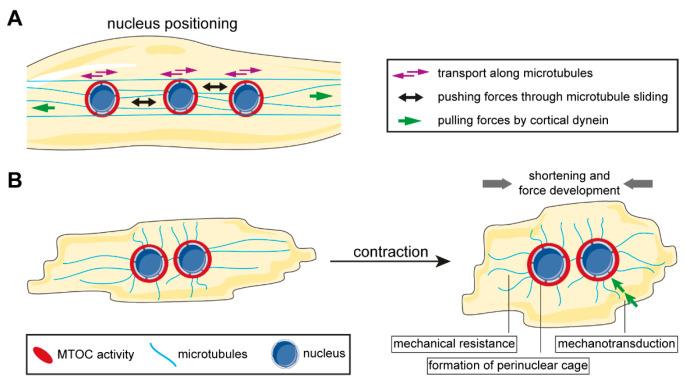
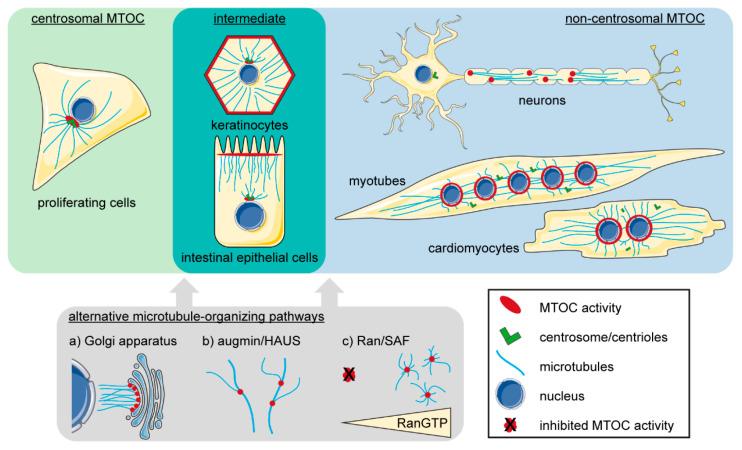
Distinctly organized microtubule networks contribute to the function of differentiated cell types such as neurons, epithelial cells, skeletal myotubes, and cardiomyocytes. In striated (i.e. skeletal and cardiac) muscle cells, the nuclear envelope acts as the dominant microtubule-organizing center (MTOC) and the function of the centrosome-the canonical MTOC of mammalian cells-is attenuated, a common feature of differentiated cell types. We summarize the mechanisms known to underlie MTOC formation at the nuclear envelope, discuss the significance of the nuclear envelope MTOC for muscle function and cell cycle progression, and outline potential mechanisms of centrosome attenuation.
组织结构明确的微管网络有助于神经元、上皮细胞、骨骼肌肌管和心肌细胞等分化细胞类型的功能。在横纹肌(即骨骼肌和心肌)细胞中,核膜充当主要的微管组织中心(MTOC),而中心体——哺乳动物细胞的典型 MTOC——的功能减弱,这是分化细胞类型的一个共同特征。我们总结了已知的在核膜处形成 MTOC 的机制,讨论了核膜 MTOC 对肌肉功能和细胞周期进程的意义,并概述了中心体减弱的潜在机制。

 Zotero 插件